
Spacefast for Kenyan SMEs: Publish an AI-Built App Safely
Assess Spacefast for a Kenyan SME app: verified hosting prices, private previews, enquiry handoffs, access controls and a practical launch checklist.
UniqueTechCamp
Digital Solutions Team • UniqueTechCamp Engineering Unit
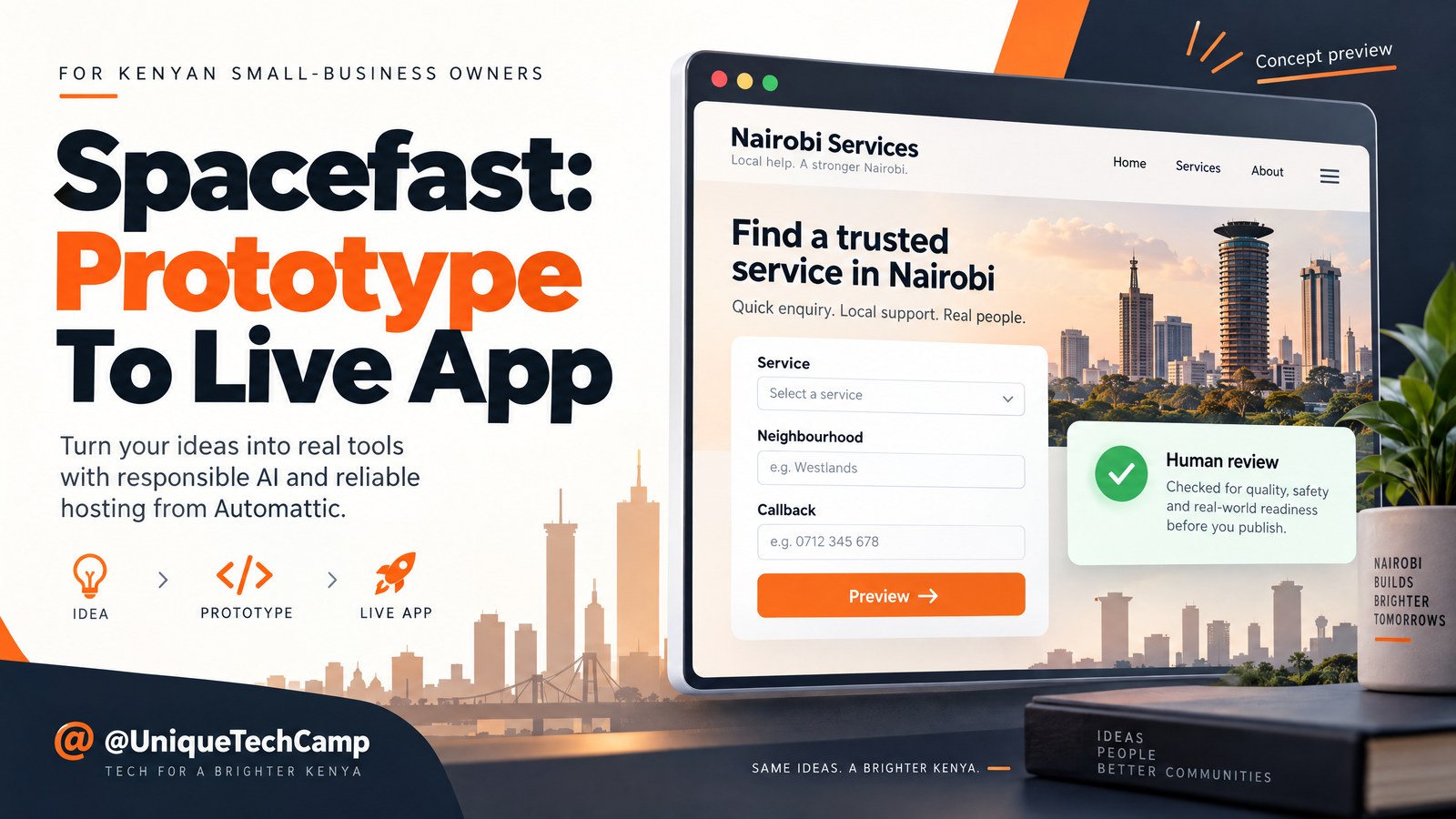
Spacefast ↗ addresses a familiar problem: an AI assistant has made an impressive prototype, but nobody has agreed how it will become a dependable business tool. Where will enquiries go? Who can change the application? What happens when a form fails, usage grows or the person who built it leaves?
For a Nairobi service business, those questions matter more than the first attractive screen. A small enquiry application could help staff gather useful job details, but a public form that loses requests or exposes customer information can create more work than it saves. Treat hosting as one part of an operating workflow, not proof that the workflow is ready.
This guide explains the newly announced service, its published costs and a practical pilot for Kenyan SMEs. The example is a proposed service-enquiry application, not a documented customer result or a claim that a particular platform will increase sales.
What has actually launched?
Automattic announced Spacefast's public launch on 9 November 2026. Its official announcement ↗ describes hosting infrastructure that works with an AI assistant or coding agent the user already has. Spacefast is not itself the AI that writes the application, and its infrastructure subscription should not be mistaken for an included AI-model subscription.
The distinction between a public launch and first existence matters. The announcement says the product soft-launched in September. TechCrunch's launch reporting ↗ corroborates that earlier feedback period. This is a fresh public-launch development, not a claim that the underlying idea appeared for the first time yesterday.
Advertised capabilities include publishing, custom-domain support, version history, private sharing and database infrastructure for supported application paths. Static files and supported framework builds are different deployment cases. Crucially, the launch announcement lists built-in application authentication as coming soon. A private preview link is not a substitute for a tested customer-account system.
Choose one commercial problem, not a replacement for everything
Consider a hypothetical cleaning company receiving incomplete messages: a customer asks for availability without giving the service, neighbourhood or preferred callback time. Staff repeat the same questions, and useful requests become difficult to distinguish from casual browsing. A short enquiry app could standardise the first handoff.
The first version might collect a service choice, broad service area and callback details, then assign the request to a named staff member. It should explicitly say that submission is an enquiry, not a confirmed visit or final quotation. Keep staff judgement in the loop for coverage, capacity, unusual requirements and pricing.
Do not start by rebuilding the company's main website, booking engine, payments and customer portal together. Select a bounded workflow whose failure is recoverable. A prototype can demonstrate whether customers understand the questions before the business commits to a wider system.
Step 1: Write a brief the owner can approve
Before asking an AI to build, write a one-page acceptance brief. Name the intended visitor, the one action they should complete and what staff will do afterwards. List the fields, confirmation message, receiving queue, responsible person and response expectation. Separate essential behaviour from attractive extras.
- Define the allowed services and areas from an approved business list, not from the model's assumptions.
- Explain which fields are required and why; do not request identification documents for a simple callback.
- State what happens if a request arrives outside working hours or the responsible staff member is absent.
- Specify who approves wording, accessibility, privacy information and changes to the live application.
- Set a launch decision: the pilot stays private until agreed customer and staff tests pass.
A useful brief also names the existing fallback. If the form stops working, customers should still have a verified way to reach the business. Preserve the current enquiry route during the pilot rather than making the new tool the only door.
Step 2: Build and claim a private preview
The official Spacefast documentation ↗ describes dashboard, command-line, API and MCP publishing routes. Ask the implementer to identify the actual deployment path and dependencies instead of accepting the vague instruction to upload an app. A static page and a database-backed application need different checks.
Use invented test records while developing. Review how sharing works before sending a link: new Spaces are private, and an ordinary address alone does not grant access. A share link can grant access to anyone holding it, so treat that link according to the sensitivity of the preview. Public visibility and search indexing are separate decisions.
Claim the Space into an owner-controlled account before a real campaign. Anonymous publishing is useful for trials, but unclaimed Spaces expire. Confirm the account, recovery access and domain ownership belong to the business, not only to the person experimenting with an AI assistant.
For an AI-built enquiry pilot, UniqueTechCamp ↗ can help translate a prototype into a reviewed workflow brief. The useful output is a clear boundary between customer-facing behaviour, staff decisions and technical dependencies, not a promise that every prototype deserves a launch.
Step 3: Test the handoff behind the form
Test on an ordinary phone and a second browser, including a slower connection. Can a customer understand the service choices, correct an error and submit without losing their text? Check labels, keyboard navigation, focus order and confirmation messages. Do not assume a polished desktop screenshot proves mobile usability.
Then follow the request beyond the browser. Staff should be able to find the record, identify its source and take the next action. Submit a valid example, a missing-field example and a repeated tap. Verify the system does not quietly create duplicate work or say success before a record exists.
Simulate a failed delivery or unavailable integration. The application needs an honest error state and a recovery route; a green confirmation screen is not enough. If email notifications are used, test the receiving mailbox and record storage separately. A notification failure should not make the underlying enquiry impossible to recover.
Keep the first pilot away from collecting payments or making binding bookings. Those actions introduce reconciliation, cancellation and authorisation requirements that should be scoped and tested separately. Spacefast hosting is not, by itself, evidence of a working M-Pesa integration.
Step 4: Budget beyond the headline plan price
The live Spacefast pricing page ↗ lists monthly, per-team prices before tax. All plans permit commercial use. At the time of this review, the main self-service options are:
- Personal: USD 0 per team per month, with USD 1 of metered usage included each month, one publishing member and community support.
- Go: USD 5 per team per month, with USD 5 of metered usage included each month, one publishing member and email support.
- Pro: USD 15 per team per month, with USD 15 of metered usage included each month. The first five publishing members are included; further members are listed at USD 15 per member per month.
Included usage is an allowance against metered resources, not a promise of unlimited application activity. The detailed pricing and limits ↗ explain the separate resource meters and note that some resources are temporarily complimentary. Do not forecast a permanent bill using a temporary concession or assume a published example matches your application.
Budget separately for the AI assistant or coding service, domain registration or renewal, implementation, maintenance and any outside messaging or application APIs. Supporting custom domains does not mean domain registration is included. Taxes, exchange-rate movement and the payment provider's charges can also affect the amount a Kenyan business ultimately pays.
Go and Pro offer spending caps, initially set at twice the plan price. Review those settings before a campaign. Reaching the allowance or cap does not simply mean every feature carries on normally: the pricing page says new builds and Workers pause while deployed Spaces keep serving. Test the consequence for the exact application; do not promise that a spending cap preserves every dynamic function.
Step 5: Separate sharing, staff access and customer access
Ask three different questions: who may view the preview, who may change the application, and which customer may see a particular record? These are not the same permission. A public enquiry form must not expose the staff queue or return another customer's details when an address or identifier changes.
The launch statement's coming-soon status for built-in application authentication makes this especially important. Do not design a sensitive customer portal on an assumed feature. Have the implementer document the access approach supported today, then test it with separate identities and an unauthenticated visitor.
Use the least access necessary for publishing agents and staff. Keep secrets out of public source files and chat transcripts. Review an AI-generated change before it can alter domains, access controls or stored data. Platform safeguards help, but they do not replace application-specific authorisation tests.
Step 6: Prove recovery and ownership before launch
The publishing guide ↗ distinguishes creating a ready version from promoting it live. A preview deployment can therefore be reviewed without automatically replacing what customers see. Agree who may promote a version and retain a known-good version for recovery.
Version rollback and customer-data recovery require separate thought. Use the database documentation ↗ to check the actual runtime and export mechanism. Do not assume restoring an older page also restores the desired enquiry records. Test a complete export with dummy records and document how an authorised person would recover it.
Keep an owner-readable handover containing account ownership, repository or exported files, dependencies, deployment instructions, data export, support contact and rollback steps. Static files are generally easier to move than an app tied to a particular runtime. Portability should be demonstrated, not inferred from the availability of a download button.
Measure a business outcome without promising revenue
For a small pilot, record eligible visitors, completed enquiries, valid service-area matches, staff response time and requests that progress to a quotation or booked job. Define each stage and the review period before comparing results. Page views are not qualified leads, and form submissions are not completed sales.
Compare the new route with a clearly described baseline, noting campaign source, seasonal demand and changes to staff availability. If completion improves but follow-up becomes slower, fix the operating bottleneck before adding features. If users repeatedly misunderstand the form, simplify it rather than blaming traffic quality.
Commercial value is possible when the application removes friction and staff complete the next step. It is not guaranteed by deployment speed, an AI-generated interface or a low hosting price. Stop or revise the pilot if it adds administration without producing a clearer customer journey.
Review privacy and operational limits
Collect the minimum information needed for the enquiry and explain the purpose, recipients and relevant follow-up. Determine who can access records, how long they are kept and how deletion or correction requests are handled. A developer should also identify subprocessors and hosting locations rather than assume a familiar brand resolves every privacy question.
Kenya's ODPC regulatory framework ↗ is a primary reference for a qualified privacy review. This article is operational guidance, not legal advice. Obtain appropriate advice for your circumstances, especially before collecting sensitive information or arranging cross-border processing.
Do not use the proposed pilot for clinical decisions, credit decisions or other high-stakes judgements. Check generated copy for misleading prices, fabricated testimonials and unsupported capabilities. Name the person responsible for incidents and keep a practical manual fallback when the app or an integration is unavailable.
Frequently asked questions
Does Spacefast build my application for me?
Spacefast describes itself as infrastructure for what your AI builds, not as the AI builder. You still need a supported assistant or development process, an approved brief and testing. Its hosting prices do not establish what your separate AI tool will cost.
Can a Kenyan business use the free plan commercially?
The published pricing permits commercial use on every plan, including Personal. That is not a guarantee that every signup or payment arrangement will suit a particular Kenyan business. Confirm access, limits and requirements in your own account before relying on it for a live campaign.
Does a private Space protect every customer record automatically?
No. Space sharing controls and application-level access are different. A public app needs its own tested rules for staff and customer data. The launch announcement says built-in application authentication is coming soon, so do not assume it already solves a customer-login requirement.
Should I move my whole website immediately?
Not on the strength of a launch announcement. Start with a reversible, low-risk workflow and prove mobile completion, staff handoff, costs, privacy, export and recovery. Keep an existing reliable route until the pilot's evidence supports a broader decision.
Conclusion: publish a workflow you can operate
Spacefast's public launch offers another way to host AI-built work without changing the assistant used to create it. For an SME, the sensible opportunity is a modest application with clear ownership and measurable usefulness. Start privately, verify the handoff, understand usage costs and make recovery part of the launch decision. A working link is the beginning of verification, not its end.
Need this built for your business?
Business owners can bring one enquiry journey, the current form or prototype and a list of staff handoff problems to UniqueTechCamp's AI Solutions Desk ↗. Explore the matching Online Forms service ↗, then book a consultation ↗ to scope a reviewed pilot, realistic operating costs and an accountable human handoff before wider deployment.
Deploy An Autonomous AI Lead Gen System Today
We engineer high-converting web applications with integrated 24/7 WhatsApp qualification bots and multi-channel follow-up drips.
Related Strategy Articles

AI Training Signals in robots.txt: A Kenyan SME Checklist
Google, OpenAI and Microsoft are adding AI-training controls. Learn what robots.txt signals do, what they do not do and what Kenyan SMEs should check.

Core Web Vitals for SME Owners: What to Check Before Paying for a Speed Rebuild
Check LCP, INP and CLS field data, test a real mobile customer task, and scope evidence-led website fixes before approving a speed rebuild.

What Should a Business Website Quote Include in Kenya? A Practical Owner Checklist
A practical checklist for comparing Kenyan website quotes: define scope, test key journeys, separate build and renewal costs, and protect account ownership.
UniqueTechCamp Desk
Online • Reply < 5 mins