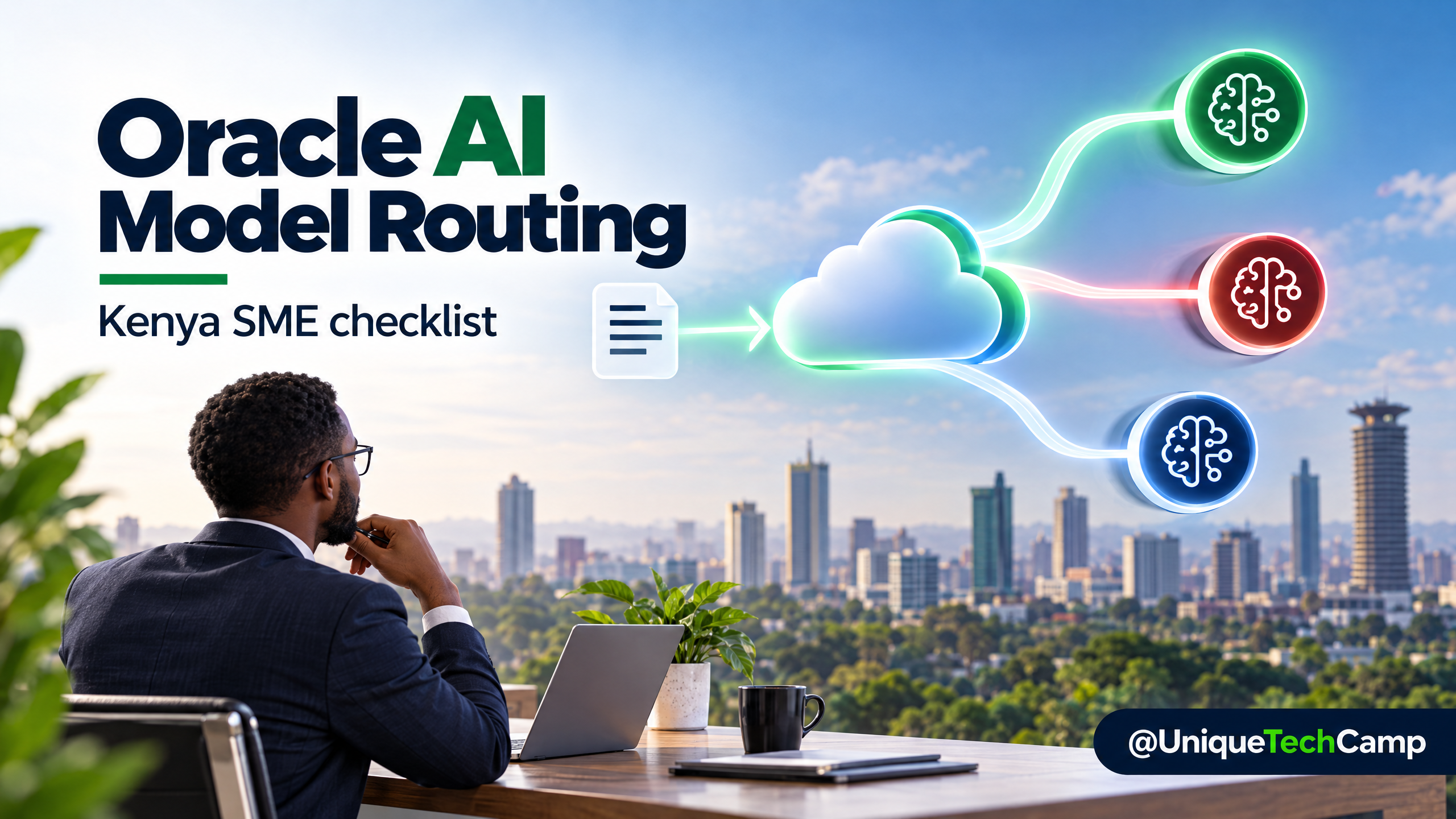
Oracle AI model routing is a feature to evaluate, not a business outcome. For a Kenyan SME, the more important questions are practical: which model sees each request, where that model is actually hosted, what customer data moves between providers, and whether the new route improves a complete business task enough to justify its cost and oversight.
Oracle's 9 October 2026 AI update brings together several Oracle Cloud Infrastructure (OCI) AI changes, including a regional model router, Model Discovery and xAI's Grok 4.7. For Kenyan SMEs, those are reasons to review the architecture, not proof that a new model is automatically cheaper, more accurate or locally hosted. This guide explains what the changes mean and how to test them before putting a customer workflow on them.
 brings together several Oracle Cloud Infrastructure (OCI) AI changes, including a regional model router, Model Discovery and xAI's Grok 4.7. For Kenyan SMEs, those are reasons to review the architecture, not proof that a new model is automatically cheaper, more accurate or locally hosted. This guide explains what the changes mean and how to test them before putting a customer workflow on them.
What Oracle's October AI update actually says
The roundup groups product and documentation updates that landed over the preceding weeks. Oracle's release note dates its Smart Model Router to 23 September 2026, while the Model Discovery documentation , updated on 28 September 2026, describes a separate way to inspect model availability. The Grok 4.7 model page is another distinct entry in the service catalogue. Treat the October roundup as a timely summary, not as a single launch with one universal feature or deployment date.
That distinction matters. A model catalogue answers, "What can this account call from this region?" A router answers, "How can a configured service direct a request among the models available to its profile?" Neither answers, by itself, whether a model is suitable for your customers, what information a provider retains, or whether an AI-generated action should be allowed to run without a person.
Model discovery and routing solve different questions
Model Discovery is for finding out what the service makes available. Oracle documents it as an API and command-line interface capability rather than a console screen. A discovery result can help an implementer identify models in a region and whether the model is hosted by Oracle or offered as a proxy to an external provider. Ask for that inventory in writing, with the account's intended production region and the date it was checked; a screenshot from a different tenancy or region is not enough.
The Smart Model Router works at another layer. Its profile restricts routing to the regions selected for that profile, within the same Oracle realm, and to models available there. It can simplify model selection for an application, but it does not mean every request can reach every model, nor does it replace a test of output quality. The current model availability by region page should be checked for the models and locations your application will actually use.
It is also worth asking whether a router is needed at all. A predictable task such as routing a request to "sales", "support" or "booking" may be cheaper and easier to audit with ordinary rules. A language model is more useful where the input is varied and a human-reviewed interpretation helps. A multi-model setup can add fallbacks and options, but it also adds credentials, data paths, logs and failure modes. Start with a business need, not with the number of models in a menu.
For Kenyan SMEs, a region selector is not a data-residency answer
The most important deployment detail in this update is easy to miss. Oracle's regional availability documentation says that xAI Grok models accessed through OCI are hosted externally by xAI; a call through OCI results in a call to an xAI location. That is materially different from assuming that selecting an OCI region means the model's inference stays inside that region. The documentation does not establish a Kenya-resident Grok endpoint, so a business should not infer one from the Oracle service name or router setting.
Map the complete path before sending customer information: the application and its logs, the OCI region, the model operator, any external service, any storage or monitoring tool, and any human reviewer. Record what is sent, why it is needed, who can access it, how long it is retained, and what happens if the customer asks for correction or deletion. Do not send a full customer record when a short, de-identified description would answer the test question.
Kenya's Data Protection Act 2019 sets out principles that include lawful, fair and transparent processing, purpose limitation, data minimisation, accuracy and storage limitation. Part VI addresses transfers outside Kenya and safeguards. The ODPC's 2026 cross-border transfer guidance adds practical emphasis on transparency, appropriate safeguards, due diligence and accountability. These are prompts for your privacy lead and qualified adviser; this article is not a legal opinion. A cloud-region setting alone is not evidence that the organisation has met its obligations.
A practical pilot for a real business task
Choose one bounded workflow with an outcome a manager can verify. For example, a service business might classify inbound enquiries into a few approved queues, draft a response for staff review, or extract requested fields from a document. Do not begin with a bot that diagnoses a customer, promises a price, approves a payment, changes a customer record or sends a binding commitment on its own.
1. Write the success rule first
Describe the task in ordinary language: what arrives, what a correct result looks like, what the system must refuse to do, and who handles exceptions. Name the business measure that matters, such as correctly assigned enquiries or documents that need less manual re-keying. Keep the measure separate from model output volume. A large number of generated messages does not show that the customer got a useful answer or that work was completed.
Keep a manual baseline for the same task. Note the current steps, time spent, corrections and common failure reasons. If there is no reliable baseline, the pilot can still test feasibility, but it cannot support a credible claim that a new model saved time or money.
2. Map the data before choosing a model
List the fields the workflow needs and remove the rest. Decide whether prompts may contain personal data, account details, health information, payment records, confidential contracts or staff information. Set a rule for masking identifiers in test data. Tell customers and staff, in language they can understand, what the workflow does and when a human takes over. Ask the provider or implementer about retention, deletion, training use, subprocessors, incident notice and contract terms; do not assume the answers from a generic product page.
3. Verify the exact model path
For every proposed model, record its identifier, selected service region, hosted or external status, price row and any provider hand-off. Confirm availability for the account that will run the pilot, not just for a demo environment. If the path uses an external provider, ask what location and terms govern that call and have the privacy owner assess the transfer. Check the details again before launch because catalogues and availability can change.
4. Compare like with like
Give each candidate the same approved test cases and the same task instructions. Include straightforward examples and difficult cases: incomplete enquiries, misspellings, contradictory details, requests outside the allowed scope and messages that try to override the system's instructions. If your customers use English, Kiswahili or code-switching, include representative, consented or safely de-identified examples. Do not assume a model handles local phrasing until your own reviewers have checked it.
Score results against a written rubric. Have a staff reviewer mark whether the output is correct, grounded in supplied information, appropriately uncertain and safe to send. Record the correction required. A model's own confidence statement is not independent verification. The same set of cases should be used when you change a prompt, model or router policy so that comparisons remain meaningful.
For teams that want help turning a workflow into a bounded test, the UniqueTechCamp AI Solutions Desk offers a route to scope an AI system with an architect. Keep the first conversation focused on the task, data path and human review rather than on choosing a fashionable model.
5. Limit what the model can do
Keep model access to the minimum permissions required. Put business rules, price lookups, customer-record updates and payment checks in ordinary application code where they can be validated. Do not expose API keys or broad database credentials in a prompt. Require a person to approve sensitive decisions or actions that are difficult to reverse. Make it possible to pause the automation and return to the existing process if a provider is unavailable or the output quality falls.
The OWASP prompt-injection guidance describes how direct or indirect instructions in user input, files or web content can alter a model's behaviour. Its mitigations include separating untrusted content, validating output formats, applying least privilege, requiring human approval for high-risk actions and running adversarial tests. No single prompt wording should be treated as a complete security boundary.
6. Define the fallback and the owner
Write down what happens when the model is uncertain, unavailable, slow or returns an invalid format. Send the case to a named queue or person, preserve the original request, and give staff a way to see which model or route produced the draft. Name the person who reviews quality, cost and complaints after the pilot starts. Without an owner, exceptions can become invisible even when the main flow looks smooth.
Estimate the full cost, not just tokens
On 13 October 2026, Oracle's live price list with USD selected showed the standard short-context Grok 4.7 rows at US$2.00 per 1,000,000 input tokens, US$0.50 per 1,000,000 cached input tokens and US$6.00 per 1,000,000 output tokens. Its long-context rows are US$4.00 per 1,000,000 input tokens, US$1.00 per 1,000,000 cached input tokens and US$12.00 per 1,000,000 output tokens. Priority service has separate rows. Check the live Oracle AI price list and the cost calculation guidance before procurement; these public figures are a snapshot, not a quotation for your account.
For an estimate, count input, cached input and output tokens separately and apply the rate line that actually matches the service and context band. Then add the costs that a token table does not include: implementation, testing, monitoring, privacy review, logging, staff training, human corrections, fallback handling and any other paid services. Other models may bill using different units, so do not reuse a Grok rate for another model.
For return on investment, compare the whole workflow cost with a measured business result. A useful denominator is successful tasks, not prompts or chats. A lead classifier that makes staff check every result may be more expensive in practice than its token line suggests; a modest model that handles a narrow, well-defined job may be a better fit. Use your own baseline and volume, and include mistakes and exceptions. Do not promise savings until the pilot has measured them.
Make the pilot a measurement, not a demo
Agree in advance what would make the pilot pass, fail or need another test. Track task completion, correctness under the rubric, correction rate, human hand-offs, time to resolution, failure cases, model and route used, and input/output usage. Review a sample of both successful and unsuccessful cases. A dashboard should show the denominator and date range, not only a success percentage without context.
Test security and privacy cases as well as ordinary prompts: an instruction to reveal internal information, a malicious command inside an uploaded file, an attempt to trigger an unauthorised tool, a request to send a message without approval, and a customer request to stop or correct processing. The NIST AI Risk Management Framework is a voluntary resource; its Generative AI Profile can help teams organise risk questions and monitoring, but it is not a certification or a substitute for local legal and security review.
Set a rollback condition. For example, pause the route if a required human hand-off is missed, if an answer uses information the model was not given, or if the system reaches a business action that it was not authorised to take. Keep the previous workflow available until the new one has passed the agreed tests and the responsible manager has signed off.
Frequently asked questions
Does a model router automatically choose the best model?
No. A router can direct requests according to its profile and the models available to it, but "best" depends on the task, permitted data, quality checks, price and latency. Test the same representative cases and keep a human review path for important outputs.
If I select an Oracle region, does that mean my data stays in Kenya?
Not necessarily. Oracle's current documentation says calls to xAI Grok models through OCI are external calls to an xAI location. Confirm the model's hosting status, full data path and applicable transfer safeguards with your provider and privacy lead before sending personal or confidential information.
Should a small business use more than one model?
Only when a measured need justifies the extra configuration and controls. A single model or deterministic rule can be simpler to test and operate. Consider a router when different tasks need different capabilities and you can verify that the routing policy improves the complete workflow.
What should we ask an implementer before a pilot?
Ask for the exact model identifiers and region, hosted or external status, data-retention and deletion terms, current price unit, permissions, logging plan, evaluation rubric, human escalation owner and rollback path. Request a short data-flow diagram and a test report that names the sample and its limitations.
Conclusion
Oracle's AI update is worth reviewing, but the useful decision is not whether to switch because a feature is new. Confirm the model path, protect the data, compare candidates on the same business task and measure the cost of completed work. For Kenyan teams, treat regional routing and data residency as separate questions, especially when the selected model is hosted by an external provider.
Need this built for your business?
Bring one repetitive task, the information it uses and the human decision points to the UniqueTechCamp AI Solutions Desk . You can review a matching inbound lead-qualification service or book a strategy consultation to scope a safe, measurable pilot for your team.


UniqueTechCamp Desk
Online • Reply < 5 mins