
OpenAI’s Decisions API in Public Beta: A Human-Reviewed SME Support-Triage Pilot
OpenAI’s Decisions API entered public beta on 6 October 2026. Learn how SMEs can pilot human-reviewed support triage, measure quality and control costs.
UniqueTechCamp Editorial
Lead Systems Architect • UniqueTechCamp Engineering Unit
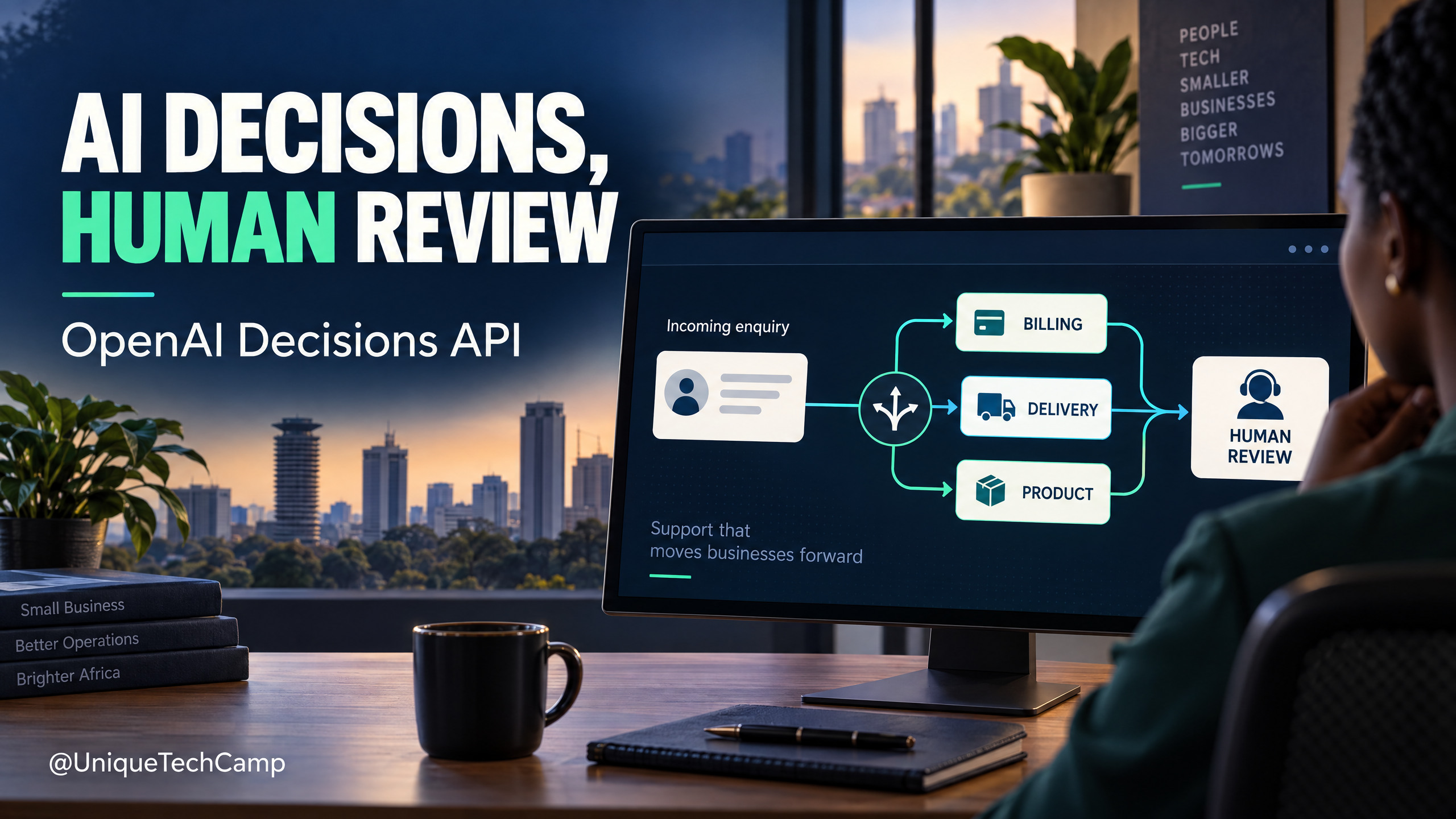
A small business support inbox is really a queue of decisions. Is this message about delivery, payment or a product fault? Does the attached photograph show visible damage? Which team should see it first? Staff who answer those questions repeatedly have less time for the work that actually resolves the customer’s problem.
On 6 October 2026, OpenAI released its Decisions API in beta: a dedicated endpoint for returning a small, typed answer rather than a long conversational response. For a Kenyan SME, the interesting possibility is not an “AI employee” that runs the service desk. It is a carefully bounded first-pass classifier that helps a person sort incoming cases, while leaving customer commitments and financial actions with staff. OpenAI’s API changelog records the beta release date and model .
What the Decisions API does
The endpoint accepts text or text paired with images, then answers developer-defined questions in one of three formats. A predicate estimates whether a stated condition is true. A choice selects from a fixed list that the developer supplies. A score rates an input against ordered rubric levels. Each answer is typed, so an application can route it without first extracting a label from free-form prose.
OpenAI currently documents one supported model, gpt-6-luna, and a dedicated POST /v1/decisions endpoint. Its guide describes uses such as content classification, request routing, prioritisation and checking a product image for visible damage. OpenAI states that the endpoint returns typed answers 10x faster than the Responses API. Treat that as a vendor claim, not a service-level promise: real latency depends on the request, network, workload and account limits. The Decisions API guide explains its three answer types, examples and beta status . Independent coverage by The Decoder , published on 7 October, also describes the public beta and its current scope.
The product was first introduced in limited preview at OpenAI’s September DevDay, before the wider beta release. That distinction matters: it is a recent API update, but not a brand-new foundation model, and the beta may change before general availability. OpenAI’s DevDay recap describes the original limited preview .
A useful first case: route after-sales enquiries
Imagine a Nairobi-based electronics or home-goods retailer with enquiries arriving through a website form, email and messaging channels. A single queue may contain order-status questions, payment discrepancies, delivery damage, product faults and requests that do not fit any of those labels. A staff member can read each case, decide its destination and forward it. The delay is often in the hand-off, not in writing a polished answer.
A Decisions API pilot could read a normalised copy of the message and return a proposed department. If a customer attaches a product photograph, a separate predicate could flag visible damage for review. A human still checks the case, contacts the customer and decides whether to replace an item, issue a credit or ask for more information. The API’s result is a routing aid, not proof that a claim is correct.
This is distinct from a sales chatbot or lead-scoring system. The target is a narrow internal task where the allowed outcomes are known in advance. If you cannot describe the options clearly, or staff themselves disagree about what belongs in each queue, an AI endpoint will not fix the underlying process.
Build a small, human-reviewed pilot
1. Choose one low-risk queue. Start with a repeatable support category, such as “delivery question”, “payment query”, “product issue” and “other”. Do not begin with high-stakes decisions such as approving refunds, closing complaints or suspending customer accounts. The first goal is to suggest a destination for a staff member to confirm.
2. Write the routing rules in plain language. For each category, define what belongs there and what does not. “Delivery question” might cover tracking, missed delivery and collection details. “Product issue” might cover a fault after receipt. Include an other option for ambiguous or unanticipated messages. Without a fallback, a closed list can force a wrong answer just because the system must choose something.
3. Prepare representative examples. Take a small batch of historical cases that staff have already labelled. Remove names, phone numbers, order identifiers and other details the model does not need. Ask two staff members to label a sample independently; use their disagreements to improve the category definitions before testing the model. Keep a separate set of examples aside so that you do not evaluate only on cases used to tune the wording.
4. Make the model’s job explicit. Send the case text as input and define one choice question with clear, mutually distinct options and descriptions. For an image check, the API documentation currently requires the image to be included as an inline base64 data URL; hosted image links and file_id inputs are not supported by this endpoint. Avoid asking for a customer reply in the same decision question. The API is designed to select or score, not draft a complete explanation.
5. Run in shadow mode first. For an initial period, let the system propose a route without changing the live queue. Compare the proposed category with the staff member’s actual choice. Review both the answer and the provided probabilities or confidence, but do not assume a high score makes an answer correct. Where the result is unclear, send it to the general review queue.
6. Keep a person responsible for action. Once the shadow test is understood, the result may pre-fill a queue field or create a suggested assignment. A staff member should still confirm the route, especially for payment disputes, damaged goods, angry customers or repeated complaints. Do not connect a beta classifier directly to a refund or order-cancellation control.
7. Log enough to learn. Record the model version, the question and options used, the proposed answer, the final staff decision, any override and the time taken to assign the case. Keep the minimum data needed for evaluation and follow your organisation’s access and retention practices. Store API credentials in the server-side integration, not in a browser page or an employee’s shared document.
If a team wants help turning a support queue into a bounded test, the AI Solutions Desk at UniqueTechCamp can help map the workflow and identify where human approval should remain. The useful question is not “Can AI answer every ticket?” but “Can this one classification step be made more consistent without hiding uncertainty from the team?”
Measure whether it helps
Record a baseline before changing the queue. Useful measures include the time from receipt to the correct team, the proportion of cases that staff re-route, the share sent to other, the number of high-priority cases misclassified and the time a human spends reviewing each suggestion. If first-response time is already short, faster routing may not be valuable; if staff spend little time on classification, the integration may cost more to maintain than the work it removes.
Compare the model’s routes with the labelled examples and then with shadow-mode cases. Review mistakes by category rather than relying on one overall accuracy number. A rare but serious misroute can be hidden by many easy order-status cases. Set thresholds according to the cost of a wrong route: uncertain or high-consequence cases should go to people. OpenAI’s documentation recommends calibrating thresholds on labelled examples and weighing the cost of false positives against false negatives.
Track the operational cost alongside quality. Include API usage, integration work, staff review, monitoring and the time required to update category rules. A lower token price does not automatically make the whole workflow worthwhile, and a faster API does not guarantee a faster customer resolution. Decide in advance what evidence would justify keeping, changing or stopping the pilot.
Price and availability in Kenya
The Decisions API is in public beta, with only gpt-6-luna currently documented as available. OpenAI’s Decisions guide lists endpoint-specific pricing at $0.10 per 1M input tokens and says only input tokens are billed, with no output-token, cache-read or cache-write charge. Regional-processing premiums and long-context input multipliers still apply, so the headline rate is not a complete estimate for every configuration. Check the live documentation before making a budget or contract commitment.
Kenya appears on OpenAI’s current list of countries supported for API access. That does not guarantee every organisation, account tier or project has the same rate limits or feature access. Confirm the endpoint is enabled for your project, test the limits in your own account and set a spend cap before connecting a live workflow. OpenAI’s supported-countries page lists Kenya , while its Decisions guide publishes the endpoint pricing and beta caveats .
Limits and safeguards to understand
A beta endpoint is not a finished service contract. OpenAI says general availability is expected in the coming weeks, but that timing can change. The current guide lists only gpt-6-luna, so an application that depends on a particular model or response format should be tested again when the service changes. Keep the routing schema and integration easy to edit, and do not build a critical process around an untested assumption about future availability.
The output types are deliberately narrow. A predicate is a probability estimate, not a verified fact. A choice is limited to your options, and a score is meaningful only if the rubric levels have clear definitions. For a custom JSON object, a written explanation or more flexible generation, OpenAI points developers to Structured Outputs with the Responses API; for a request to call a tool, it points to function calling. The Structured Outputs guide and function-calling guide describe those alternatives.
Image handling also has a practical constraint: input images must be sent inline as base64 data URLs. The endpoint does not accept an ordinary hosted image URL or an existing file ID. If a current workflow stores photographs only in a cloud bucket, the integration needs a safe way to retrieve and encode the image before sending it. That creates engineering work and another point to test.
Finally, speed and confidence do not remove the need for human judgement. Test cases can be incomplete, messages can be ambiguous, and image quality can vary. Keep sensitive or consequential actions behind a person, minimise the information sent, restrict who can inspect logs, and review errors regularly. The documentation says Zero Data Retention and HIPAA use are available only to eligible customers; its listed data-residency and regional-processing options cover the United States and Europe, not East Africa. Organisations with specific data-handling requirements should assess those facts with their own technical and compliance advisers rather than infer suitability from the beta label.
Frequently asked questions
Is the Decisions API a new OpenAI model?
No. OpenAI released a dedicated API endpoint in beta on 6 October 2026. It currently uses gpt-6-luna; the change is a narrower way to request typed decisions from that model, not a separate general-purpose model release.
Can a Kenyan business try it?
Kenya is on OpenAI’s supported API-country list, and the endpoint is publicly available in beta. Your organisation still needs API access and a project that can call the endpoint. Check your account’s current limits and availability before designing a production workflow.
Can it write a complete customer-service reply?
That is not the purpose of the endpoint. It returns a predicate, a choice or a score. Use a generation endpoint when a workflow needs a natural-language explanation or a custom structured response, then keep customer-facing messages subject to the business’s review rules.
What will the endpoint cost?
OpenAI currently lists $0.10 per 1M input tokens for gpt-6-luna on the Decisions endpoint, with no billed output or cached tokens for that endpoint. Regional processing and long-context pricing multipliers still apply, and your integration and human-review costs are separate.
Should it automatically approve a refund or close a complaint?
Not in a first pilot. Use its proposed label to send the case to the right person. Keep refunds, cancellations and complaint closure behind staff approval until the business has evidence that the whole process is reliable and has clear escalation rules.
Conclusion
OpenAI’s Decisions API gives developers a new beta endpoint for fixed-choice routing, condition checks and rubric-based scoring. It may suit one low-risk, repetitive classification step, but it does not replace a service process, write full replies or guarantee correct outcomes. Test it against labelled cases, run it in shadow mode, keep a person in control and compare the total workflow cost with the baseline before expanding.
Need this built for your business?
If you run a business and want to test AI-assisted support routing without handing important decisions to an unreviewed model, start with a scoped workflow discussion. The AI Solutions Desk at UniqueTechCamp can help identify a safe first queue; you can book an appointment to discuss the process and its approval points. For implementation across your inbox, CRM and internal hand-offs, see Workflow Automation .
Deploy An Autonomous AI Lead Gen System Today
We engineer high-converting web applications with integrated 24/7 WhatsApp qualification bots and multi-channel follow-up drips.
Related Strategy Articles

CrowdStrike AI Kill Switch: SME Team Reviewing an Agent Safety Dashboard
A practical SME playbook for reviewing CrowdStrike’s AI Kill Switch, testing agent containment safely, measuring trade-offs and checking Kenya eligibility.

Microsoft Agent 365 Business Analytics: An SME Readiness and Value-Validation Guide
Microsoft Agent 365 Business Analytics is in Frontier preview. Here is how Kenyan and East African SMEs can validate access, usage cost, value, privacy and readiness before buying licences for a dashboard.

Canva AI Controls: SME Design Review and Human Approval on a Laptop
A practical Canva AI Controls workflow for Kenyan and global SMEs: control settings, human review, asset provenance, measurements, costs and limitations.

UniqueTechCamp Desk
Online • Reply < 5 mins