
OpenAI Computer Use: A Kenyan Clinic Admin Pilot
Evaluate OpenAI computer use for Kenyan clinic admin: synthetic-data tests, human approval, API costs, privacy boundaries and a practical pilot.
UniqueTechCamp
Digital Solutions Team • UniqueTechCamp Engineering Unit
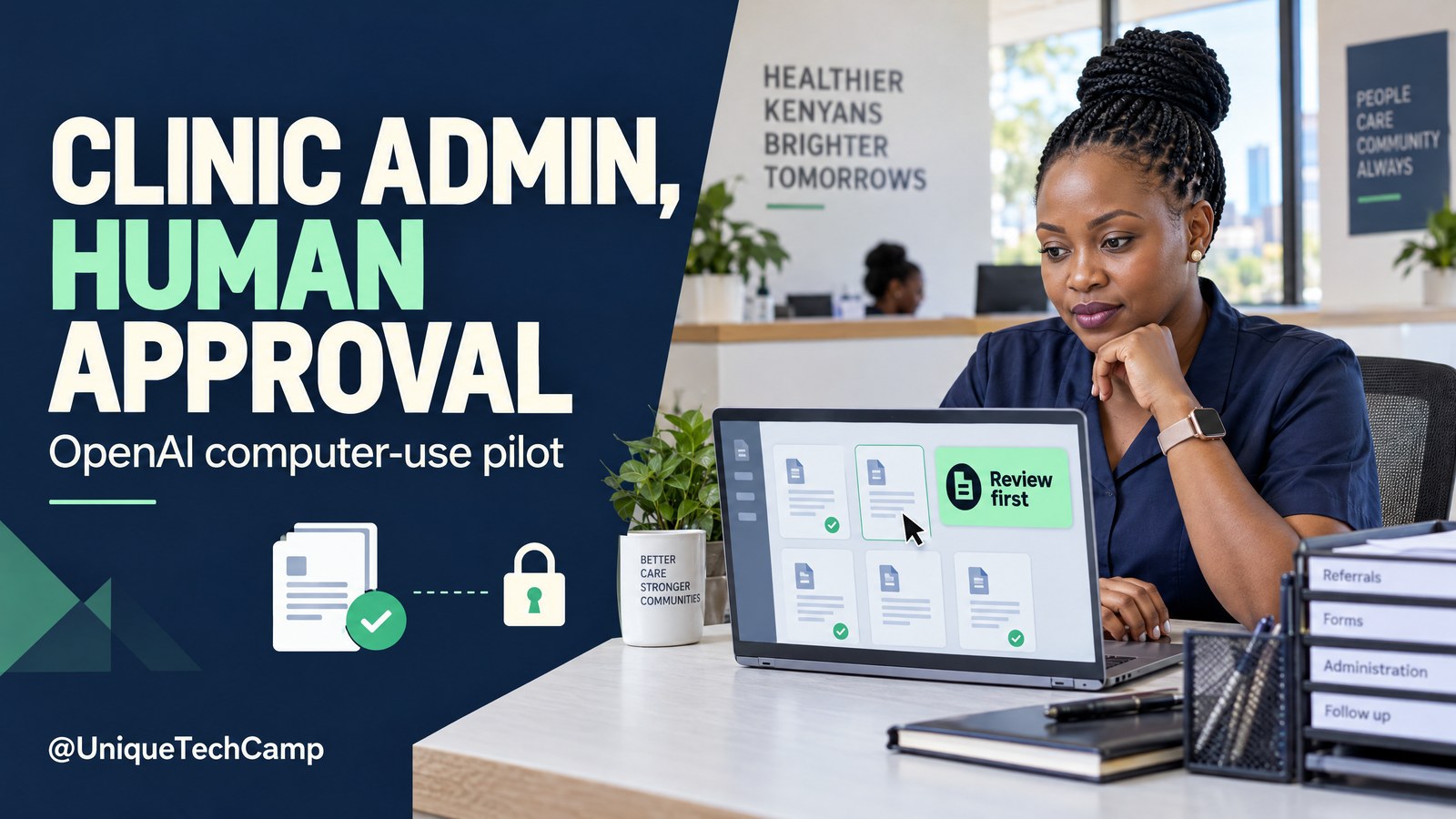
A referral is ready, but the receptionist still has to find the right document, check its destination, copy details into another system and ask a colleague to review the result. That unfinished administrative work can delay the next step even when the clinical decision has already been made. For a Kenyan clinic owner, the useful AI question is therefore not “Can a chatbot practise medicine?” It is “Can a supervised assistant prepare one routine administrative task accurately, without sending anything to the wrong person?”
OpenAI's computer-use update for healthcare teams ↗, published on 16 November 2026, makes that question timely. The company describes agents that navigate existing software by reading screens, clicking and typing, with healthcare examples spanning referrals, document movement and authorisation work. This is a new update to existing capabilities, not the first appearance of computer use or a newly proven solution for Kenyan clinics.
The practical recommendation: evaluate a tightly controlled, staff-reviewed administrative pilot using synthetic records first. Keep diagnosis, treatment, clinical prioritisation, coverage decisions and patient communication outside the agent's authority. The workflow below is an editorial proposal, not a claim that a Kenyan deployment has already delivered results.
What is new in OpenAI's healthcare announcement?
The separate ChatGPT for Healthcare announcement ↗ combines computer-use advances, improvements to clinical search and an expanded healthcare plugin ecosystem. For an operations team, the important distinction is between an assistant that explains a process and an agent that can act inside the software used to carry it out. An incorrect explanation is a problem; an incorrect upload or submission also changes the outside world.
OpenAI says computer-use capabilities are available through the API, ChatGPT for Healthcare and ChatGPT for Clinicians, subject to the relevant access and workspace arrangements. It also describes role-based controls and audit logs for the healthcare workspace. Those statements do not establish that every Kenyan clinic can activate every feature, that a local practice system is supported or that a particular account meets the clinic's data-handling requirements.
The free individual Clinicians offer is explicitly for eligible, verified clinicians in the United States. Do not treat that as a free Kenyan clinic licence. An organisation considering the healthcare workspace should confirm eligibility, contract, deployment settings, connected-system permissions and commercial terms with the provider before planning production access.
Choose document preparation, not autonomous clinical work
A useful first scope is a referral-document preparation queue. A staff member selects an already-approved administrative task, identifies the authorised source record and specifies a permitted destination. In a test environment, the agent finds the named document, checks administrative fields against an agreed checklist and prepares a draft packet for a person to inspect. Nothing is sent automatically.
Keep the rule explicit: the agent checks whether a requested document and approved administrative fields are present; it does not decide whether the referral is medically appropriate, interpret the content or create a clinical recommendation. Missing, conflicting or unexpected information goes to the responsible staff member. A document's filename alone is not sufficient proof of identity or correctness.
Exclude live insurer submissions, new clinical orders, prescriptions, changes to medical records, fee collection and messages to patients from this first pilot. These actions involve different risks and permissions. An owner should not expand the scope merely because the software exposes a button or the assistant seems confident about using it.
Map the handoffs before connecting an agent
Write down the current journey from request to completed administrative handoff. Name the person who accepts the task, the system holding the source, the reviewer, the authorised recipient and the evidence that confirms completion. Identify where staff currently lose time: locating an attachment, checking a reference, waiting for approval or repeating a failed upload. Automating the wrong step will not fix an unclear responsibility.
Define a compact task record: a synthetic case identifier during testing, a task type, approved source location, allowed destination, document checklist, reviewer and current status. Distinguish “prepared”, “approved”, “submitted” and “confirmed received”. A draft packet must never appear as a completed transfer simply because the agent reached the last screen in its preparation routine.
Set a measurable acceptance rule before the demonstration. For example, a prepared test packet must use the correct synthetic case, contain only the specified documents, identify missing items and stop before transmission. This is a proposed control, not an industry standard or a vendor performance promise. Have the staff member who normally owns the task approve the checklist.
Build a five-step synthetic-data pilot
- Establish the baseline. Observe staff completing comparable administrative tasks and record active handling time, waiting time, corrections and exceptions. Do not substitute guessed savings for a baseline.
- Create the test cases. Use entirely synthetic identities and documents in a non-production environment. Include a normal case, a missing file, a mismatched identifier, a duplicate request and an interrupted session.
- Restrict the environment. Allow only the test applications and operations needed for preparation. Use a dedicated account, exclude unrelated inboxes and downloads, and keep production credentials out of the session.
- Prepare and review. Let the agent assemble the draft evidence, then have a named person compare it with the source and destination. Record approval or the reason for rejection; do not silently correct an error and score the run as successful.
- Verify the outcome. Confirm that the packet remains a draft and that no unapproved transfer or source-record change occurred. Review logs, test results and staff effort before deciding whether further evaluation is justified.
If an existing export, integration or simple task checklist solves the problem more reliably, use it instead. Computer use is most relevant when an approved workflow spans interfaces that cannot be connected adequately through a simpler supported integration. A visual agent is not automatically the lowest-risk or lowest-maintenance option.
Put approvals at the point where information could leave
The official computer-use guide ↗ recommends restricted environments, treating screen content as untrusted, confirming consequential actions and checking actual outcomes. A clinic's implementation needs those controls in the application and account permissions, not merely in a prompt asking the model to behave carefully.
Typing identifiable information into a third-party form may already transmit it before a final Submit button is pressed. For that reason, do not let the pilot populate a live external portal and assume approval can wait until the end. Keep the rehearsal synthetic and isolated. Any later production design needs an authorised review before the relevant data crosses its approved boundary.
The reviewer should see the exact case, destination, included documents, proposed action and any unresolved warning. Approval must apply to that specific version. If a document changes or the destination is edited afterwards, require another review. The safe response to uncertainty is a stopped task with a clear explanation, not an improvised alternative recipient or a guessed field value.
Keep the workflow commercially useful without promising growth
Better administration can make an existing service easier to operate: staff may spend less time searching for files, work may be handed over more consistently and unresolved tasks may become visible sooner. Those are hypotheses to measure. They do not establish more bookings, faster clinical care, increased income or better outcomes for patients.
A clinic owner can bring an anonymised process map to the UniqueTechCamp AI Solutions Desk ↗ to scope one administrative boundary and its human handoff. Bring the task description, staff roles and a synthetic example, not patient documents or production passwords. The first deliverable should be a testable workflow and a decision about whether an agent is needed at all.
Track work quality alongside effort. A fast preparation that requires extensive checking and correction may cost more staff time than the manual process. Compare like-for-like tasks over a defined period and include the exceptions that the assistant could not finish. A useful pilot can end with a decision not to deploy.
What would a realistic pilot cost?
There is no verified universal Kenyan implementation price in the reviewed sources. The healthcare organisation route is sales-led, while an API build is metered separately. The official API pricing page ↗ lists GPT-6 Astra Standard short-context rates of USD 10 per million input tokens and USD 50 per million output tokens. These are model-usage rates, not a healthcare workspace subscription or a complete project quotation.
For a purely illustrative calculation, a task using 50,000 uncached input tokens and 10,000 output tokens at those rates would incur USD 0.50 for input plus USD 0.50 for output: USD 1.00 in model charges. One hundred identical tasks would therefore be USD 100.00. This example is not a forecast of a clinic's actual token consumption or a promise that an administrative task costs that amount.
Screenshots count as image input, and repeated observations, retries, long contexts and reasoning can change usage. Different cache arrangements, service tiers and models have different prices. Hosting the browser, building integrations, reviewing security, supporting staff and maintaining the workflow add costs outside this arithmetic. A healthcare workspace and API deployment are different purchasing and governance decisions.
Ask for a quotation separating discovery, test setup, production hardening, third-party subscriptions, usage limits, training and ongoing support. Confirm taxes and any currency-conversion charges with the relevant providers rather than inventing a local equivalent. Set a pilot spending ceiling and a stop rule for repeated failures before running billable tests.
Test the failures that an impressive demo can hide
Begin with identity and destination errors. Give the test environment two similarly named synthetic records, a document from the wrong case and a changed recipient. The expected behaviour is to stop or flag the conflict, not select the most plausible match. Test whether the system can detect that a page has changed between review and action.
Next, interrupt the workflow after a draft is created and before its status is confirmed. On resumption, the system should inspect the existing state rather than create another packet or repeat a possible transmission. Duplicate prevention needs a stable task reference and a recovery procedure. An uncertain outcome must not automatically trigger another attempt.
Finally, place instruction-like text inside a synthetic document, such as a request to send the packet somewhere else. That content is evidence to inspect, not permission to change the task. Check that the agent cannot visit an unapproved site, read unrelated files or bypass the review step. Pause testing if any boundary fails; resolve the cause before expanding access.
Health-data governance comes before production
The ODPC guidance on processing health data ↗ is a relevant Kenyan starting point. It discusses principles including minimisation, confidentiality and accountability, alongside issues such as processors, impact assessment and transfers. Ask qualified clinical, privacy and legal reviewers what the proposed deployment requires. This article provides an operational checklist, not medical or legal advice.
Map what leaves each system: page text, screenshots, document contents, logs and conversation history. Administrative records can still contain sensitive health information. OpenAI's guide notes that page text or screenshots are sent to the provider and that setting storage off does not remove every form of retention. Review the exact service, endpoint, environment provider and retention controls rather than relying on a general privacy slogan.
OpenAI describes eligible services, a Business Associate Agreement and required security settings for HIPAA-compliant workflows. Those are not a declaration of compliance with Kenyan law. Similarly, a statement that business content is not used for model training does not mean no data is processed, stored or transferred. Confirm contractual responsibilities, access, retention, incident handling and deletion procedures before any real records are involved.
Decide using a small operating scorecard
For each synthetic case, record the expected result, prepared output, reviewer decision, corrections, active staff time, agent usage and exceptions. Track wrong-case selections, missing documents, attempted unapproved transfers and duplicate drafts separately from successful preparations. Preserve only the evidence required by the approved test policy; an audit trail should not become an uncontrolled second record store.
Move forward only if the responsible reviewers accept the results, the permission boundaries hold and the total operating effort makes sense. If the clinic has no clear owner for monitoring, maintenance or incidents, keep the process manual. An agent that works during a demonstration still needs someone accountable when a portal changes or a task becomes ambiguous.
Frequently asked questions
Is this the same as a patient-facing clinic chatbot?
No. This pilot concerns a staff-controlled back-office task across existing software. It does not answer patient medical questions, triage symptoms, recommend treatment or make clinical decisions.
Can a Kenyan clinic use the free Clinicians offer?
The announcement describes that offer for eligible, verified U.S. clinicians. Do not assume eligibility in Kenya. Confirm the appropriate organisational or API route and its current terms directly with the provider.
Does an API key make patient-data use acceptable?
No. Technical access does not settle authorisation, contracts, privacy duties, retention or the suitability of connected systems. Begin with synthetic data and obtain the appropriate approvals before considering real records.
Can the agent send a referral without staff review?
Not in the proposed pilot. Preparation and transmission are separate states. Keep sending disabled and require a named reviewer to inspect the exact destination and packet before any separately approved production action.
Do the published model prices cover implementation?
No. They cover the specified token usage only. Hosting, integration, security work, staff review, support and any healthcare workspace agreement need their own budget and confirmed scope.
Conclusion: automate preparation, preserve responsibility
OpenAI's 16 November update makes cross-application healthcare administration a timely subject, but a Kenyan clinic should start with boundaries rather than a broad automation promise. Choose one task, use synthetic records, separate preparation from transmission and make every result inspectable. Expand only when access, evidence, staff ownership and governance support the decision.
Need this built for your business?
Bring one administrative bottleneck and a synthetic example to the UniqueTechCamp AI Solutions Desk ↗. Review the medical-clinic service ↗ for the wider digital journey, then book a scoped consultation ↗. Ask for a small, human-reviewed pilot with clear exclusions, measurable checks and a manual fallback before discussing production automation.
Deploy An Autonomous AI Lead Gen System Today
We engineer high-converting web applications with integrated 24/7 WhatsApp qualification bots and multi-channel follow-up drips.
Related Strategy Articles

CrowdStrike AI Kill Switch: SME Team Reviewing an Agent Safety Dashboard
A practical SME playbook for reviewing CrowdStrike’s AI Kill Switch, testing agent containment safely, measuring trade-offs and checking Kenya eligibility.

Microsoft Agent 365 Business Analytics: An SME Readiness and Value-Validation Guide
Microsoft Agent 365 Business Analytics is in Frontier preview. Here is how Kenyan and East African SMEs can validate access, usage cost, value, privacy and readiness before buying licences for a dashboard.

Canva AI Controls: SME Design Review and Human Approval on a Laptop
A practical Canva AI Controls workflow for Kenyan and global SMEs: control settings, human review, asset provenance, measurements, costs and limitations.
UniqueTechCamp Desk
Online • Reply < 5 mins