NVIDIA RTX Spark for SMEs: A Local-AI Buying Checklist
NVIDIA RTX Spark PCs bring local-AI claims and US storefront pricing. Here is a practical checklist for Kenyan SMEs before spending on new hardware.
UniqueTechCamp Editorial
Lead Systems Architect • UniqueTechCamp Engineering Unit
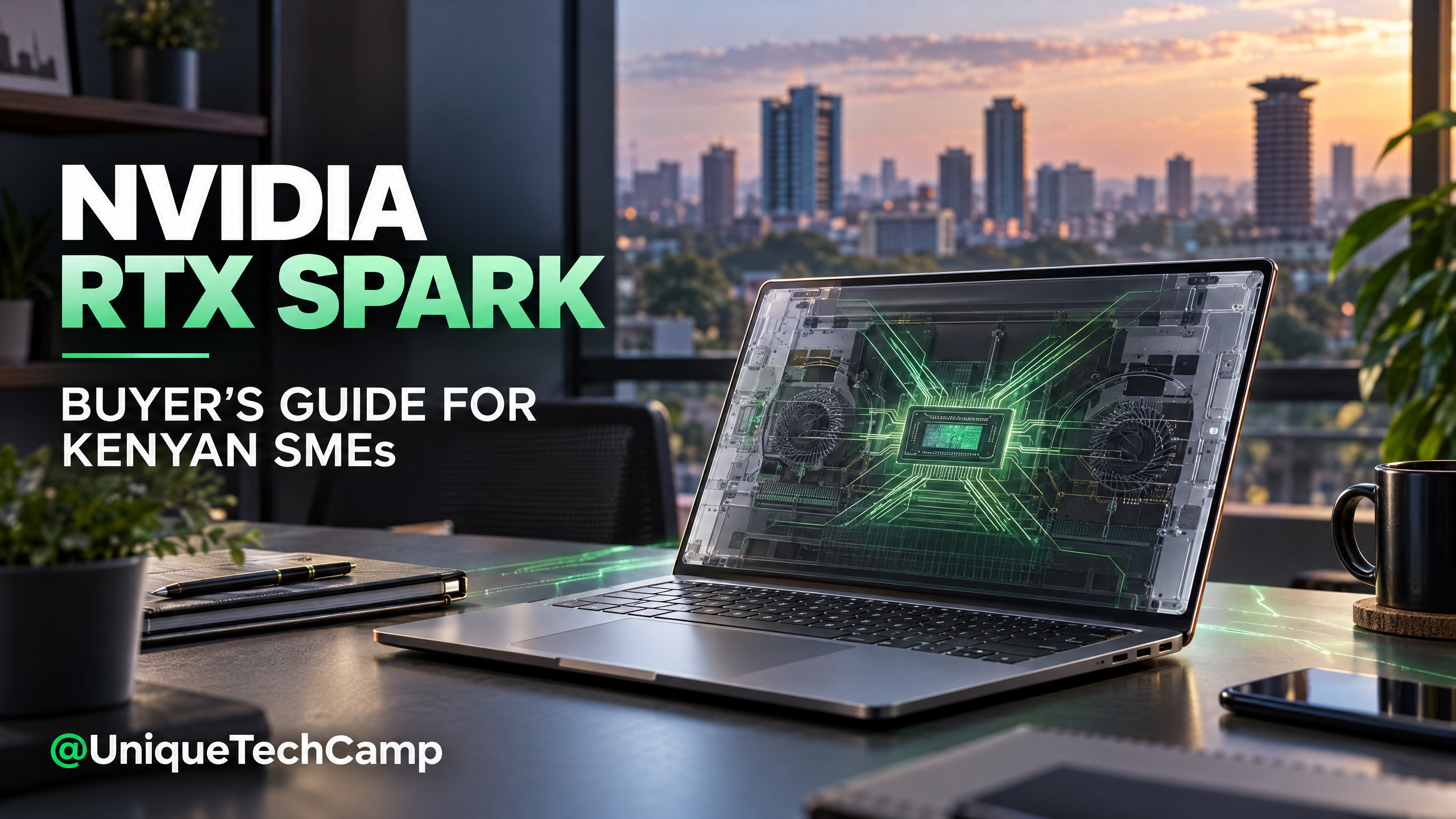
On 16 October 2026, NVIDIA's RTX Spark laptops arrive in the launch window that many hardware headlines have been building towards. The Microsoft US business listing lists 16 October 2026 as the Surface Laptop Ultra for Business release date, while NVIDIA's live RTX Spark product page is taking pre-orders. For a Nairobi business owner, though, the useful question is not whether the new machine can run a large model. It is whether a repeatable job in your business justifies buying and maintaining local AI hardware rather than using existing computers or a cloud service.
 lists 16 October 2026 as the Surface Laptop Ultra for Business release date, while NVIDIA's live

The launch material presents RTX Spark as an on-device AI platform with large shared memory and an NVIDIA software stack. Those are vendor specifications and claims, not proof of a particular sales, productivity or privacy outcome. Before spending, identify one workflow, check the exact laptop configuration and local support, then compare the complete cost with the work it could realistically improve.
What NVIDIA RTX Spark is - and what the headline does not prove
RTX Spark is not simply a familiar graphics card placed in a laptop. NVIDIA describes a tightly integrated Windows PC platform that combines a Grace CPU, a Blackwell RTX GPU and unified memory. The current product page lists laptop configurations up to a 20-core CPU, 6,144-core GPU and 128GB of LPDDR5X unified memory, plus a lower configuration with an 18-core CPU, 5,120-core GPU and up to 64GB. The listed laptop thermal design power is 45-80W. Compact desktop systems are a separate category with different power and enclosure requirements; do not assume a laptop specification applies to them.
NVIDIA's May 2026 announcement with Microsoft describes up to one petaflop of FP4 AI performance and up to 128GB of unified memory. It also promotes running models up to 120 billion parameters with a context window of up to one million tokens. Read each number as an upper-end platform claim, not a promise that every laptop, model, application or prompt will perform that way. Model quantisation, context length, thermal limits, software support and memory left for the operating system all matter. Microsoft notes that CPU and GPU share unified memory and that the amount addressable by the GPU is less than the total installed memory.
The promise is local compute: a compatible model can run on the PC instead of sending every inference to a remote model endpoint. That can reduce dependence on a connection and may keep selected prompts and files on the device. But the laptop does not make every AI feature local automatically. A desktop app may still send prompts to a cloud service, use an online account, sync files, or collect diagnostics. A local model can also produce incorrect output or expose information to a person or process that already has device access. Treat the hardware as one part of a system, not as a privacy switch.
There is also an evidence gap at launch. In a Notebookcheck hands-on report published before the official launch, the reviewer was only able to inspect a powered-off HP sample and did not run benchmarks. That is useful physical context, not an independent performance review. A business should wait for workload-relevant tests, driver maturity and software compatibility checks instead of treating a launch presentation as a benchmark.
Where local AI hardware could help an SME
A capable local machine is most plausible when staff repeatedly work with large files, images, video, code or documents and have a clear reason to keep a model close to that work. A design studio might test local image-generation workflows against its own approved assets. A software team might prototype code assistants or run evaluation models against synthetic tickets. An operations team could assess local classification or summarisation of non-sensitive documents before extending a process. These are candidates for a test, not guaranteed RTX Spark outcomes.
For a Kenyan business, connectivity and data handling may be part of the decision, but neither should be simplified into 'local is always better'. Some workloads need a frontier model, current information, shared collaboration or access to a provider's tools; those may still depend on cloud services. Some smaller workloads run adequately on an existing computer or a lower-cost hosted service. If only one person experiments occasionally, a premium workstation can sit idle while still consuming budget, training time and support attention.
Make the decision around the job rather than the machine. Examples of measurable jobs include preparing a first draft of an internal report, sorting a set of product images for human review, generating a rough video cut, or helping a developer search a local codebase. Exclude automated approval, price commitments, credit or hiring decisions, medical judgement and unsupervised customer messages from an early pilot. A person should remain responsible for anything consequential.
Price reality: a US list price is not a Kenyan quote
Microsoft's US consumer product page displays a starting price of US$2,599.99 for the Surface Laptop Ultra. Its separate US business storefront starts the Surface Laptop Ultra for Business at US$2,749.99 and lists a release date of 16 October 2026. These are different storefront and product listings; do not assume the prices refer to identical configurations. Check processor, unified memory, storage, warranty, operating-system edition and service terms on the written quote. Both amounts are US listings, not a verified Kenyan retail price or landed cost.
At the time of writing, the official pages checked do not establish Kenyan stock, local delivery, a Kenyan warranty route or a final price in Kenya shillings. Ask an authorised local seller to confirm the exact SKU, availability, keyboard layout, charger, support process, replacement parts, warranty territory, delivery, tax and return terms in writing. If a seller quotes an import price, ask whether the price includes all applicable charges and who handles a warranty claim. Avoid converting the US price and presenting the result as a Kenyan price: exchange rates, duties, retailer margin and logistics can change the final amount.
Compare total ownership, not sticker price alone. Write down the device and accessories, deployment and configuration time, any paid model or creative-software licences, electricity, backup and storage, security administration, staff training, repair cover and the cost of keeping a second device available if the machine fails. Against that, estimate the real cloud spend and staff time for the same accepted workload. NVIDIA's 'no per-prompt fee' message describes a potential usage model; it does not mean the hardware, electricity, software, maintenance or human review are free.
For a local-AI workflow to pay its way, the avoided cost or useful capacity must be attributable to a real job. Do not count every generated draft as saved labour. Count only an output that a staff member accepts and uses, then subtract review, correction and administration time. If the PC is also a staff member's main computer, separate ordinary laptop value from the incremental benefit of the AI workload; otherwise a business may credit the AI feature for work the laptop would have done anyway.
A six-step buying pilot before you place an order
- Choose one bounded task. Name the person who owns the process, the input it uses and what a satisfactory output looks like. Start with an internal, reversible task such as classifying approved product images or drafting a private project summary. Avoid workflows where the model's output directly changes a customer's record, sends a message, approves a payment or makes a high-impact decision.
- Record today's baseline. Use your own work records to note how many times the task occurs, current turnaround, staff minutes, errors, rework and the acceptance standard. Keep the sample definition consistent. If the volume is tiny or the manual method is already quick, a separate machine may not be justified. Do not borrow a vendor's demo result as your expected saving.
- Verify the exact software path. List the application, model, operating-system support, required memory, context length, connectors and licence. Ask the vendor whether the target model runs fully on-device, which features call a cloud endpoint, and what happens when the device is offline. Test a demonstration or returnable evaluation unit on representative files before buying a higher configuration. Confirm that the application can use the chosen GPU and that the model fits after memory is shared with Windows and other software.
- Set boundaries before loading real data. Use synthetic or redacted samples first. Create a dedicated account, restrict the agent to a small working folder, keep it read-only at first, and require a human to review every output. Check encryption, device updates, backups, access control, logging, retention, prompt injection in documents and how to stop the agent. NVIDIA and Microsoft describe security primitives and an OpenShell runtime for on-device agents; verify the current implementation, configuration and support in the actual product and software you will use.
- Run a limited comparison. Compare local execution with the method your team uses now, including an existing computer or cloud service where appropriate. Use the same task examples and acceptance criteria. Record latency, output quality, correction effort, reliability, temperature or fan behaviour, battery impact for mobile work and what happens after an update. Keep a named reviewer and a clear rollback path; a pilot should not silently become a live process.
- Write a go/no-go rule. Set a review date and the minimum acceptable result before the trial begins: for example, fewer staff minutes per accepted output without higher error rates or added privacy exposure. Include the device's full support and operating costs. If results are mixed, narrow the task, improve the workflow or stop. The purchase is not validated by a convincing demo, a large parameter count or the fact that the model ran once.
During a workflow review, the UniqueTechCamp AI Solutions Desk can help a business map the job, data path, human checkpoint and success measure before choosing a model or device. That planning is not a hardware endorsement or a substitute for checking a supplier's specifications and terms.
Privacy and governance for a Kenyan business
Running an inference locally may reduce the amount of material sent to a model provider, but it does not remove a business's responsibilities for the data it collects and uses. Kenya's Data Protection Act sets principles including lawful, fair and transparent processing, specified purposes and limiting personal data to what is necessary. Section 29 addresses information to be given to people before collecting personal data. Section 31 requires a data-protection impact assessment where processing is likely to create a high risk to people's rights and freedoms. The exact steps depend on the business, the data and the system; seek advice from the organisation's privacy lead or a qualified Kenyan adviser. This is practical guidance, not legal advice.
For each candidate workflow, document what enters the prompt, where files are stored, whether the model is actually local, whether diagnostics or licensing transmit information, who can access the device, how long inputs and outputs remain, and how deletion works. If an app can switch to a cloud model, make that choice visible and approved. Do not put customer records, employee details, financial documents or confidential client files into an unapproved assistant just because the computer is marketed for local AI. NIST's AI Risk Management Framework is voluntary guidance that can help structure governance and measurement; it is not a Kenyan legal standard.
Decision checklist
- Is there a recurring business task with a named owner and a measurable output?
- Have you checked that the exact model, app and configuration work together locally?
- Can you identify which data stays on the device and which data may leave it?
- Is the device available through a seller that can confirm local warranty, returns and support?
- Have you compared the full ownership cost with current staff time, existing hardware and cloud use?
- Will a person review every consequential output and have a way to stop the system?
- Have you defined a baseline and a written go/no-go rule before the pilot?
Frequently asked questions
Can an RTX Spark laptop run AI models without the internet?
Compatible local models and applications can run on-device, according to NVIDIA and Microsoft's product material. That does not mean every AI feature is offline: account sign-in, updates, connectors, cloud models and some app features may still need a connection. Ask the software provider to identify the data path for the exact workflow you plan to use.
Does local AI automatically keep customer information private?
No. Local inference can reduce external transmission for the parts that truly run on the device, but access permissions, backups, telemetry, cloud fallback, staff behaviour and endpoint security still matter. Use approved data, minimise what is entered, restrict access and get a privacy review before using personal or confidential information.
What does an RTX Spark Surface laptop cost in Kenya?
The official Microsoft pages checked display US prices, not a confirmed Kenyan price. The consumer page lists US$2,599.99 and the business storefront starts at US$2,749.99 for a separate listing. Ask a local authorised seller for a written quote that identifies the exact configuration, taxes, delivery, warranty territory, returns and support; do not treat a currency conversion as a local retail price.
Should a small business buy the highest-memory configuration?
Only if a verified workflow needs it. Larger unified memory can help fit certain models and creative workloads, but memory is shared between the CPU and GPU and application needs vary. Start from the model, context and file sizes you actually use, then test the smallest supported configuration that meets the acceptance criteria. Do not buy extra capacity solely because the marketing headline cites a maximum model size.
Conclusion
RTX Spark makes local AI a more visible PC buying option, and its launch-day specifications may interest teams that repeatedly work with demanding models, media or code. But the announced upper limits are not a substitute for independent benchmarks, a compatible application, a local support plan or a measured business case. For most SMEs, the sound sequence is simple: define one job, test the data path and model, compare accepted outcomes with the current process, then buy only when the evidence justifies it.
Need this built for your business?
Business owners can begin by mapping one workflow, its data, the tools it must connect to and the point where a person must review or act. The UniqueTechCamp AI Solutions Desk can help assess where local AI, cloud services or existing software fit. Explore the related Workflow Automation service and use the appointments page to discuss a practical pilot. A hardware purchase should follow the workflow decision, not replace it.
Deploy An Autonomous AI Lead Gen System Today
We engineer high-converting web applications with integrated 24/7 WhatsApp qualification bots and multi-channel follow-up drips.
Related Strategy Articles

CrowdStrike AI Kill Switch: SME Team Reviewing an Agent Safety Dashboard
A practical SME playbook for reviewing CrowdStrike’s AI Kill Switch, testing agent containment safely, measuring trade-offs and checking Kenya eligibility.
Microsoft Agent 365 Business Analytics: An SME Readiness and Value-Validation Guide
Microsoft Agent 365 Business Analytics is in Frontier preview. Here is how Kenyan and East African SMEs can validate access, usage cost, value, privacy and readiness before buying licences for a dashboard.
Canva AI Controls: SME Design Review and Human Approval on a Laptop
A practical Canva AI Controls workflow for Kenyan and global SMEs: control settings, human review, asset provenance, measurements, costs and limitations.

UniqueTechCamp Desk
Online • Reply < 5 mins