Nectar Creator Agent: A Kenyan Brand's Creator Pilot
Evaluate Nectar Creator Agent for Kenyan brands: verified access, pricing limits, creator vetting, approved outreach and order-level campaign measurement.
UniqueTechCamp
Digital Solutions Team • UniqueTechCamp Engineering Unit
A Kenyan consumer brand can spend days finding creators, checking their posts and chasing missing delivery details, yet still struggle to explain which partnerships produced genuine customer enquiries. A large creator shortlist is not a working campaign. The missing pieces are usually a clear offer, an accountable reviewer, an agreed customer journey and a way to connect the activity to fulfilled orders.
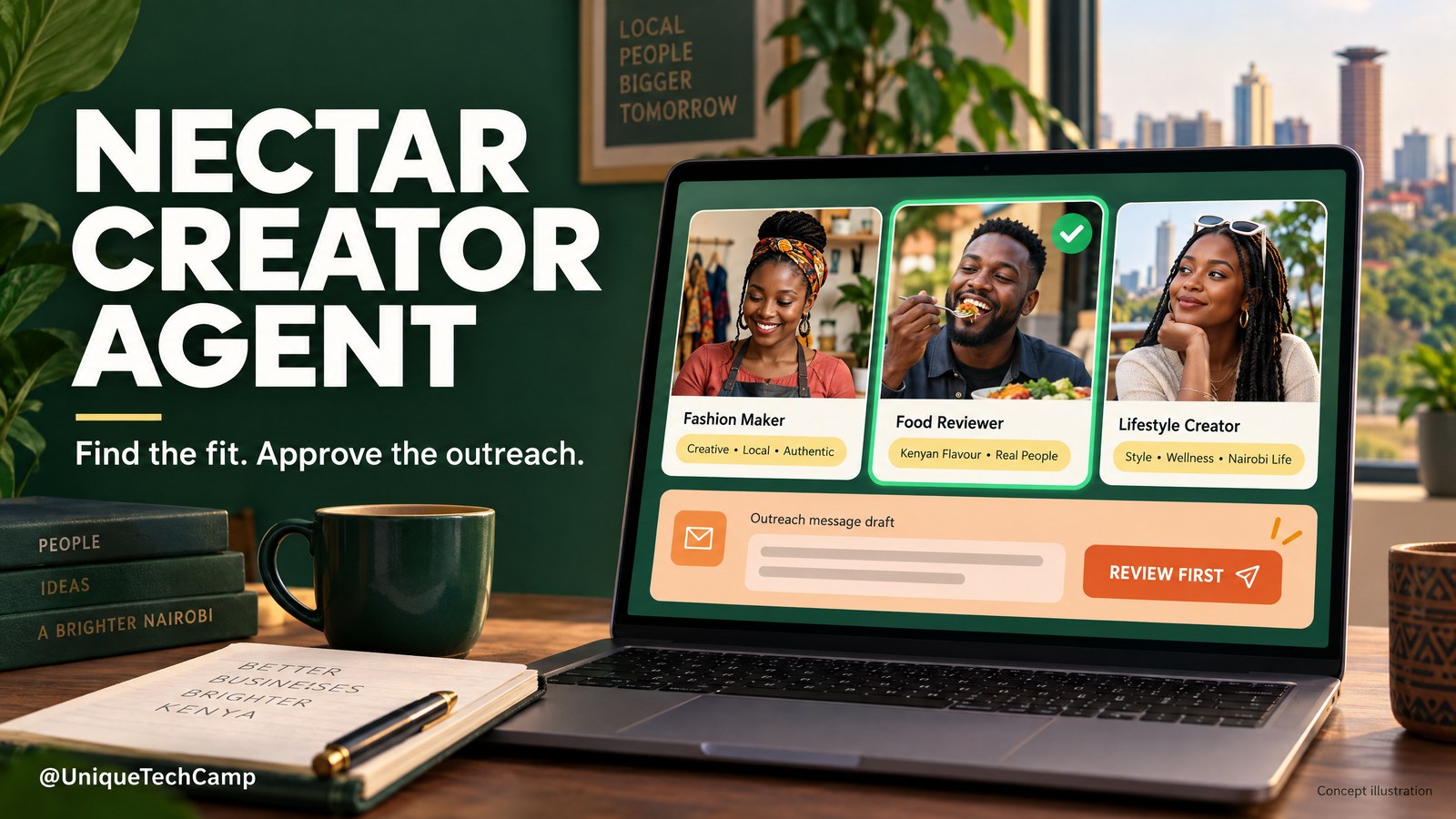
Nectar's newly announced Creator Agent is relevant because it brings discovery, vetting, outreach, relationship history and reporting into one platform. But the sensible question for a Nairobi retailer, food brand or marketing team is not whether an agent can send more direct messages. It is whether a controlled creator programme can reach appropriate customers without creating unwanted messages, unsupported product claims or unmanageable fulfilment promises.
This guide explains what launched, what remains unconfirmed for a Kenyan buyer, and how to evaluate one small campaign before connecting your social accounts or approving automated outreach. The workflow below is a proposed operating plan, not evidence that a particular Kenyan business has achieved these results.
What Nectar actually announced
On 12 November 2026, Nectar announced Creator Agent, powered by its Ren agent. The official launch release ↗ describes a system that finds and ranks creators, reviews content and previous brand partnerships, handles outreach and activation, maintains relationship context and reports on campaigns.
Nectar says it monitors more than 300 million creator profiles and analyses videos across more than 300 attributes. Those are vendor descriptions of its index and analysis, not an independently verified count of suitable Kenyan partners. A large global index does not establish the depth of coverage in Nairobi, Mombasa, Kisumu or a particular language and product category.
The release says Creator Agent is available to Nectar customers as an additional component of the platform, covering Instagram and TikTok creators globally. Independent launch reporting ↗ corroborates the announcement and describes discovery, personalised messages, collaboration management and reporting. Neither source proves that your own accounts, payment arrangements or local campaign requirements are supported.
There is also an important timing distinction: the launch says Creator Agent will soon be available through Nectar's Model Context Protocol integration. Do not buy on the assumption that this specific new agent can already be operated from every named AI assistant. Ask the supplier to demonstrate the exact current connection and distinguish it from Nectar's other existing integrations.
Check access and commercial fit before designing around it
The official Creator Agent feature page ↗ offers a demo rather than a public self-service price. Its stated audience is consumer-brand influencer, social and community teams, particularly programmes starting from around 20 creators and scaling further. That is a description of intended users, not a verified minimum contract or a recommendation that every small shop recruit that many people.
No numeric Creator Agent tariff is published on the reviewed launch and feature pages. Request a written quote covering the base platform, this additional component, authorised social accounts, users, implementation, usage limits, support, contract length and exit process. Ask which activities count towards any usage charge. Do not mistake a statement that one feature has no additional cost for a claim that the complete platform is free.
Ask for a live demonstration using a small, non-sensitive brief. Can it find relevant Kenyan creators? Can your staff inspect why a creator was ranked? Can they reject a match, hold a message and export relationship records? Confirm who can connect accounts and revoke permissions. If the commercial or access requirements do not fit, use the same disciplined workflow in an existing shared register rather than buying software merely to run an experiment.
Start with one offer and one customer action
Suppose a Kenyan homeware brand wants to test a new locally delivered product range. Define the eligible products, actual stock source, delivery areas, available support hours and one intended action: a completed purchase or a qualified product enquiry. This is an illustrative scenario, not a live campaign or a promised result.
Write a short campaign brief with an audience, a product truth sheet, approved claims, excluded claims, creator responsibilities and a named approver. Decide whether a creator should direct people to a product page, an enquiry form or a staff-managed conversation. Avoid asking the same post to drive unrelated actions that the reporting cannot distinguish.
Prepare the destination before contacting anyone. A customer should be able to understand the product, check delivery coverage, see the current purchase or enquiry route and reach a person when stock or suitability is uncertain. A creator campaign cannot repair a broken checkout or make a team respond to messages it never sees.
Rank creators for fit, then verify the evidence
Use the agent to propose candidates, not to make a final judgement about a person's character or commercial suitability. For each potential partner, record the profile link, content category, apparent audience relevance, language, recent examples, previous competing partnerships, review date and the reason a staff member accepted or rejected the match.
Look beyond follower totals. A creator whose audience is largely outside your delivery area may be a poor match even when their posts attract attention. Ask for appropriate audience evidence and review whether comments indicate genuine interest in the product category. Treat location, purchase-intent and brand-safety scores as signals to investigate, not facts established by a colourful label.
Nectar describes contextual content analysis and creator histories. The human review should still include a sample of recent posts, the context of potentially concerning content and whether the creator is comfortable with the proposed relationship. Avoid inferring sensitive characteristics or treating an automated risk score as a reason to publish allegations about someone.
Keep an explicit decision state: proposed, under review, approved for contact, declined or do not contact. Record why a previously approved creator was paused. This prevents a refreshed recommendation list from repeatedly reintroducing a person who has already refused or was found unsuitable for this specific campaign.
Put a real approval gate before the first message
The launch describes automated outreach and direct messages. The product page also illustrates drafted messages waiting for approval. Before assuming how either works in your account, require the demo to show the exact approval controls, roles, logs and sending permissions for your proposed workflow.
Your first pilot should hold outbound messages for a named reviewer. The reviewer checks the creator's identity, relevant content, previous contact history, personalised opening, offer and next step. A message should explain why the partnership might fit, not pretend that a staff member has followed the creator for years when that is untrue.
Set a modest, documented follow-up policy and a stop state. A refusal, request not to be contacted or existing conversation should remove the person from an automated prospecting queue. Test duplicate prevention with the same creator appearing under two campaign lists. If the system cannot demonstrate a reliable hold or stop, keep sending manual and separate from automated discovery.
A useful mid-campaign architecture review with UniqueTechCamp's AI Solutions Desk ↗ would focus on these boundaries: what the agent proposes, what a person approves, what the customer sees and which exceptions return to staff. That is a more concrete automation brief than simply asking for an influencer bot.
Separate a gift, a contract and permission to reuse content
Do not let an agent's ability to organise gifting become authority to promise a commercial arrangement. Before dispatch, staff should confirm the recipient's agreement, product availability, delivery details and who handles failed delivery. Collect an address through an appropriate private process only when it is needed; never put it into a public campaign sheet.
Agree deliverables, timing, factual product claims, the review process and any required sponsorship disclosure before work starts. Obtain appropriate advice on the agreement and current platform rules. Sending a product does not by itself establish that a creator must post, that their opinion must be positive or that your business may reuse their work in paid advertising.
Nectar also describes detecting personal milestones and suggesting gifts. For a small pilot, consider leaving that capability unused. A detail appearing publicly does not mean a person expects a brand to build an intimate profile around it. Relationship quality can be supported by remembering an agreed preference without collecting unrelated family or sensitive information.
Protect creator information and account permissions
Nectar's published privacy policy ↗ describes its controller and processor roles, social-platform data and AI processing. It says Customer Data is not used to train or fine-tune AI models, while separately describing uses of de-identified insights. Read the applicable contract and data-processing terms rather than turning a marketing summary into a blanket privacy guarantee.
A Kenyan business should map the data it introduces, the purpose, staff access, connected providers, retention, export and deletion. The ODPC regulatory framework ↗ is the official starting point for the Data Protection Act and related regulations. Get qualified advice on the lawful basis, notices, international processing and obligations for your actual arrangement; this article is operational guidance, not legal advice.
Keep the evaluation narrow. Use a generic campaign brief before uploading customer conversations, creator addresses or historic contact lists. Assign an account owner, avoid shared passwords and test how access is removed when a team member leaves. Ask how a correction or deletion request reaches both your business register and the supplier's relevant systems.
Measure the customer journey, not just estimated media value
Nectar highlights earned media value, including analysis of untagged posts. That can be useful for comparing exposure under a stated methodology, but it is not cash received, profit or proof that a particular post caused a sale. Ask how the estimate is calculated and keep it separate from your actual order records.
Use consistent campaign links where the platform and creator placement allow them. Google's official campaign-URL guidance ↗ explains source, medium, campaign and content parameters. Use stable campaign names and a non-personal creator identifier, rather than putting private information into a URL. Test the complete mobile route before a creator publishes.
Maintain a small weekly register: approved creators, accepted partnerships, agreed deliverables, posts published, relevant visits, qualified enquiries, fulfilled orders, cancellations, returns and staff time. Record platform estimates separately from website observations and orders confirmed by your own team. A click, a chat start, an order request and a fulfilled sale are different stages.
Calculate campaign contribution using actual received sales less the relevant product, fulfilment and campaign costs, with your finance reviewer deciding the treatment. Include software allocation and staff review time when assessing whether the process is worthwhile. Disclose attribution limits: people may share links, use another device or enquire offline. A referral code can help reconciliation, but it cannot prove every sale was incremental.
Run an acceptance test before expanding the programme
Start in discovery-and-draft mode. Manually check a small candidate set and keep a record of incorrect matches. Rehearse an approved message, a rejected message, a duplicate creator, an opt-out, an unavailable product, a failed delivery and a request to reuse content outside the agreement. These are proposed acceptance tests, not claims about features already verified in your own account.
Write pass and stop conditions before sending. Every outbound message needs the agreed approval; every shipment needs a confirmed arrangement; every live customer route needs a responsible staff owner. Pause if permissions are unclear, a refusal is ignored, claims drift beyond the approved brief or orders exceed your capacity to fulfil them.
Review quality and workload after the pilot's defined observation period. Did staff spend less time maintaining records, or merely move that work into another interface? Were creators appropriate and willing? Could you reconcile the important outcomes without relying on estimated exposure? Expand only the part that has demonstrated value. A smaller, well-managed programme can be the right result.
Frequently asked questions
Is Nectar Creator Agent available to Kenyan brands?
The 12 November launch describes global Instagram and TikTok creator coverage and availability as an additional component for Nectar customers. It does not confirm an individual Kenyan business's account eligibility, local data depth, billing or contractual fit. Verify those points through the official demo before committing.
How much does Creator Agent cost?
The reviewed official announcement and feature page do not publish a numeric tariff for the complete product. Request a written quote separating the base platform, Creator Agent, implementation, limits and ongoing support. Do not interpret an included capability as a promise of a free platform.
Can the agent send creator messages without staff involvement?
Automated outreach is part of the announced scope, while the product page illustrates approval-held drafts. Ask the supplier to demonstrate the actual controls for your configuration. For an initial campaign, require human approval, duplicate checks, clear sending permissions and a tested do-not-contact state.
Does higher earned media value mean more profitable sales?
No. Earned media value is an exposure estimate under a particular method. Compare it separately with your own qualified enquiries, fulfilled orders, returns and campaign contribution. Neither a high estimate nor a large creator index guarantees sales, profit or incremental growth.
Conclusion: automate the administration, own the relationship
Nectar Creator Agent's useful idea is a connected creator workflow, not unlimited outreach. For Kenyan brands, the decision should rest on suitable local matches, transparent commercial terms, respectful contact, staff-approved commitments and evidence from the customer journey. Define that process first; then assess whether the new product improves it.
Need this built for your business?
Business owners can bring one campaign brief, a current product or service page, their approval rules and their measurement gaps to UniqueTechCamp's AI Solutions Desk ↗. Use the appointments page ↗ to request a scoped consultation, and review the matching Social Media Management service ↗. Ask for a practical pilot linking creator discovery, human-approved outreach, a working customer destination and accountable reporting—not a promise of automatic sales.
Deploy An Autonomous AI Lead Gen System Today
We engineer high-converting web applications with integrated 24/7 WhatsApp qualification bots and multi-channel follow-up drips.
Related Strategy Articles
Gemini Small-Business Tools: A Safe Growth Pilot for Kenyan SMEs
Google's Gemini business page brings brand, finance and app tools together. A cautious pilot for Kenyan SMEs, with privacy and review checks.
Google Docs Captions and Cross-References for Kenyan SMEs
Use Google Docs captions, cross-references and caption tables to keep Kenyan SME reports and tender documents easier to navigate after edits.

ChatGPT for Sales: A Human-Reviewed CRM Pilot for Kenyan SMEs
OpenAI's new ChatGPT for Sales adds sales workflows. Learn how Kenyan SMEs can pilot CRM connections with human review, privacy checks and clear measures.
UniqueTechCamp Desk
Online • Reply < 5 mins