
Mailchimp Analytics AI: A Kenyan SME Email Test Plan
Kenyan SMEs can use Mailchimp Analytics AI to autopsy email campaigns, define evidence and approve one bounded test without autonomous sending.
UniqueTechCamp Editorial
Digital Services Team • UniqueTechCamp Engineering Unit
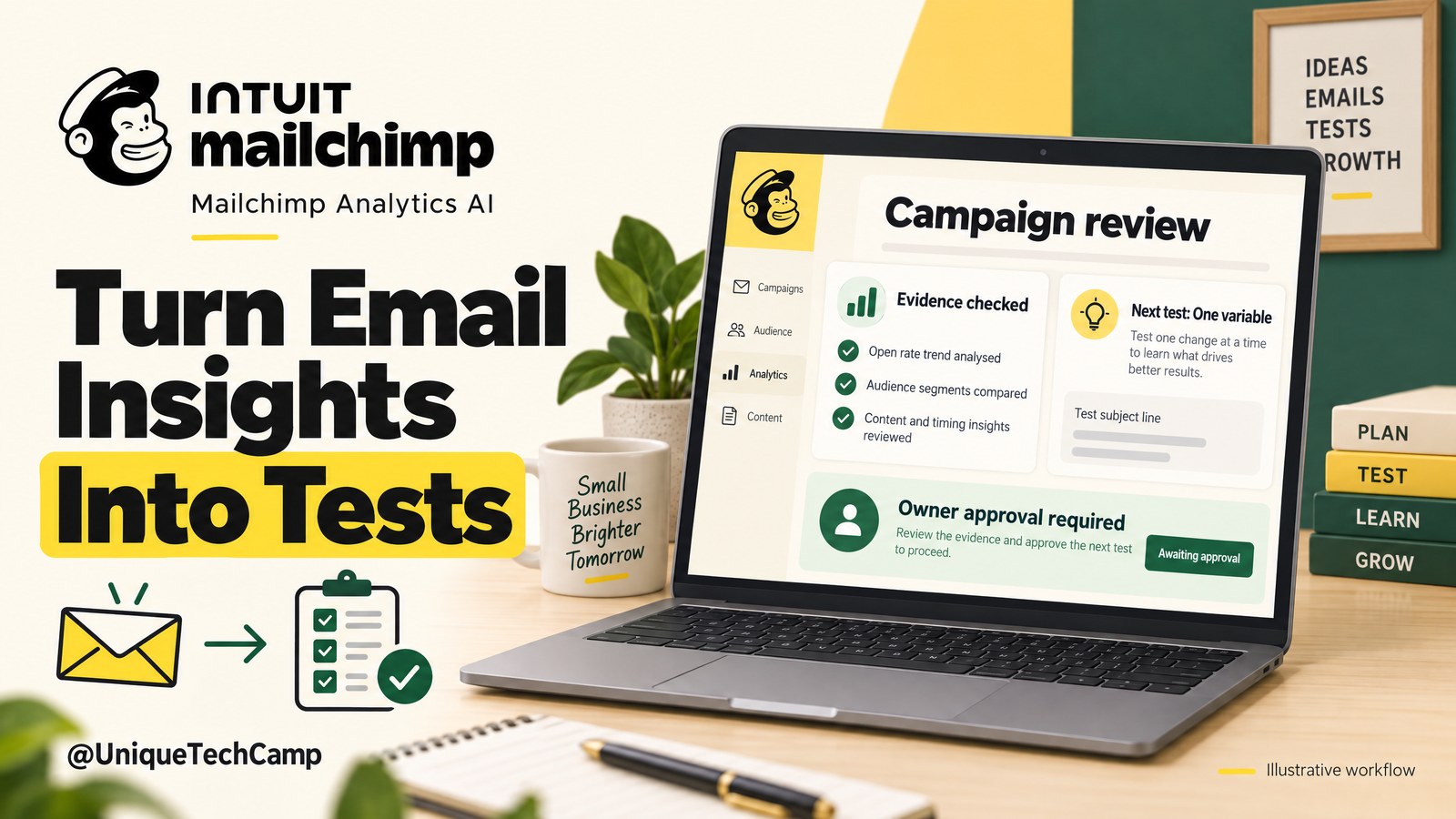
A Nairobi retailer opens last month’s campaign and sees a familiar pattern: plenty of opens, fewer clicks, and no confident answer to the owner’s question, “Did this email help anyone buy?” The temptation is to ask an AI tool for a new subject line and send it to everyone. A safer and more useful sequence is slower: reconstruct what happened, check which data Mailchimp can actually see, choose one approved test, and stop if the evidence or customer experience turns sour.
Mailchimp Analytics AI is useful in that sequence. Mailchimp’s official launch note dated 28 May 2026 describes native conversational analytics connecting campaign, audience and connected-store revenue data. Its May 28 product update says the capability is rolling out globally to paid Admin and Owner users with campaign activity. The feature is therefore an existing reporting capability, not a licence to let a system send customer messages without an accountable person.
This guide uses an illustrative Kenyan SME scenario, not a client case and not a claim of results. The aim is a campaign autopsy, evidence register and one bounded test, with connected-store limits stated plainly.
What Analytics AI can and cannot answer
Mailchimp’s Analytics AI help page says the experience can work with campaign, automation, audience and revenue data, and is most useful after at least one campaign. It can analyse data going back at least 90 days; ask it what longer history is available for your account. This describes historical coverage, not a requirement to accumulate 90 days before starting or a fixed retention limit. Ask the interface to show “how it was calculated”, and treat the resulting summary, chart or recommendation as something to inspect.
The feature can help an owner ask questions in ordinary language: which campaigns produced the most clicks, how an audience segment behaved, or whether connected-store revenue is visible for a selected period. It cannot turn an incomplete integration into complete attribution. If the store is not connected, product and revenue questions may have no dependable Mailchimp answer. If purchases happen through a till, phone, WhatsApp conversation or M-Pesa workflow that is not joined to the campaign record, the system cannot infer every sale merely because a customer opened an email.
Mailchimp also states that recommendations and pre-filled actions require user confirmation. Keep that distinction in the brief: Analytics AI can summarise evidence and suggest a next move; an owner or named marketing reviewer approves any change. Do not describe it as autonomous sending, autonomous optimisation or guaranteed revenue generation.
There is an eligibility detail worth checking before a Kenyan business changes plans. Mailchimp’s AI tools page specifically describes Analytics AI for Standard and Premium, while the newsroom and help materials describe paid Admin/Owner access with phased global rollout. Kenya is not specifically excluded in those materials, but there is no blanket guarantee that every account has the same controls. Check the actual account, role, rollout status and plan before upgrading.
The public marketing plan comparison currently displays a conditional US$20 per month for 12 months Standard offer for a 0–500-contact selector. That is not a guaranteed Kenyan price, permanent fee or tax-inclusive quotation. Confirm contact tier, billing period, currency, taxes and the offer shown at checkout. Mailchimp’s additional-charges guidance also explains that peak contact total can determine billing even after contacts are reduced, with possible add-on blocks for contact or send overruns. Budget staff review and measurement work, not only the plan line.
The illustrative scenario: Bahari Home Supplies
Consider Bahari Home Supplies, a fictitious Nairobi SME selling storage, kitchen and home-organisation products. The owner sends a monthly email to a permission-based audience and takes orders through a connected online store, occasional phone calls and M-Pesa messages. The store connection is enabled, but not every offline order is linked back to a campaign. No result in this example is real, and no percentage is presented as a benchmark.
The owner, Wanjiku, wants to know whether one product-education email deserves a follow-up test. She does not ask Analytics AI to “improve sales”. She first defines the question: among recipients eligible for this campaign, did the email generate measurable clicks and connected-store orders during the agreed window, and what evidence is missing? Her sales assistant owns offline order reconciliation; Wanjiku approves audience use and any send.
The first output is a factual campaign card: send date and time, audience name, recipient count, subject line, content version, links, offer terms, automation status, connected-store state, and reporting window. The second is a limitation log: duplicate contacts, purchases without campaign identifiers, orders paid outside the store, delayed conversions and any field the team cannot verify. This is more useful than a polished summary with no denominator.
Start with the campaign autopsy
An autopsy is a reconstruction, not a verdict. Save the campaign report and note the account timezone, date range and audience definition. Record sends, deliveries, opens, clicks, unsubscribes, bounces and reported revenue where available. Define each metric before comparing it. A delivered email is not a read; an open is not a click; a click is not an order; reported revenue is not automatically incremental revenue.
A practical metric sheet might define delivered rate as delivered messages divided by sent messages, unique click rate as recipients with at least one tracked click divided by delivered messages, click-to-open rate as unique clickers divided by unique openers where the denominator is available, and connected-store order rate as attributed orders divided by delivered messages. Write the numerator, denominator, time window and source beside every number. If Mailchimp reports a value differently, preserve its definition rather than silently substituting your own.
Use Analytics AI to ask narrow, inspectable prompts, for example: “Compare the last three product-education campaigns by delivered messages, unique clicks and connected-store orders. Show the date range, denominators, audience differences and how each value was calculated.” Follow with: “Which fields are missing for orders that came through phone or M-Pesa, and which conclusion should not be drawn?” A useful answer may be “insufficient data”. That is evidence, not failure.
A practical workflow for a Kenyan SME
The following eight steps produce one approved test, not an always-on AI programme. Keep a named owner, a second reviewer and a written stop rule.
1. Define one decision question
Write one sentence such as, “Should we test a clearer delivery message in the next newsletter?” Avoid combining subject line, offer, audience, landing page and send time in one experiment. Name the decision-maker, business period, audience eligibility and what would count as enough evidence to continue.
2. Freeze the campaign evidence
Export or record the source campaign, send time, audience version, message content, links and reporting window. Take a dated screenshot or report copy according to the business’s ordinary access policy. Do not edit the original campaign while trying to understand it. If the campaign was part of an automation, record the trigger and the other messages a recipient could have received.
3. Check account access and data connections
An Admin or Owner should confirm whether Analytics AI is visible and which data sources are connected. Verify the connected store, currency display, product mapping and campaign-to-order linkage. List sales that happen outside that path, including phone, till, WhatsApp or M-Pesa records. A connected store improves the scope of ecommerce evidence; it does not prove every Kenyan customer journey is connected.
4. Ask for a transparent comparison
Use prompts that request date ranges, segments, denominators and “how it was calculated”. Compare like with like: similar audience definition, content purpose and reporting window. Ask Analytics AI to label unavailable fields rather than fill gaps with assumptions. Save the question and answer in the test log, including any chart or recommendation the reviewer relied on.
5. Separate observation from explanation
An observation might be, “Campaign A recorded more unique clicks than Campaign B in the selected report.” An explanation such as “the shorter subject line caused the difference” requires a controlled comparison and may remain unproven. Note alternative explanations: audience mix, offer, product availability, send timing, tracking changes, seasonality or offline orders.
6. Approve one bounded test
Choose one variable and one audience slice that the owner is authorised to contact. For example, test two subject lines among a small, randomly assigned eligible segment while holding body copy, offer, destination page and send window constant. Set a minimum audience rule, success metric, observation window and reviewer. Do not send until the owner approves the exact copy, recipients, exclusions and schedule.
7. Set rollback and stop conditions
Before sending, define a stop condition: a broken link, wrong price, incorrect stock message, unexpected audience inclusion, complaint spike, unsubscribe pattern outside the agreed tolerance or tracking failure. If the system supports pausing a sequence, name who can pause it. Rollback means stopping the remaining send or automation and correcting the source message; it cannot unsend an email already delivered. Escalate customer complaints to the responsible human owner.
8. Review, reconcile and record the decision
At the end of the pre-agreed window, compare the test groups with the same definitions. Reconcile connected-store orders with the sales assistant’s offline log without claiming that every match is causal. Record pass, fail or inconclusive, the evidence reviewed, the data gaps and the next approved action. If the evidence is inconclusive, do not manufacture a winner; improve the tracking or repeat only with fresh approval.
For help turning this owner-approved evidence routine into a working brief, UniqueTechCamp’s AI Solutions Desk is an implementation route; keep the send decision with the business owner.
A simple test log and acceptance checklist
Use a spreadsheet or document with these columns: test ID, owner, reviewer, campaign ID, audience rule, exclusion rule, variable changed, control copy, variant copy, send window, account timezone, metric definition, numerator, denominator, data source, connected-store status, offline-order note, approval timestamp, stop condition, rollback action, result, limitation and next decision.
A test is ready only when the owner can answer yes to each of these checks:
- The question and one changed variable are written in plain language.
- The audience, exclusions and approval holder are named.
- The campaign evidence and account timezone are frozen.
- Analytics AI access, store connection and data gaps are documented.
- Every key metric has a denominator and reporting window.
- The exact copy, link, offer and destination page have been reviewed.
- Stop conditions and a human pause owner are recorded.
- The review date and pass, fail or inconclusive rule are agreed.
- Offline sales are labelled as reconciled, unmatched or unavailable.
- No recommendation is sent or applied without confirmation.
For a Kenyan SME, this checklist is also a handover tool. A staff member should be able to reproduce the question and see why the business chose the test. Keep customer data access to the smallest role needed, and avoid pasting personal data into prompts when an aggregate or campaign identifier will answer the question.
Attribution and connected-store limits
Mailchimp campaign reporting and connected-store reporting answer different questions. A click can show interest without a purchase; a purchase can occur after an email without the email being the only influence. Direct visits, repeat customers, search, social posts, staff follow-up and offline conversations may all sit between message and order. If an order is not joined to the campaign through the configured store connection or a documented identifier, label it unknown rather than assigning credit by intuition.
Keep the Mailchimp autopsy separate from a broader analytics implementation. If the business later compares website, WhatsApp, M-Pesa and email journeys, define a common campaign naming convention and a lead or order register first. Do not import a GA4 attribution model into Mailchimp’s summary without checking field definitions. A sensible decision might be “the email is worth another controlled test”, not “the email generated all revenue in the period”.
There is also a rollout and plan caveat. The official sources differ in how narrowly they describe plan eligibility: the newsroom and help page discuss paid Admin/Owner access and phased global rollout, while the AI tools page highlights Standard and Premium. Treat the account interface and current support response as the operational authority. Do not buy a higher tier solely because a generic page suggests it, and do not assume a Kenya-specific tax, currency or feature arrangement from US display copy.
For a careful implementation review, UniqueTechCamp’s AI Solutions Desk can help a team turn the evidence register, approval path and metric definitions into an owner-readable operating routine. The point is not to replace the marketing owner; it is to make the handoff and limits visible.
Frequently asked questions
Is Mailchimp Analytics AI an autonomous email sender?
No. The official help guidance describes summaries, charts and recommendations, while recommendations or pre-filled actions require user confirmation. Treat it as an analysis assistant inside an approval process. An authorised person should review audience, content, links, exclusions, timing and tracking before any send or change.
Does a connected store prove that Mailchimp caused every order?
No. It can provide ecommerce evidence for orders that the connection can associate with the relevant activity. Phone, till, WhatsApp and M-Pesa orders may be outside that path, and other customer touchpoints can influence a purchase. Keep unmatched orders visible and state the attribution rule and denominator.
Can a Kenyan SME assume Analytics AI is available on its account?
No. Mailchimp describes paid Admin/Owner access and a phased global rollout, while another official page highlights Standard and Premium. Kenya is not specifically excluded in the reviewed guidance, but account role, plan, rollout and connected data still need checking. Confirm in the account before upgrading or promising a workflow.
What should the first test change?
Change one approved variable that answers the decision question, such as a subject line, while holding audience rule, body copy, offer, destination and send window as constant as practical. Define the metric, observation window, minimum audience, stop conditions and reviewer first. If tracking is incomplete, repair measurement before declaring a winner.
Conclusion
Mailchimp Analytics AI is most useful when a Kenyan SME asks it to expose evidence and uncertainty rather than to manufacture confidence. Start with a frozen campaign autopsy, verify Admin/Owner access and connected-store scope, request calculations and denominators, then approve one bounded test. Keep offline orders, plan eligibility, currency, taxes and attribution limits in the record. A careful process may produce a clear next action—or an inconclusive result that tells you what to measure next. Both are better than an autonomous send built on an attractive but uncheckable summary.
Need this built for your business?
Need this built for your business? The verified AI desk can help scope a reviewable campaign evidence workflow. For an owner-approved conversation, use appointments and ask about Marketing Performance Analysis . Bring one campaign report, its audience definition, the connected-store status and the business question you want the next test to answer.
Deploy An Autonomous AI Lead Gen System Today
We engineer high-converting web applications with integrated 24/7 WhatsApp qualification bots and multi-channel follow-up drips.
Related Strategy Articles

Gemini Small-Business Tools: A Safe Growth Pilot for Kenyan SMEs
Google's Gemini business page brings brand, finance and app tools together. A cautious pilot for Kenyan SMEs, with privacy and review checks.
Google Docs Captions and Cross-References for Kenyan SMEs
Use Google Docs captions, cross-references and caption tables to keep Kenyan SME reports and tender documents easier to navigate after edits.

ChatGPT for Sales: A Human-Reviewed CRM Pilot for Kenyan SMEs
OpenAI's new ChatGPT for Sales adds sales workflows. Learn how Kenyan SMEs can pilot CRM connections with human review, privacy checks and clear measures.

UniqueTechCamp Desk
Online • Reply < 5 mins