
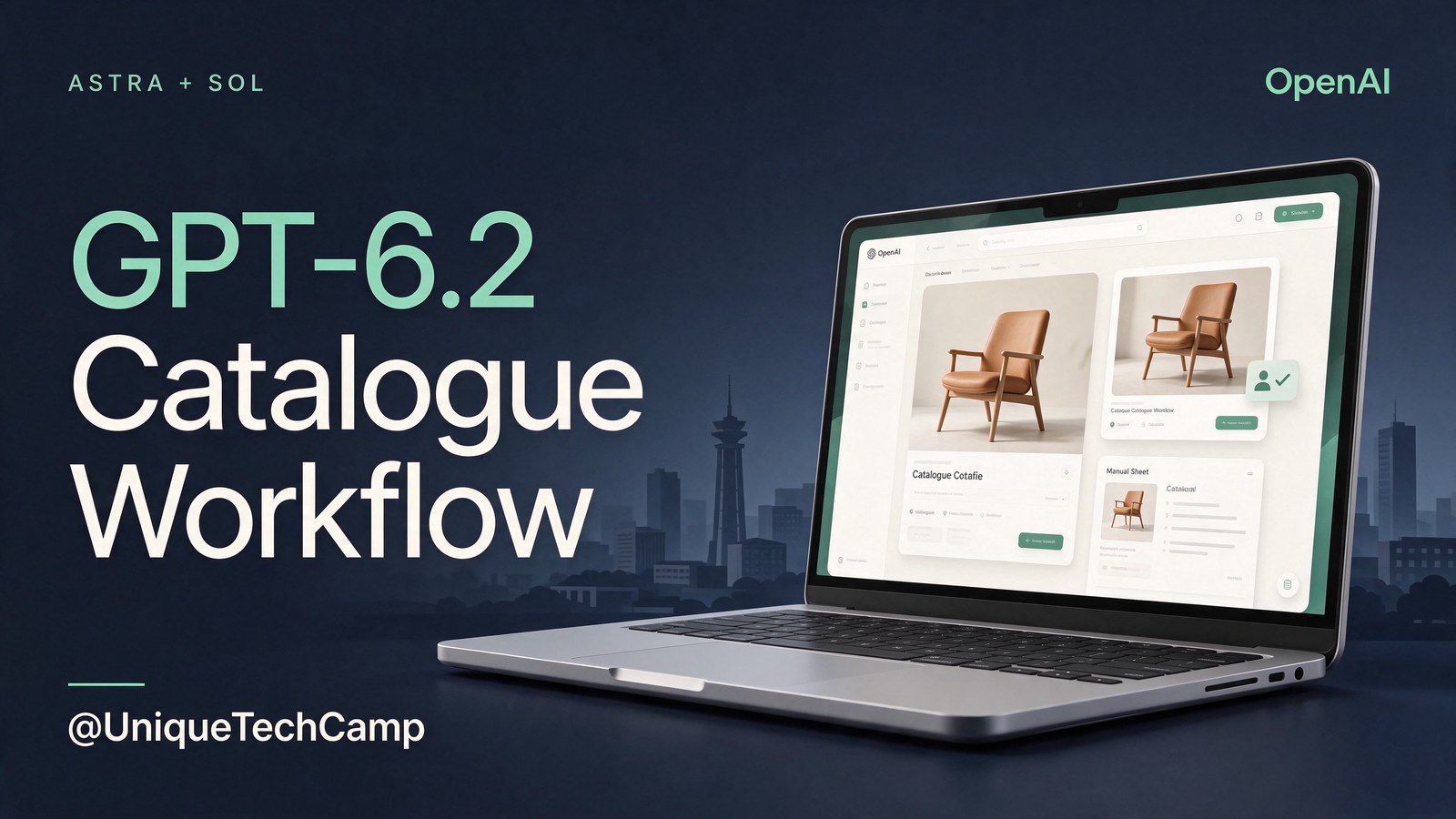
For many Kenyan small and medium-sized businesses, the problem is not a lack of products. It is the gap between what the business knows and what a customer can confidently see, understand and act on online. Product photographs sit in a phone folder, manuals are PDFs, specifications live in a spreadsheet, and a sales person carries the exceptions in their head. Turning that material into a useful website and catalogue normally means repeated hand-offs between an owner, designer, copywriter and developer.
Launched on 17 November 2026, OpenAI’s GPT-6.2 Astra and Sol introduce a potentially practical way to organise that work. The important question for an SME is not whether a launch page reports a benchmark win. It is whether an approved set of product photos and manuals can become a staged, reviewable visual catalogue and customer-facing website, with people checking every important claim before publication.
The customer problem: good products, weak digital evidence
A customer comparing products online needs more than polished adjectives. They need to recognise the item, understand its use, distinguish variants, see what is included and know how to ask the next question. A wrong model number, connection or accessory can create more support work than it saves. A beautiful page that omits a manual or implies stock is available is not reliable.
This is particularly relevant where a small team serves customers through a mixture of website, WhatsApp, phone and in-person sales. The same product may have several photos, a scanned instruction sheet and a local sales description. Before AI is introduced, the business should decide which source is authoritative for each field: for example, the manufacturer manual for assembly instructions, the approved price sheet for price, and a named staff member for current availability. The model can help reconcile material; it should not silently become the authority.
The GPT-6.2 announcement describes Astra working with reference photos and build manuals to create an animated assembly guide and illustrated parts catalogue. It also describes work with individual parts and connections in CAD and simulation tools, plus interactive web design. Those are official product demonstrations, not a promise that an arbitrary SME catalogue will be accurate. They do, however, point to a useful workflow: put messy source material into a controlled staging process, ask the model to expose uncertainty, and require human approval before anything customer-facing is published.
What Astra and Sol each contribute
The official developer release note positions Astra as the model for difficult, multi-step reasoning and Sol as the everyday coding, writing and work model. In a catalogue project, Astra is the sensible candidate for the first pass: inventorying source material, matching photos to product records, spotting contradictions, proposing an information structure and building a visual presentation or front-end prototype. Sol is better suited to routine follow-up such as copy revisions, code review, formatting changes and small content updates.
That does not mean the project should be handed to one model and left unattended. Think of Astra as a reasoning and production assistant in a supervised studio. It can create a draft product record, a visual card, a comparison view or a page section. A human then checks the source, status and presentation. Sol can make the approved revision across a set of records, but the approval still belongs to the business.
Keep API work and ChatGPT work separate in the plan. The API is a developer service billed by token usage. ChatGPT Work and Codex are product experiences governed by the selected plan, included allowance or applicable credits. An existing ChatGPT subscription does not include API usage. Access can also depend on plan, workspace settings, rollout status and administrator settings. Kenya appears on OpenAI’s supported country lists for both ChatGPT and the API, but country support is not a guarantee of access to every model, plan or plug-in.
A concrete workflow from approved source material to staged catalogue
1. Create a source-of-truth pack
Start with a deliberately small product family rather than uploading every file the business owns. Select approved product photographs, manuals, existing descriptions, variant or SKU information, the brand guide, a page template and the customer action you want the site to support. Name files consistently and keep the original documents separate from working copies.
Alongside the files, write an authority map. Mark fields as verified, supplied for review, unknown or not applicable, and name who approves claims, images, prices, dimensions, compatibility notes and calls to action. If a fact is absent, the draft should say “needs confirmation”, not fill the gap with plausible language. Remove customer details and confidential supplier information; never upload passwords or API keys. Review the chosen product’s data settings before sharing business files.
2. Ask Astra to build an inventory, not a sales page
The first prompt should produce a structured inventory. Ask Astra to identify each product, photo, visible component, manual section and apparent variant; link evidence to the proposed field; flag conflicts; and list questions for a human reviewer. Request a table or machine-readable record with fields such as product name, model, use, included items, compatibility, dimensions, safety or handling notes, image references and source citations.
This inventory turns a folder into a review queue. A reviewer can approve individual fields rather than rereading an entire page. Conflicts should remain visible and go to a person; an attractive illustration must not conceal an unresolved specification.
3. Turn the approved records into visual catalogue components
After review, ask Astra to propose a consistent visual system: product cards, detail pages, variant labels, parts call-outs, assembly steps, comparison blocks and enquiry actions. Use supplied photographs as the visual anchor. Label an illustration or 3D-style view where it could be mistaken for a photograph, and compare it with the approved source.
For a parts catalogue, require each call-out to map back to a named part or manual section. For an assembly guide, require a reviewer to confirm sequence, orientation and connection points. For a product page, require a visible distinction between included, optional and unavailable items. The acceptance test is not “does it look professional?” It is “can a customer identify the right item without being misled?”
4. Build the website in a staging environment
Use the approved records to create a staging site or front-end prototype. Ask for a mobile-first product listing, search or category route where needed, a clear detail page, a visual gallery, an enquiry path and a handoff note for staff. Keep customer-facing copy tied to the approved record, and keep internal notes—uncertainties, reviewer comments and source links—out of the public interface.
Astra can help with the larger front-end structure and interaction design. Sol can review the resulting code, apply a consistent wording change, fix a small layout issue or update a batch of approved records. The business should test the real journey on a phone: select a product, inspect its status, tap to enquire and confirm that staff receive enough context.
5. Run a human approval gate
Do not publish directly from the model’s workspace. Set a gate with named owners. A product or technical reviewer checks factual fields and diagrams. A commercial owner checks price, availability and the intended customer action. A brand or editorial reviewer checks clarity and consistency. A final site owner checks links, forms, analytics and mobile presentation.
Record approvals by product version, date and reviewer. If a price or availability field changes, the affected page should return to the relevant review queue. Treat customer feedback and support questions as change requests, not as permission for the model to improvise. This approach makes AI useful without confusing draft generation with operational authority. Keep a backup and tested rollback route; pause publication when a material source conflict remains unresolved.
A short actionable prompt
Use a prompt that makes evidence and review explicit:
“Using only the attached approved product photos, manuals, product records and brand reference, create a staged visual catalogue for review. For each product, produce: (1) a structured record; (2) a proposed customer-facing page; (3) an image and parts mapping; (4) unresolved conflicts and missing fields; and (5) an acceptance checklist. Cite the source file and page for each factual claim. Do not invent specifications, prices, availability, safety instructions, compatibility or included items. Mark every uncertain field NEEDS HUMAN APPROVAL. Keep illustrations distinct from photographs. Propose a mobile website flow from category to product detail to enquiry, but do not publish or imply approval.”
That establishes a boundary between a useful draft and a live customer commitment.
Specific acceptance criteria before launch
- Every published product has a named source record and a human reviewer.
- Every specification, compatibility statement, price and availability label is either verified or deliberately omitted.
- Photographs, illustrations and generated visualisations are clearly distinguishable where confusion is possible.
- Parts call-outs and assembly steps match the approved manual or are held back for review.
- Customers can reach the intended enquiry route from a phone, and staff receive the product identifier and relevant variant.
- Broken links, empty states, missing images, duplicate records and form failures have been tested in staging.
- A named person owns updates, approvals and escalation after launch.
For teams that want to test this boundary before a full build, the UniqueTechCamp AI assistant service ↗ can be considered as part of a wider review-led digital workflow, subject to confirming the tools, access and handoffs the business actually needs.
Pricing: plan by tokens, not by pages
The API pricing unit is 1 million tokens, not one image, page or finished website. All figures below are US dollars. The official standard short-context rates are $8 per 1 million input tokens, $0.40 per 1 million cached input tokens and $40 per 1 million output tokens for Astra. Sol is $2 per 1 million input tokens, $0.10 per 1 million cached input tokens and $10 per 1 million output tokens.
Inputs above 272K tokens have higher rates. Batch processing is listed at half the standard rate; fast mode doubles standard pricing. Other speed tiers, regional processing, reasoning, output length and tool calls can change charges. Hosting, storage, integration, review time, taxes and currency conversion are separate budget considerations. Check the current pricing table rather than treating these token rates as a finished-project quote.
A stable catalogue, brand guide and system instruction may be reused as cached context. OpenAI recommends keeping prompt prefixes unchanged and appending new instructions, which can improve cache reuse, cost and latency. Still, no honest cost-per-website figure follows from the announcement. A sensible pilot is a recommendation, not a vendor statistic: for example, one product family, a deliberately limited set of records and one enquiry journey, with the number of model runs and review hours recorded.
Do not compare an API estimate with a ChatGPT subscription as though they were the same product. In ChatGPT Work and Codex, usage draws on the plan’s allowance or applicable credits; Astra may consume allowance faster than Sol depending on task size, reasoning level and speed. API access is billed separately. Before committing, confirm the workspace’s actual model access, administrator settings, service tier and data-handling requirements.
What to measure, and what the workflow cannot promise
Measure the workflow before claiming business impact. Useful operational measures include the number of source records reviewed, percentage of fields approved on the first pass, unresolved conflicts, time from source pack to approved page, reviewer correction types, broken links found in staging and customer enquiries that include a usable product identifier. After launch, track page engagement and enquiries alongside staff outcomes such as response time, clarification requests and catalogue-related corrections. Define the period and segment; do not manufacture a return-on-investment number where the business has no baseline.
There are important limitations. Vision does not guarantee that a model will read a poor photograph or scan correctly. A generated visual may show a wrong connection or part. Manuals can be outdated; stock and price information can change. Tool access, context size, latency, hosting and integration quality affect the experience. Inconsistent source material can create more work than it removes.
OpenAI’s benchmark comparisons are vendor-reported and depend on the stated harnesses, settings and exclusions. They should not be converted into a claim that Astra is universally superior or that a Kenyan SME will achieve a particular result. The defensible case is narrower: the feature set may help a supervised team move from multimodal source material to a reviewable website and catalogue, while Sol offers a lower-cost path for routine iteration. Human approval remains the safeguard against publishing a plausible error.
Four questions owners should ask
1. Can we use this if our product information is mostly PDFs and phone photos?
Yes, that is a reasonable pilot input, provided the team first identifies authoritative sources and accepts that scans and images may need manual checking. Start with a small product family, ask for an evidence-linked inventory and hold uncertain fields for approval. Do not treat the ability to upload material as proof that every detail has been extracted correctly.
2. Should we use Astra for everything?
Not necessarily. Use Astra where the task needs broader reasoning, visual interpretation, reconciliation or a substantial front-end draft. Use Sol for routine revisions, code review and repeated changes to already approved content. The right split depends on the source pack, workflow and review effort, and should be measured rather than assumed.
3. Is ChatGPT included in our API budget?
No. ChatGPT and the API are separate billing products. ChatGPT Work and Codex access depends on the plan, allowance, credits, workspace settings and rollout. API usage is metered separately using token rates. Confirm the exact plan and project arrangement before estimating a production workflow.
4. Does Kenya support mean our team is guaranteed GPT-6.2 access?
No. Kenya is included in the official country lists for ChatGPT and API access, but that establishes country-level support. Model, plan, workspace, administrator and rollout conditions can still apply. Treat availability as something to verify in the intended ChatGPT workspace or API project, not as a promise that every account has the same access.
Sources
The launch overview is in OpenAI’s GPT-6.2 Astra and Sol announcement ↗. The developer details are in the official developer release note ↗. Check the API pricing documentation ↗, ChatGPT Work and Codex guidance ↗, ChatGPT supported countries ↗ and API supported countries and territories ↗ for current access and billing conditions.
Need this built?
If your business has approved product photos, manuals and a clear customer enquiry route, begin with a scoped staging pilot rather than a promise of instant automation. Define the source-of-truth pack, one product family, the reviewers, the visual components and the acceptance tests. UniqueTechCamp ↗ can help shape the customer-facing catalogue and website workflow through its e-commerce setup service ↗ and discuss the review process through its appointments route ↗ and its contact route ↗. Ask for a one-page pilot scope that names the source files, approval owners, staged deliverables, measurement period and what will remain human-controlled.




UniqueTechCamp Desk
Online • Reply < 5 mins