
Gemini Omni 1.2 Flash: A Product-Video Pilot in Kenya
Kenyan retailers can pilot synthetic product videos with Gemini Omni 1.2 Flash using approved references, frame QA, cost controls and enquiry tracking.
UniqueTechCamp Editorial
Digital Services Team • UniqueTechCamp Engineering Unit
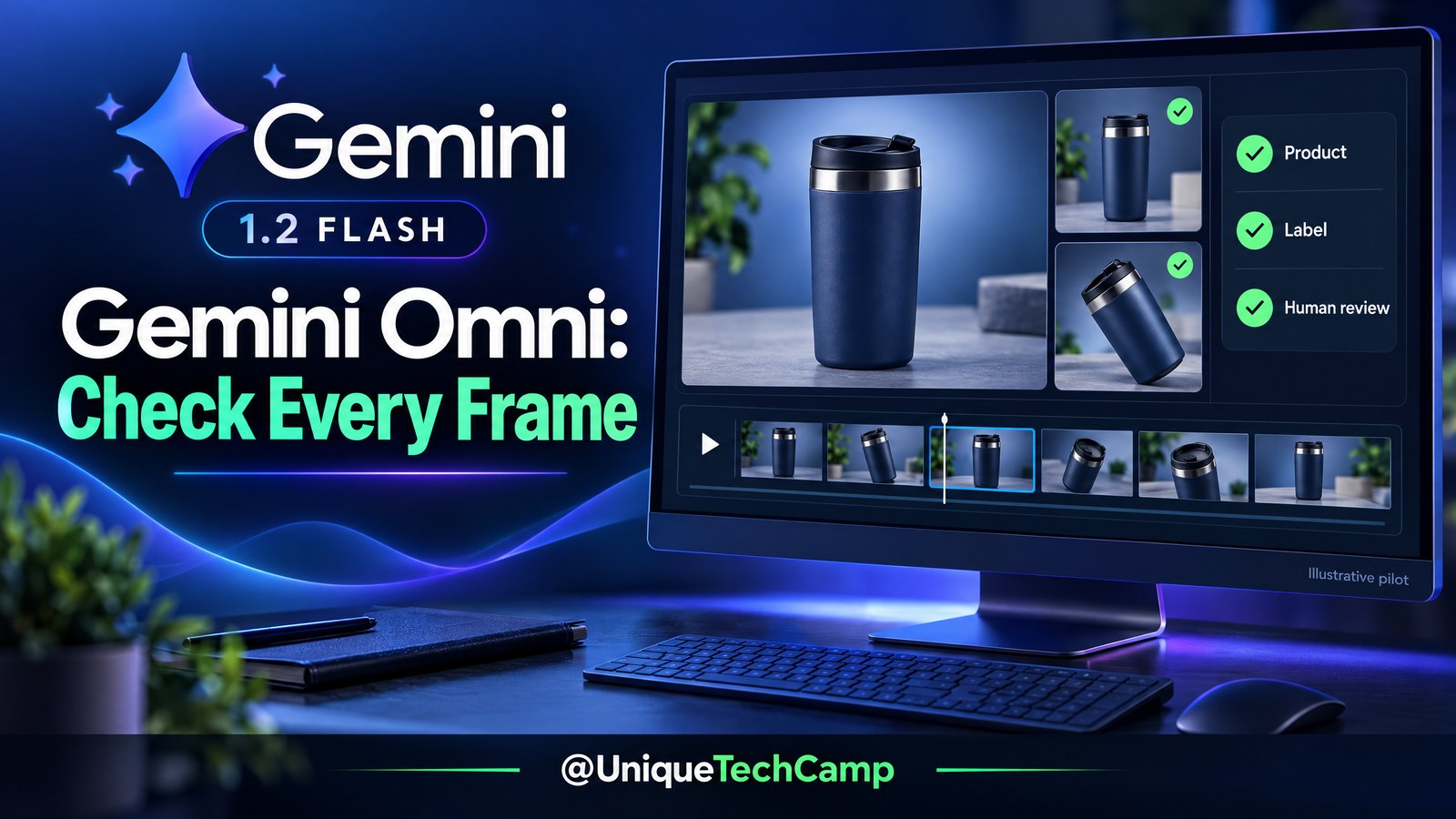
A product video can answer a buyer’s first question before a salesperson does: what is this, who is it for and what should I do next? For a Kenyan retailer, that does not mean manufacturing a glossy advert that implies a product was tested when it was not. It means producing a short, clearly controlled visual from an approved product reference, checking every frame and connecting the asset to a real enquiry path.
Google announced Gemini Omni 1.2 Flash on 5 November 2026. Its official launch announcement describes a model aimed at native video generation and editing, while the Gemini Omni Flash model reference records the API model as stable. The opportunity for a retailer is not “AI makes sales”. It is a small pilot: one real SKU, one approved source, a few controlled variants and a measurement plan that counts qualified enquiries rather than views alone.
This distinction matters. A generated clip can show packaging, a use context or a sequence of product details, but it cannot prove physical performance, stock, a customer review or a medical or legal claim. Treat the output as synthetic marketing content requiring review. The practical question is whether it helps a prospective buyer understand the offer well enough to make an informed enquiry.
The business problem: useful product context is expensive to produce
Small retailers often have the ingredients for a product page but not the time or budget for a new shoot every time a campaign changes. A phone photograph may show the package, yet leave buyers unsure about scale, features, colour, accessories or how the item fits their need. A long catalogue description is easy to ignore on social feeds. A generic stock clip may attract attention while saying nothing trustworthy about the actual SKU.
The operational gap is therefore between an approved product reference and a customer action. The retailer needs a short asset that is accurate enough to review, distinctive enough to test and specific enough to send a buyer to a product page, WhatsApp conversation or enquiry form. The asset also needs an owner: someone must confirm that the product is real, available, correctly described and allowed to be promoted.
A pilot should start with one product that has stable packaging and verified specifications. Record the SKU, current price or price policy, stock status, variant, destination landing page and intended audience. If the item is frequently substituted, regulated, medical, safety-critical or dependent on a changing offer, use stricter approval and avoid claims the source material does not support. This is a marketing workflow, not a product-certification workflow and not medical or legal advice.
What changed with Omni 1.2 Flash
The Google AI Studio guide for Omni video documents native video generation and editing from 3 to 15 seconds in whole-second increments. The default API duration is 10 seconds, but a specified duration overrides wording in the prompt. Single-image generation can run to 15 seconds. First/last-frame interpolation is limited to 3–10 seconds, and an extension adds 3–10 seconds to up to the last 30 seconds of source video. These limits make a 15-second product explainer a useful pilot unit, not a promise that every creative idea is available in one request.
The model supports 360p, 720p, 1080p and 4K outputs. The model reference identifies 720p as the default; 1080p and 4K are upscaled outputs rather than native capture. It can generate synchronised audio, including speech, music and sound effects, and can return text. Audio is not a standalone input modality in the Cloud matrix, and audio-reference inputs are allowlist-gated, so do not build a pilot around unsupported standalone audio input.
Conversational editing is exposed through the Interactions API. A follow-up correction is another billable operation: the resulting video consumes output tokens, while supplied source video can consume input tokens. In other words, “change the label text” is not a free post-production instruction. It is a new request whose output must be checked again.
Access also needs careful wording. The Google AI Studio pricing page lists Omni 1.2 Flash as paid-tier only for developers, with no free-tier input or output. Kenya appears on Google’s available-regions list for AI Studio and Gemini API access, subject to account, billing and product eligibility. That is API availability, not a guarantee that the Gemini consumer app is available to every Kenyan user. Google Cloud marks the model GA and its endpoint global in the Cloud announcement , while Gemini for business is described as coming soon. Product-specific consumer terms may differ.
A controlled seven-step pilot workflow
A useful pilot is deliberately narrower than “make us a campaign”. It creates an auditable chain from product truth to approved asset.
The UniqueTechCamp AI Solutions Desk can help a business owner turn that chain into a named brief with a reference owner, release reviewer and enquiry handoff before generation begins.
1. Select the product and define the buyer action
Choose one SKU with a named owner and a current source of truth. Record the product name, variant, packaging, dimensions, included accessories, verified specifications, price treatment, stock or fulfilment status and destination URL. Decide whether the clip’s job is to drive a product-page visit, a WhatsApp question, a booking or an enquiry. A CTA should lead somewhere the retailer owns and can monitor; “learn more” without a working destination is not a funnel.
2. Prepare one approved reference pack
Use a clear product photograph or packaging image plus a short fact sheet approved by the retailer. Add only claims that can be checked against the source. Note what must not change: logo, label text, colour, dimensions, included items and any safety or usage wording. Do not use a synthetic image as the product truth merely because it looks polished. If a reference is incomplete, stop and obtain the missing detail.
3. Write a bounded generation prompt
A practical prompt names the audience, shot sequence, duration, resolution, style and exclusions. For example: “Create a clearly synthetic 15-second 720p product explainer for Kenyan mobile shoppers using the attached approved reference. Show the real package on a clean counter, a close-up of the front label, three on-screen benefits copied only from the supplied specification sheet, and a final frame with ‘Check availability’ plus the approved landing-page CTA. Keep logo, label text, colour, dimensions and accessories consistent. Do not show a hand using the product, a performance test, a customer testimonial, a medical outcome or an invented feature. Use neutral voiceover or captions and leave space for a synthetic-content disclosure.”
Prompt wording is not a substitute for review. It is a way to make the intended boundaries testable. Keep the original prompt, reference files, model ID, duration, resolution and request timestamp in the pilot record.
4. Generate a small set of variants
Request two or three versions that differ in opening frame, caption order or CTA wording, not in product facts. Keep duration within the documented 3–15-second range and use whole seconds. Avoid generating a dozen loosely specified alternatives: that increases review load and can hide an inconsistency. If you use an image-to-video or edit request, record whether a source video was supplied because input billing may apply.
5. Review every frame and the sound
The reviewer checks packaging, logo, label text, colour, dimensions, accessories, captions, spoken claims and CTA spelling frame by frame. Compare each detail with the approved reference. Watch for warped text, extra components, impossible handling, invented testimonials, unsupported performance, misleading before-and-after scenes and a final URL that is not live. Review synchronised speech, music and sound effects for intelligibility and appropriateness. A generated clip can look plausible while being factually wrong.
Keep a defect log: timestamp, defect, severity, decision and owner. Use a conversational edit only for an identified defect, then repeat the full review. Do not treat a clean-looking second draft as automatically approved.
6. Approve, disclose and publish to a controlled destination
The retailer’s release owner signs off the selected asset, product facts, CTA and destination. Add a clear AI or synthetic-content disclosure where the channel, retailer policy or applicable rule requires it. Google documents an imperceptible SynthID watermark and Cloud documentation marks Content Credentials support, but neither should be treated as a guaranteed visible label in every viewer’s experience. Operational disclosure is still the team’s responsibility; this article does not make a legal determination.
Publish first to one channel and one landing page or enquiry route. Check the mobile experience, page speed, WhatsApp handoff, form ownership and response process. A video that generates questions without a person able to answer stock, price or delivery details is an attention expense, not a customer journey.
7. Measure the approved asset and the business handoff
Record asset ID, variant, channel, dates, spend, impressions, completed views, clicks, enquiries, qualification status, response time and outcome. Use a consistent definition of a qualified enquiry, such as a prospect who supplied a relevant product need, location and contact route. Where possible, connect the CTA to campaign parameters and a lead register. Review approved-asset cost, reruns, editing time, qualified enquiries and downstream sales conversations—not views as a revenue proxy.
Compare variants only when the audience, placement, offer and time window are sufficiently similar. A short pilot can show whether a specific asset produces useful enquiries; it cannot establish that the model universally improves conversion. Record losses and unanswered handoffs as carefully as wins.
Costs, limits and a realistic pilot budget
The Google AI Studio pricing documentation and Google Cloud Model Garden pricing express the paid Standard tier in tokens. The official advertised US$0.07 per second for 720p video output is a rounded effective rate, not a universal flat charge. The actual video-output rate is US$12.00 per million video-output tokens; input is US$1.50 per million input tokens, and returned text is US$9.00 per million text-output tokens. Google’s tokenisation notes use up to 5,792 tokens per video second at 720p.
At 720p, 5,792 tokens per second × 15 seconds gives 86,880 output tokens. Applying US$12.00 per million video-output tokens produces an estimate of US$1.04 for 15 seconds of 720p output. Three 15-second versions therefore cost approximately US$3.13 for 45 seconds of 720p video output before input tokens, returned text, edits, review time, taxes or foreign-exchange effects. This is a derived illustration, not a flat quote. A supplied source video, follow-up edit or upscale can add separately billed tokens. Do not describe the API as free.
Resolution changes the estimate. The documented output rates are 1,931 tokens per second at 360p, 5,792 at 720p, 8,688 at 1080p and 17,376 at 4K, with audio. 1080p and 4K are upscaled outputs, and upscaling itself consumes output tokens. Start at 720p for a pilot unless the distribution requirement justifies another choice. Keep a budget ceiling and stop after a defined number of retries; the dominant cost may become review, creative iteration, landing-page work or staff time rather than the first generation.
A Kenyan team should also check billing account eligibility, tax treatment and the exchange rate with its finance owner. Kenya is listed for API availability, but account approval and paid-tier access still matter. Consumer app, Google Vids, Workspace and Gemini for business terms are separate product questions. Google’s launch materials mention Google Vids clips at no additional cost under product-specific terms and Gemini-app rollout to qualified Google AI Ultra subscribers; neither changes the paid-only API position.
For a retailer that needs help turning this into an accountable customer journey, the UniqueTechCamp AI Solutions Desk can be a practical starting point for defining the reference pack, approval owner and enquiry handoff before more content is generated.
Frequently asked questions
Can a Kenyan retailer use Gemini Omni 1.2 Flash through the API?
Kenya is listed among available countries for Google AI Studio and Gemini API access. The API is paid-tier only, so a team still needs an eligible account, billing setup and permission to use the model. Availability of the API should not be turned into a claim that every Kenyan consumer has access to video generation in the Gemini app.
Does one generated clip prove that the product works?
No. A synthetic scene can illustrate approved information, but it cannot demonstrate real physical performance, a customer review, stock status or a result that was not measured. Review the clip against the reference, disclose synthetic content where required and keep medical or legal claims out of a general marketing pilot. For regulated or safety-sensitive products, involve the appropriate reviewer.
Is the advertised per-second rate the final bill?
No. US$0.07 per second for 720p video output is a rounded effective headline. Actual billing uses output tokens, with US$12.00 per million video-output tokens, plus possible input and text-output charges. Edits, source-video input, upscales, retries, staff review, taxes and exchange-rate effects can add cost. Budget from the selected model and request, not the headline alone.
What should the retailer measure first?
Measure whether the approved asset creates useful business movement: landing-page clicks, product questions, qualified enquiries, response time and the next recorded sales stage. Keep views and completion rate as diagnostic distribution measures. Assign a release owner, record the approved asset and CTA, and connect enquiries to the SKU where possible. The first pilot should produce a learning record, not a guaranteed revenue claim.
Conclusion
Gemini Omni 1.2 Flash makes a tightly scoped synthetic product-video pilot more practical because it supports short native video generation and iterative editing. The responsible advantage is the workflow around it: one verified product reference, a bounded prompt, controlled variants, frame-level QA, a named release owner, clear disclosure and a CTA that reaches a real enquiry process. The model is a production component, not a substitute for product truth or sales operations.
For a business deciding whether to test this approach, start with one SKU and a 15-second 720p output. Price the operation in tokens, reserve time for review and reruns, and judge it by qualified enquiries and the quality of the handoff. A modest, documented pilot is more useful than a large batch of attractive clips that no one can verify or follow up.
Need this built for your business?
Business owners can bring one product reference, its verified specifications, current customer journey and intended CTA to the UniqueTechCamp AI Solutions Desk . To discuss a scoped pilot, book an appointment and explain who will own product approval, landing-page updates and enquiry follow-up. If the next step is a repeatable content workflow rather than a single experiment, review social media content creation services and define the channel, approval process and measurement plan before production.
Deploy An Autonomous AI Lead Gen System Today
We engineer high-converting web applications with integrated 24/7 WhatsApp qualification bots and multi-channel follow-up drips.
Related Strategy Articles

Gemini Small-Business Tools: A Safe Growth Pilot for Kenyan SMEs
Google's Gemini business page brings brand, finance and app tools together. A cautious pilot for Kenyan SMEs, with privacy and review checks.

Google Docs Captions and Cross-References for Kenyan SMEs
Use Google Docs captions, cross-references and caption tables to keep Kenyan SME reports and tender documents easier to navigate after edits.

ChatGPT for Sales: A Human-Reviewed CRM Pilot for Kenyan SMEs
OpenAI's new ChatGPT for Sales adds sales workflows. Learn how Kenyan SMEs can pilot CRM connections with human review, privacy checks and clear measures.

UniqueTechCamp Desk
Online • Reply < 5 mins