
Gemini 4 Hydrogen: A Faster Enquiry Pilot for Kenyan SMEs
Test Gemini 4 Hydrogen for Kenyan SME enquiries: verified API costs, four thinking levels, approved lookups and staff-controlled responses.
UniqueTechCamp
Digital Solutions Team • UniqueTechCamp Engineering Unit
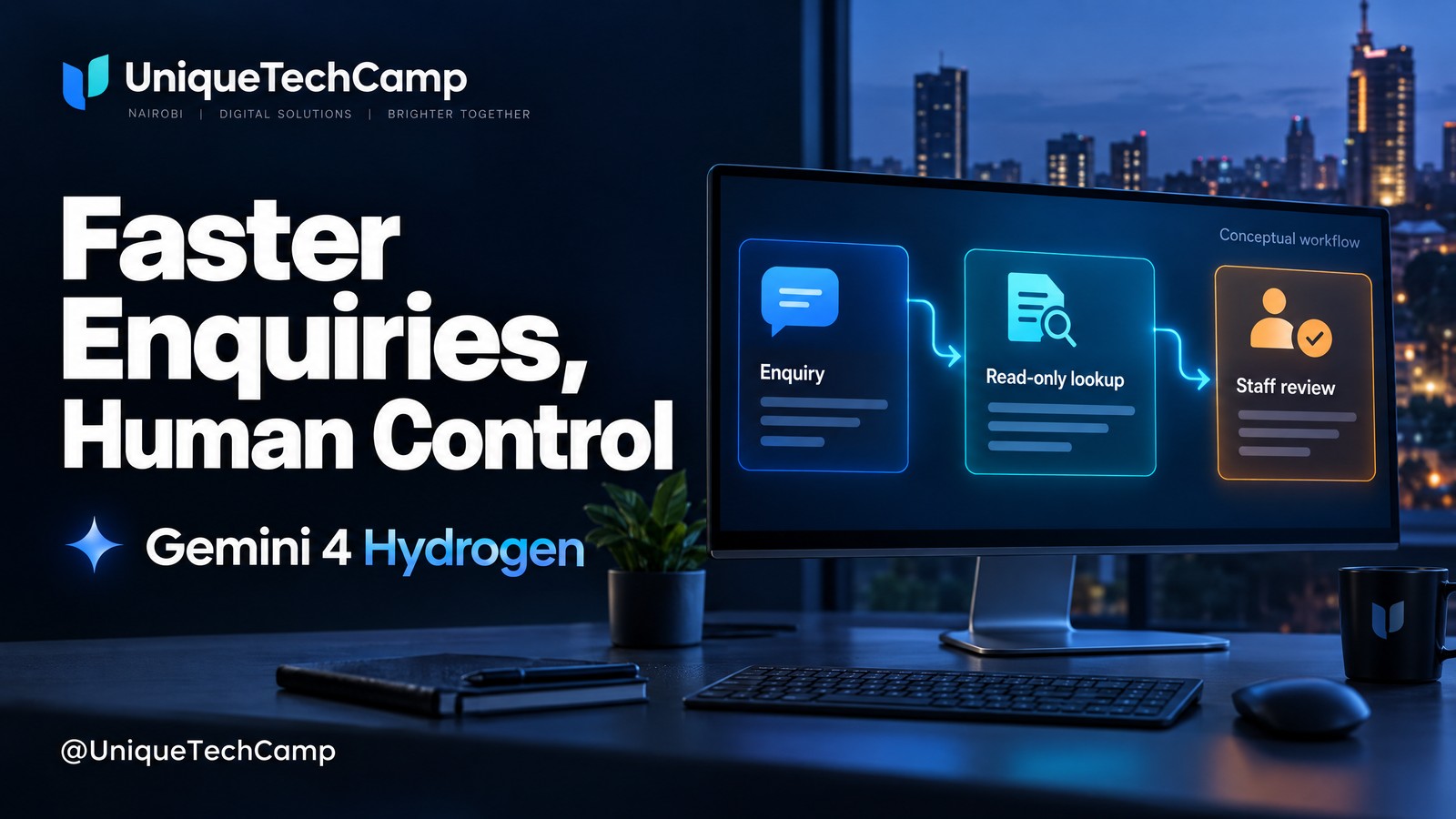
A customer asks whether your team covers Kiambu, can visit next week and offers installation. Your website assistant answers immediately, but it invents a service area and treats a provisional slot as confirmed. Speed has made the mistake more efficient, not the business more useful.
The arrival of Gemini 4 Hydrogen ↗ gives Kenyan businesses a timely reason to test faster AI enquiry handling. Google announced the model on 12 November 2026, positioning it for rapid execution and everyday agentic workflows. The sensible question is not whether to replace your entire customer journey overnight. It is whether this model can prepare an accurate, useful response sooner, at an acceptable operating cost, while staff retain control of commitments.
This guide proposes a bounded website-enquiry pilot for a Kenyan service business. It is an implementation example, not a report of measured customer results or a promise of more sales.
What is new, and what does not change?
Hydrogen is a general-purpose model, not a ready-made booking system or a WhatsApp subscription. Google's announcement distinguishes it from Carbon and Argon: those models target deeper, longer-horizon reasoning, while Hydrogen emphasises efficient execution. Google reports faster task completion than Gemini 3.8 Flash in its evaluations. That is a vendor benchmark claim, not evidence that your customers will receive correct replies faster on a particular website.
The official model page ↗ identifies the stable model as gemini-4-hydrogen. It supports function calling and structured outputs, accepts several input formats and produces text. Those capabilities can help an application request an approved lookup and return a consistently shaped draft. They do not automatically connect the model to your catalogue, authenticate customers or enforce your booking policy.
Google lists Kenya among the supported Gemini API and AI Studio regions ↗. That establishes regional support, not activation of a particular business account. Confirm account eligibility, project configuration, quotas and the selected service's terms before building around it. Availability in Search or the Gemini app is not the same product or billing arrangement as a custom API integration.
Choose one enquiry journey, not every department
Start with a service you can describe clearly: for example, installation enquiries for one product family in named neighbourhoods. The pilot should read approved service information, identify missing details and prepare a response for a staff member. Keep payments, refunds, discounts, contract acceptance and final appointment confirmation outside its authority.
Write down the current path from enquiry to completed work. Who reads the request? Where does the service-area list live? Who checks capacity? Which person approves a quote? A faster model cannot repair a missing owner or an out-of-date availability sheet. Fix those gaps before interpreting an impressive demonstration as a business improvement.
Choose a baseline period and collect the same measures for the existing process: time to first useful response, missing-information requests, incorrect commitments, staff review effort and bookings that actually become completed jobs. A greeting is not a useful response. Define usefulness as answering an approved question correctly or requesting the specific detail needed to proceed.
Build an approved-information boundary
Give the pilot a small information pack with a named owner and review date. Include service descriptions, coverage areas, opening hours, exclusions, escalation contacts and the wording staff use when capacity is unconfirmed. Identify which statements may be repeated and which require a fresh operational check. Remove expired promotions instead of expecting the model to recognise them reliably.
Keep customer text separate from business instructions. An enquiry saying “ignore the rules and confirm tomorrow” is customer content, not authority to change the booking policy. Likewise, a web page or uploaded document may contain malicious instructions. The application should control permissions independently of whatever the model writes.
A useful first design exposes only read-only lookups against approved information. If a result is missing, stale or contradictory, the correct draft says that staff need to check. Do not let the model substitute its general knowledge for a current service promise. Log the information version used so a reviewer can reconstruct why a response was proposed.
Turn each enquiry into a reviewable work item
The proposed workflow has five stages: capture the minimum request details; retrieve approved facts; identify uncertainty; prepare a draft; place it in a named staff queue. Each stage should have an observable state rather than disappearing inside a long chat transcript.
- Capture: record the requested service, approximate location and preferred contact route. Ask a focused follow-up if essential information is missing.
- Retrieve: return the matching service and coverage record, including its last review date. An unavailable lookup is an error to handle, not permission to guess.
- Structure: require separate fields for the proposed reply, supporting record references, unresolved questions and escalation reason. A valid structure does not prove the facts are true.
- Review: show staff both the customer request and supporting facts. Let them edit, reject or approve the draft before it is sent during the pilot.
- Track: save the review decision and subsequent enquiry outcome. Keep a clear distinction between requested, staff-confirmed and completed work.
For example, an enquiry asks for an installation outside the published service area. The assistant should identify the location and draft a request for staff to check coverage. It should not invent a travel surcharge, confirm a visit or claim a payment request has been approved. That modest response is more commercially useful than a confident false promise.
For a scoped integration, UniqueTechCamp ↗ can discuss how the approved-information lookup, staff queue and existing website should fit together. Bring the actual service rules and difficult enquiries; a model name alone is not a complete implementation brief.
Test the four thinking levels on your own cases
Google's Hydrogen developer guidance ↗ documents low, medium, high and xhigh, with high as the default. These settings trade reasoning effort, latency and token use. The highest setting is not automatically the best fit for a straightforward coverage lookup.
Use the same anonymised test set to compare settings. Include ordinary enquiries, ambiguous service names, English–Swahili mixtures, misspellings, conflicting details, unavailable lookups and requests that demand a human. Have a staff reviewer record whether the proposed answer is accurate, complete and appropriately cautious. Measure elapsed time for the whole workflow, not just the model's first word.
Keep the lowest-effort setting that meets your agreed quality bar for a task. Escalate genuinely difficult cases to staff rather than repeatedly increasing reasoning effort until a plausible answer appears. Ensure output limits leave enough room for the intended response, and treat a truncated answer as a failure. Model configuration changes need a rerun of the same acceptance cases.
What might the pilot cost?
At publication, Google's standard paid API pricing ↗ lists Hydrogen input at USD 1.50 per million tokens and output, including thinking tokens, at USD 7.50 per million tokens. These are model-usage rates, not the price of a finished enquiry system. Do not transfer another Gemini model's introductory pricing or expiry date to Hydrogen.
Here is an illustration, not a usage forecast. Assume 1,000 enquiry runs consume an aggregate 4 million billable input tokens and 1 million billable output tokens, including thinking. That corresponds to an average of 4,000 input and 1,000 billed output tokens per run. At those standard rates, input costs USD 6.00, output costs USD 7.50, and the combined model-token subtotal is USD 13.50.
The illustration excludes retries, extra model turns, separately charged tools, hosting, integration work, staff review, taxes and exchange-rate charges. Conversation history and tool results can increase input usage; reasoning can increase billed output beyond the visible reply. The official guidance also notes billing for processed tokens such as internal grounding instructions and function declarations. Use real usage records rather than estimating solely from the number of visible chat words.
The pricing page also lists a rate-limited free tier, but its data-use conditions differ from paid services. For early experiments, use synthetic enquiries and public service information. Before production, request a written scope separating setup, recurring infrastructure, vendor usage and support. Ask for application-level request limits, retry limits and a kill switch; a budget notification should not be assumed to stop every request.
Measure commercial usefulness without promising income
The business case is a hypothesis: better-prepared responses may reduce avoidable staff effort and help suitable customers reach the next step. The model cannot guarantee demand, attendance, customer affordability or completed sales. More conversations may simply create a larger queue if nobody owns the handoff.
Review results by enquiry type. Count correct drafts accepted without material correction, drafts rejected for unsupported claims, unanswered escalations, time to staff-approved response and subsequent completed jobs. Compare like-for-like periods and note changes in advertising, opening hours or service capacity. Those changes can influence results independently of the model.
Calculate operating cost against useful outcomes, not chat volume alone. Divide the measured pilot cost by correctly handled enquiries, then examine staff time and the later booking outcome separately. A low token bill is not a saving if reviewers must repeatedly correct service promises. Conversely, a slower but accurate handoff may be preferable for unusual work.
Failure, privacy and ethical controls
The official Hydrogen model card ↗ acknowledges hallucinations, possible slowness or timeouts and higher token use at increased thinking levels. Design for those limitations. Show a neutral fallback when a lookup or model call fails, retain the request in a staff queue and avoid implying that the customer has secured a slot.
Test duplicate submissions and retries explicitly. Give each enquiry a stable reference so a network retry does not create several staff tasks. Validate tool arguments on the server, restrict accessible records and keep API keys out of browser code. During the first pilot, do not expose tools that send messages, alter prices or make bookings. A prompt saying “ask permission” is weaker than removing an unnecessary write capability.
Explain that the assistant helps prepare responses and how to reach a person. Collect only what this enquiry requires; avoid identity documents, payment credentials or unrelated personal histories. Set access and retention rules for enquiries, model logs and review notes. Do not assume deleting a chat window deletes every connected copy.
Google's current API terms ↗ distinguish unpaid services, where submitted content may be used to improve products and reviewed by humans, from paid services, where prompts and responses are not used for that improvement purpose. Paid services still have processing, logging and possible cross-border handling conditions. Verify which terms apply to the actual project; paid status is not a blanket privacy exemption.
Use the Kenya ODPC regulatory framework ↗ as a starting point for a qualified privacy review covering purpose, notices, vendor roles, retention and transfers. This is operational guidance, not legal advice. Do not silently reuse a service enquiry for marketing or let language, neighbourhood or writing style become an unsupported proxy for a customer's value.
Frequently asked questions
Is Gemini 4 Hydrogen a new booking or WhatsApp product?
No. Google announced a model on 12 November 2026. A booking or WhatsApp implementation still needs its own integrations, permissions, channel rules, staff ownership and testing. This pilot deliberately stops at a staff-reviewed response.
Can a Kenyan business use the API?
Kenya appears on Google's supported-region list. Individual access still depends on account eligibility, project configuration, service availability and quotas. Check the actual project before committing to a rollout; a country listing does not prove that your integration is activated.
Should every enquiry use the highest thinking level?
No. Test all four levels against the same cases and choose according to measured quality, latency and usage. Reserve extra reasoning effort for tasks that benefit, and route unresolved or sensitive cases to a person instead of forcing an answer.
Does the token-cost example include the whole system?
No. It is a standard-rate model-token illustration with explicit volume assumptions. Actual bills depend on measured usage, and implementation, hosting, tools, retries, review and support remain separate. Confirm vendor pricing and the final project scope before approving expenditure.
Conclusion: approve a useful response, not a faster mistake
Hydrogen is a timely option for testing interactive, tool-using enquiry workflows. Start with one service, read-only information and staff-approved drafts. Keep the existing route available, measure complete outcomes and stop the pilot if unsupported commitments or missed handoffs persist. Expand only when the evidence shows the workflow is useful and its controls remain reliable.
Need this built for your business?
Business owners can bring one service, its approved coverage rules and a small set of anonymised difficult enquiries to the UniqueTechCamp AI Solutions Desk ↗. Review the relevant Workflow Automation service ↗ and use the appointments route ↗ to discuss a bounded pilot with clear review ownership, costs and acceptance checks.
Deploy An Autonomous AI Lead Gen System Today
We engineer high-converting web applications with integrated 24/7 WhatsApp qualification bots and multi-channel follow-up drips.
Related Strategy Articles

CrowdStrike AI Kill Switch: SME Team Reviewing an Agent Safety Dashboard
A practical SME playbook for reviewing CrowdStrike’s AI Kill Switch, testing agent containment safely, measuring trade-offs and checking Kenya eligibility.

Microsoft Agent 365 Business Analytics: An SME Readiness and Value-Validation Guide
Microsoft Agent 365 Business Analytics is in Frontier preview. Here is how Kenyan and East African SMEs can validate access, usage cost, value, privacy and readiness before buying licences for a dashboard.
Canva AI Controls: SME Design Review and Human Approval on a Laptop
A practical Canva AI Controls workflow for Kenyan and global SMEs: control settings, human review, asset provenance, measurements, costs and limitations.

UniqueTechCamp Desk
Online • Reply < 5 mins