
Gemini 4 Carbon: A Costed Document Pilot for Kenyan SMEs
Assess Gemini 4 Carbon for Kenyan SME document reviews: verified API prices, December changes, source checks, privacy and a human-approved pilot.
UniqueTechCamp
Digital Solutions Team • UniqueTechCamp Engineering Unit
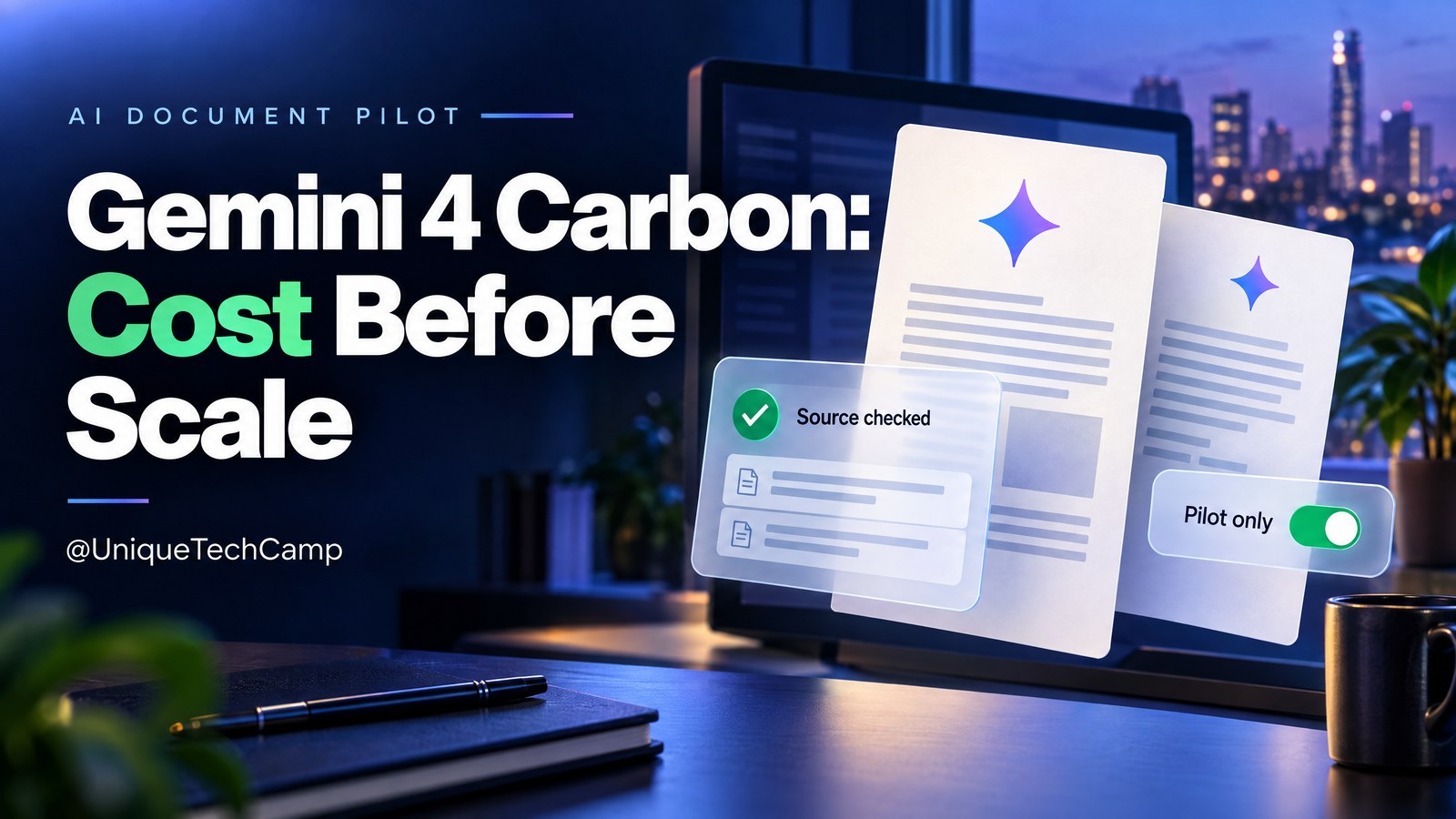
Your sales team has a customer brief, a supplier specification and a revised quotation. Before anyone promises a delivery date, somebody must check that the documents agree. A confident summary is not enough: the team needs the correct product, exclusions, dependencies and unanswered questions, with a route back to the source.
Google's Gemini 4 Carbon public-availability announcement ↗ makes that a timely workflow to examine. On 10 November 2026, Google expanded access to its deeper-reasoning model for paying developers and enterprises. For Kenyan SMEs, the useful question is not whether the newest model sounds impressive. It is whether a controlled document-comparison pilot produces a better reviewed answer at an acceptable total cost.
This guide proposes that pilot. It separates current access from marketing claims, explains a pricing change already scheduled for December, and keeps approval with your staff. It does not report a customer deployment or promise more sales.
What actually changed on 10 November?
Carbon was not invented this week. Google's announcement says selected cybersecurity defenders received access two weeks earlier. The new development is broader availability through the paid Gemini API and business routes. That distinction matters: an earlier restricted research release is not the same purchasing opportunity as a model an eligible developer can now evaluate.
The announcement links directly to Google AI Studio with Carbon selected ↗. This entry point requires Google sign-in. Before proposing a live project, confirm the model appears in your intended account, the correct billing project is attached and the account has sufficient quota. A public product announcement does not verify your individual account configuration.
Google's supported-regions page ↗ includes Kenya for AI Studio and the Gemini API. That is useful evidence of regional service availability, not a guarantee of every model entitlement, consumer-plan feature or particular billing arrangement. Keep the API pilot distinct from access through a consumer subscription.
Google positions Carbon for difficult, sustained reasoning. Its Carbon-specific developer guidance ↗ says it spends more thinking tokens and can take longer per turn than Argon. The same guidance presents Argon as the more efficient choice for much advanced day-to-day work. Do not upgrade routine extraction merely because a stronger model exists.
Choose a decision that deserves deeper checking
A useful starting case is a supplier-and-customer comparison for a business preparing a proposal. The output is an internal review sheet: what matches, what conflicts, what cannot be verified and what somebody must ask before issuing the final quote. Nothing is sent to the customer automatically.
For example, a Nairobi installation business might compare a customer requirement document against a supplier specification and the business's own draft scope. That is a proposed scenario, not a claim that Carbon has been tested successfully on those files. The owner must select an actual recurring problem and establish how staff currently resolve it.
Prefer a task where reading relationships across documents is the bottleneck. If the job is simply copying a clearly printed reference number into a form, a simpler extraction tool or existing software rule may be enough. Compare Carbon with that practical alternative, not just with another expensive model.
Exclude payment approval, medical interpretation, legal sign-off and autonomous purchasing from the first pilot. A model can flag a discrepancy without being authorised to decide what the business should accept.
Build a source-checked review sheet, not a polished guess
Start with a bounded pack of approved, redacted documents. Keep the originals unchanged and give each file a stable name and version. Record which customer request and supplier revision are current. Without version control, an apparently sensible comparison can be based on an outdated attachment.
Google's document-understanding documentation ↗ explains that PDFs can carry visual context, while different Office formats are processed differently. In particular, its current spreadsheet guidance says only the first sheet of a workbook is read. Do not assume an attached workbook's other tabs, formulas or visual layout were understood. Prepare the relevant sheet or source view explicitly.
Give the assistant a narrow instruction: compare only the supplied sources; quote or locate evidence for each material finding; separate facts from assumptions; and write “not established” when information is missing. Ask for a short review sheet with these fields:
- Requirement: the customer's actual requested outcome, tied to its source.
- Evidence: the matching supplier statement and file location, where present.
- Difference or omission: what conflicts, is excluded or remains ambiguous.
- Next question: the clarification a named staff member must obtain.
- Review status: unresolved, checked or rejected, assigned by a person.
These are requested output fields, not a claim that the model can guarantee accurate citations. Staff must open the cited passage, inspect surrounding context and confirm that the evidence really supports the finding. A reference to the right file with the wrong interpretation is still an error.
At UniqueTechCamp ↗, a sensible AI workflow conversation starts with this handoff: who reviews the evidence, who owns unanswered questions and who approves the customer-facing scope. The system should make those responsibilities visible rather than hide them behind a fluent response.
Price the work after the introductory period, too
The current official Gemini API pricing page ↗ lists Carbon's standard paid-tier input price as USD 2 per 1 million input tokens through 30 November 2026. Its output price, including thinking tokens, is USD 10 per 1 million output tokens for that period. Carbon is not available on the API's free tier.
From 1 December 2026, the listed standard rates become USD 4 per 1 million input tokens and USD 20 per 1 million output tokens. The launch announcement's footnote also identifies the end of the introductory period. A pilot justified only by November prices needs a second cost assessment before becoming routine production.
A token is a unit the service uses to measure processed content; it is not an invoice, page or completed customer job. Count actual billed input and output usage, including reasoning. Carbon and Argon can have the same published per-token rate while consuming different numbers of tokens to complete the same task.
Keep ordinary model charges separate from tool charges, hosting, integration, storage, support, human review, taxes and any currency-conversion costs. If the pilot uses search or other billable tools, check their current charging rules separately. Do not quietly include them in an estimate calculated only from standard input and output rates.
A small calculation, clearly labelled as an illustration
This is a hypothetical token-cost illustration, not measured usage or a quotation. Assume the entire pilot records 1,000,000 billed input tokens and 100,000 billed output tokens, with the latter already including thinking. Assume standard processing without caching discounts or separately charged tools.
At the introductory rates, the input component would be USD 2 and the output component USD 1, giving USD 3 in model-token charges. At the rates listed from 1 December, those same recorded totals would cost USD 4 and USD 2, giving USD 6 in model-token charges.
Those totals deliberately exclude implementation and the other cost categories above. They also do not predict how many documents Carbon will process: document complexity, file handling, repeated context, retries and reasoning depth change actual usage. Obtain a sample usage log before translating token prices into a cost per reviewed case.
For a buying decision, divide the complete pilot cost by the number of review sheets staff accept as usable. Keep rejected outputs and failed requests in the cost record. Otherwise a cheap-looking average can hide the time spent fixing mistakes.
Protect client information before connecting anything
Start with public, synthetic or carefully redacted material that your business is entitled to process. Remove unnecessary contact details, identity information, signatures and account identifiers. Keep live customer folders, email sending, CRM updates and financial systems disconnected during the first evaluation.
Google's paid-service data terms ↗ say paid-service prompts and responses are not used to improve its products. The same terms describe limited safety-related logging and potential transient storage or caching in countries where Google or its agents operate. “Not used for product improvement” does not mean no processing, no logs or local-only storage.
Review your chosen account, contractual terms, access controls, retention practices and any cross-border considerations before uploading real business documents. Kenya's ODPC regulatory-framework page ↗ links the Data Protection Act and related regulations. Use it as a starting reference for a qualified privacy review, not as a shortcut to declaring an AI setup compliant.
Treat instructions found inside a document as document content, not permission to change the workflow. A supplier attachment must not be able to tell the assistant to email files elsewhere, reveal credentials or ignore review rules. Keep credentials outside prompts and require human approval before any later external action.
Run the pilot in an order staff can audit
First, define success with the people who currently read the documents. Agree which mistakes would make an output unusable: a wrong product, an invented exclusion, a missed conflict, a changed amount or a source that does not support the statement. Write these rules before evaluating the model.
Next, create a test pack containing ordinary cases and known difficulties. Include a superseded supplier version, a missing delivery condition, a blurred scan, an ambiguous table heading and a requirement the supplier never addresses. Have staff prepare the expected findings independently so the model's answer does not become its own marking guide.
Then run the same pack through the current manual process and the proposed assistant workflow. Preserve the prompt, model identifier, relevant settings, file versions, output, token usage and review notes. Compare equivalent tasks. If you change the prompt or source preparation, record that change rather than mixing results into an unexplained average.
Finally, decide whether to stop, revise or expand. A demonstration that needs extensive rescue is a useful warning, not a reason to automate harder. Retain the manual route so a failed request, unavailable model or unsafe output does not block a customer response.
Measure accepted work, not the length of the answer
Track whether each material requirement was found, whether conflicts were correctly explained, whether citations were verifiable and whether the assistant admitted missing evidence. Record unsupported claims separately from harmless formatting differences. A beautiful review sheet with an invented commitment is not almost correct.
Measure staff review time as well as generation time. Note how long it takes to check the original files, repair errors and ask follow-up questions. If the assistant produces more material than a person can inspect sensibly, request a shorter output before assuming the workflow saves effort.
Keep a cost-and-quality record for Carbon and the realistic alternative. Use actual token consumption and apply the post-introductory rates when planning December operation. A deeper model earns its place only if its accepted work justifies the additional thinking, delay and review burden in your particular task.
Business outcomes come later. You may eventually examine proposal turnaround, avoidable rework and correctly scoped orders, but those depend on staff, suppliers and customers as well as the model. Do not attribute a sale to AI simply because an assistant helped prepare a document.
Frequently asked questions
Can a Kenyan small business try Gemini 4 Carbon now?
Google lists Kenya as supported for AI Studio and the Gemini API, and its announcement makes Carbon available to paying developers and enterprises. Confirm model access, billing and quota in the intended account. This article does not claim that your account has been tested or activated.
Is Carbon's introductory API price permanent?
No. The published introductory standard rates run through 30 November 2026, with higher standard input and output rates listed from 1 December. Price the same measured usage under both schedules, and recheck the official pricing before purchase or implementation.
Does a correct-looking citation remove the need for review?
No. A person must check that the source exists, is the correct version and supports the statement. Missing evidence, conflicting documents and unclear figures should remain unresolved until an authorised person obtains clarification.
Should Carbon replace every existing AI workflow?
No. Google's own guidance distinguishes Carbon's deeper reasoning from Argon's faster, lower-token approach. Keep a simpler tool when it meets the task's quality requirements. Choose on accepted output, total cost and operational risk, not model novelty.
Conclusion: approve the workflow, not the launch headline
Carbon's broader availability gives Kenyan teams another model to evaluate for demanding document work. It does not remove the need to prepare sources, protect information, verify claims and budget beyond an introductory offer. Begin with an internal comparison sheet, a defined reviewer and no automatic external actions.
Your next step is a short pilot brief naming the decision, approved source pack, expected findings, staff owner and acceptable failure conditions. Use evidence from that pilot to decide whether Carbon belongs in your business at all.
Need this built for your business?
Business owners can bring that brief to UniqueTechCamp's AI Solutions Desk ↗, review the matching AI Document Processing service ↗, and book a consultation ↗. Ask for a scoped document pilot with source checks, privacy boundaries, human approval and a clear separation between implementation work and ongoing model usage.
Deploy An Autonomous AI Lead Gen System Today
We engineer high-converting web applications with integrated 24/7 WhatsApp qualification bots and multi-channel follow-up drips.
Related Strategy Articles

CrowdStrike AI Kill Switch: SME Team Reviewing an Agent Safety Dashboard
A practical SME playbook for reviewing CrowdStrike’s AI Kill Switch, testing agent containment safely, measuring trade-offs and checking Kenya eligibility.

Microsoft Agent 365 Business Analytics: An SME Readiness and Value-Validation Guide
Microsoft Agent 365 Business Analytics is in Frontier preview. Here is how Kenyan and East African SMEs can validate access, usage cost, value, privacy and readiness before buying licences for a dashboard.
Canva AI Controls: SME Design Review and Human Approval on a Laptop
A practical Canva AI Controls workflow for Kenyan and global SMEs: control settings, human review, asset provenance, measurements, costs and limitations.

UniqueTechCamp Desk
Online • Reply < 5 mins