
DigitalOcean Cuttlefish: iPhone AI Approvals for Kenyan SMEs
Explore DigitalOcean Cuttlefish with a non-production iPhone approval rehearsal: proposal drafts, review ownership, preview limits and real cost checks.
UniqueTechCamp Editorial
Lead Systems Architect • UniqueTechCamp Engineering Unit
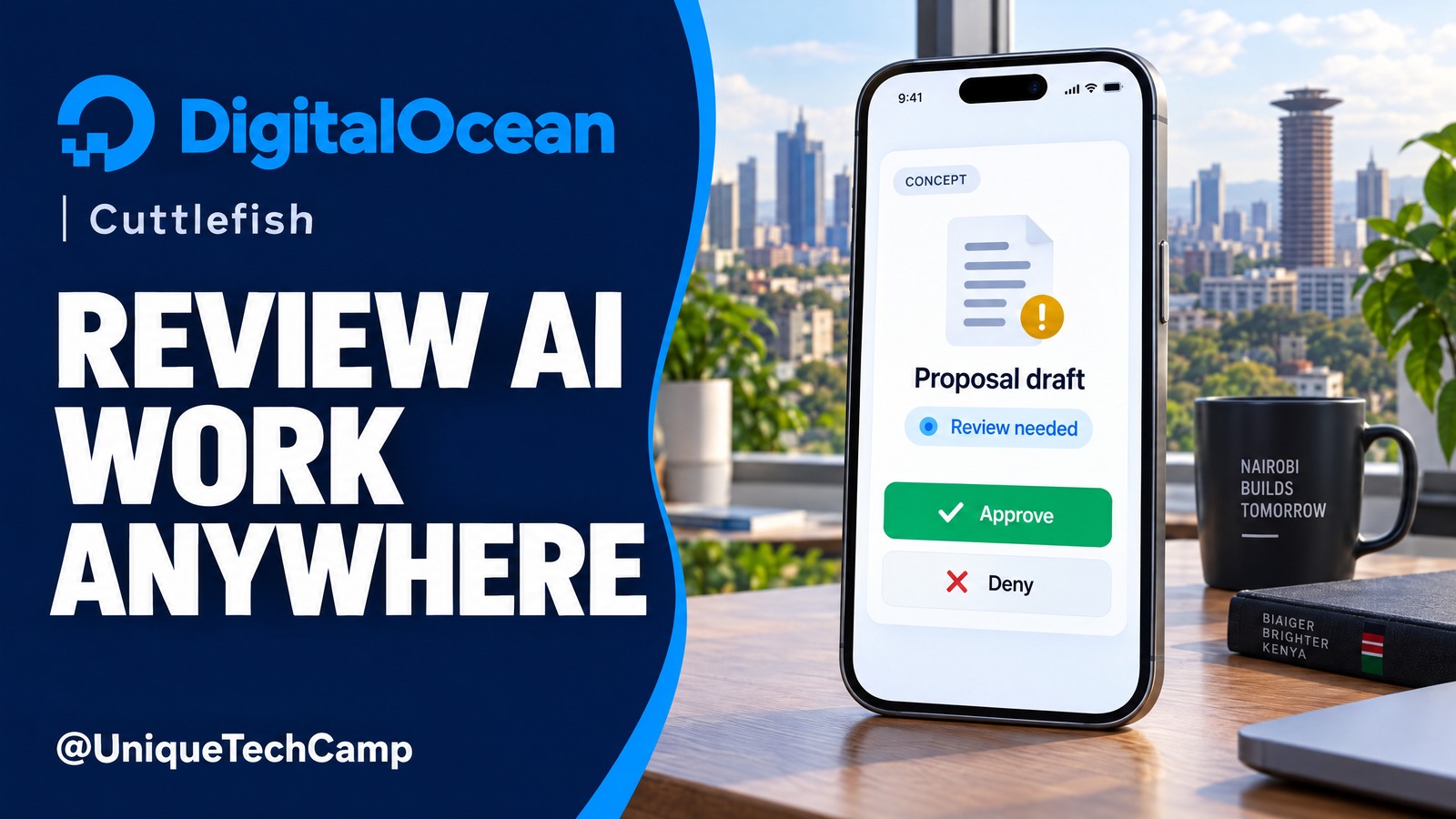
DigitalOcean Cuttlefish ↗ puts a live window into an AI agent’s work on an iPhone. For a Kenyan small-business owner, that sounds less like another chatbot and more like a practical question: can I review a proposed action when I am away from my desk, without handing an experimental system the keys to my business?
The answer is potentially useful, but only with firm boundaries. DigitalOcean announced Cuttlefish on 5 November 2026. It is a free iPhone client for supervising Managed Agents, not an agent that runs on the phone. Managed Agents and Cuttlefish are public previews, and Box Mount is a separate private preview. The Cuttlefish preview terms ↗ say the app is not recommended for production or sensitive workloads.
This article therefore describes one carefully controlled, non-production rehearsal. The service enquiry, source files and approved templates are wholly fictional. Nothing here involves a real lead, customer record, live quote, automated email, CRM write or final commercial commitment. The point is to understand where mobile approval may help an owner, and where human judgement must remain outside the preview system.
What DigitalOcean Cuttlefish actually is
The first product announcement is DigitalOcean’s 5 November launch announcement ↗. It describes a native iPhone app that lets a Managed Agents customer follow a session, approve or deny tool calls, steer a run, and stop it. The app is a control surface. The agent, sandbox and tool execution remain in DigitalOcean’s cloud environment.
That distinction matters. A locked, offline or closed app does not necessarily stop a running session. The cloud session can continue, while the phone reconnects later. Cuttlefish can stream replies, reasoning and tool calls; send corrections; pause or resume; browse, upload and share workspace files; manage checkpoints; and create environments. It can also notify an operator about approval requests, completion and failure.
Managed Agents is not one giant product with one safety button. Its documentation separates DigitalOcean Harness Runtime, which runs agents and arbitrary code in hardware-isolated microVM sandboxes with durable sessions, from Action Gateway, which provides a governed MCP endpoint and SDK for tools and connectors. Cuttlefish is the mobile operator handoff for sessions; it is not the same thing as Action Gateway’s general gateway controls. That is the useful angle for a small business: a person may be able to supervise a specific action from a phone, but the mobile app is not a universal policy gateway.
The Managed Agents documentation ↗ explains the service split, while the DigitalOcean product lifecycle guidance ↗ warns that a public preview may be paid, may have limited regional availability, may lack SLA credits and may not be fully production-ready. For this reason, treat every example below as a rehearsal, not an implementation recommendation for live work.
A safe Kenyan SME rehearsal: review a draft, not a real quote
Imagine a Nairobi field-service owner who is travelling between jobs and away from a laptop. The owner wants to test whether an agent can turn a fictional service enquiry into a coherent proposal draft using approved dummy material. The request might say that “Kijani Office Park” needs a routine inspection, but the name, scope, contact details and dates are invented. The agent’s only permitted output is a file called proposal-draft.txt in a sandbox workspace.
This is an explicitly engineered and custom workflow. It is not a bundled Cuttlefish proposal-writing feature; a developer must configure the drafting process. A desktop builder would prepare the environment, tools, dummy workspace files and permissions. The owner would then use the iPhone to watch the run and review a generated draft. There is no invented money in the example: a draft may contain placeholders such as “insert approved price after manual review”, rather than a made-up total.
A sensible rehearsal sequence is:
- The builder creates a disposable Harness environment and places only fictional enquiry text, an approved dummy service description and a blank proposal template in the workspace.
- The agent reads those files and drafts a response without sending anything, creating a proposal-draft.txt artifact in the sandbox.
- The owner receives a mobile update, opens the session and inspects the displayed action. If the agent requests a file write, the owner sees the full path and can allow or deny that specific action.
- The owner checks whether the draft follows the dummy template, then records feedback. The owner does not approve an email, CRM update, client notification, price publication or deletion.
- The final review and any release of a real proposal happen manually outside the preview system, on stable tools and against actual business procedures.
That could make mobile AI approvals relevant to a busy owner: the phone becomes a way to keep a controlled test moving, rather than a magic office in a pocket. The business value is only a possibility to measure in a controlled test. Compare the result with a simpler process in which a desktop operator creates a draft and hands it to the owner manually. If the phone adds confusion, delayed decisions or extra review work, the simpler process may be better.
For readers exploring a broader human-reviewed automation design, a relevant UniqueTechCamp AI Solutions Desk ↗ can be a starting point for discussing the workflow. It is not evidence that Cuttlefish includes a ready-made proposal system or that any particular integration has been verified.
Approvals are narrow, literal and still your responsibility
When an environment permission policy is set to ask, Cuttlefish can show the requested full command, file path or diff. Risk labels may flag recursive deletes, force-pushes, sudo or internet-to-shell scripts. A flagged request can require Face ID or a passcode. The Cuttlefish iOS supervision guide ↗ and permission configuration guide ↗ are essential reading before any test.
However, a permission decision covers the displayed action, not the truth of the document that led to it. Allowing a write does not prove that the draft is accurate, that the scope is complete or that a price is authorised. It also does not prove that every later action in a multi-step workflow is safe. Permission rules match literal commands and paths, not the owner’s intention, and adapter behaviour can differ.
The terms make the responsibility especially clear: instructions sent and actions approved in Cuttlefish have the same effect as actions taken through the Control Panel or API. They can run code, modify or delete files and use connected third-party tools. Risk labels and device authentication are conveniences, not a substitute for reviewing what the system is doing. Face ID confirms the operator’s identity; it does not certify content correctness or the safety of the whole workflow.
What the desktop builder must do first
The person building the rehearsal has more responsibility than the person holding the phone. Before inviting an owner to approve anything, the builder should define the dummy workspace, tool list, allowed paths, read/write rules, escalation route and stop procedure. The builder should also test an agent that produces a harmless draft, an agent that asks an unclear question and an agent that attempts an unapproved side effect.
Cuttlefish has practical limits. The iPhone cannot answer questions the agent asks; the operator must use doctl or dismiss the question. The app cannot create or edit Toolbelts, edit tools on an existing environment, directly connect provider accounts for Action Gateway, or perform deep code editing and in-depth code review. The phone is not a replacement for the desktop builder’s configuration and testing work.
Build explicit controls for no-action-without-approval, expiry and escalation, and test them. Do not assume that the native preview supplies your desired automatic timeout or business approval chain by default. Prepare a backup authorised operator who can use the desktop control panel, doctl or API. A stop can prevent later actions, but it cannot undo a side effect that has already completed.
Mobile checklist for a field-service owner
- Check the practical prerequisites: an iPhone on iOS 26.5 or later, a DigitalOcean team with Managed Agents access, and current Cuttlefish access.
- Check Kenya separately. The verified evidence does not establish Kenyan App Store availability, team eligibility or a Kenyan listing. Confirm the Kenyan App Store/account, your DigitalOcean team and the current regional-availability pages directly before planning a test.
- Expect delayed background notifications. They may arrive many minutes late, and notifications do not arrive after the app is force-quit.
- Do not treat force-quitting as stopping a session. Runs can continue in the cloud while the app is closed, locked or offline. Use the app’s stop or pause controls, or an authorised desktop/API route.
- Know the cost effect of pausing. Pausing suspends compute while preserving the workspace and conversation, but retained storage can still incur charges.
- Confirm who handles questions and approvals if the owner is driving, out of signal or unavailable. A backup operator should be tested, not merely named.
- Use only the dummy workspace in this rehearsal. Do not upload actual client records, sensitive documents, credentials or payment information.
Box Mount and the data boundary
The launch announcement names Box as a collaboration partner, but Box Mount is in private preview and is not a prerequisite for this rehearsal. Do not delay a dummy test while assuming Box is needed. Use local sandbox workspace files instead. If Box Mount is later evaluated, remember that syncing includes edits and deletions in both directions; a mistaken action can therefore have a wider effect than a single draft file.
The phone is not Kenyan data residency. According to the Cuttlefish privacy policy ↗, prompts, files and photos sent through the app go to DigitalOcean and the model provider selected by the environment. Sign-out deletes cached transcripts and lists from the device, but it does not mean cloud deletion. The policy does not promise a fixed short retention period.
Harness documentation says Services Content is processed in the United States regions where the services operate, while Insights telemetry is processed and stored in a US DigitalOcean region without regional localisation. DigitalOcean says it does not use Services Content, tool inputs or results, or agent outputs to train generalised AI models, but a selected third-party model provider’s terms govern information sent to that provider. Connected tools can also receive content. Nothing verified here establishes Kenyan residency.
This is not legal advice. Before any non-dummy use, an owner should review the official data-privacy documentation ↗, the Managed Agents preview terms ↗, provider retention terms, subprocessors, transfer mechanisms and relevant guidance from Kenya’s Office of the Data Protection Commissioner ↗.
Costs: free iPhone app, separate cloud bills
The app is free under its preview terms. That does not make the platform, model or provider usage free. Keep each product and unit separate. Harness Runtime lists CPU at USD 0.044 per vCPU-hour, memory at USD 0.0095 per GB-hour, session storage at USD 0.05 per GiB-month, public egress at USD 0.01 per GiB, and snapshots or checkpoints at USD 0.05 per GiB-month. BYOT template storage is also USD 0.05 per GiB-month. See the Harness Runtime pricing page ↗ for the current units.
Paused sessions stop compute charges, but retained storage still costs. Harness requires a positive prepaid balance and has no per-session or product spend limit. That makes an owner’s pause-and-review design relevant to cost control, but it is not a guaranteed budget ceiling. Model inference and external provider charges are separate.
If the rehearsal uses Action Gateway, standard SaaS and MCP tool invocations are USD 0.10 per 1,000 invocations. Other tool types can have different charges; code execution has separate compute and memory charges. Exa web search is USD 10.10 per 1,000 calls, while Exa web fetch is USD 3.10 per 1,000 calls. The Action Gateway pricing page ↗ keeps those units distinct.
Do not turn these rates into an invented proposal cost or income forecast. A real test also has builder setup, test, monitoring, phone, data and administration costs. The rational comparison is a measured rehearsal against a manual draft-and-handoff process, not a promise of faster sales or higher conversion.
Record reviewer minutes, approval waiting time, template errors, unnecessary permission requests and whether the backup operator resolves a blocked run. Check that denied actions stay blocked and that a disconnected phone does not silently authorise work. Compare those observations with the manual baseline. Only a repeatable improvement in the rehearsal would justify further evaluation; a polished draft or a fast notification alone is not a business case.
Frequently asked questions
Is DigitalOcean Cuttlefish an AI agent installed on my iPhone?
No. It is a free iPhone client and control surface for Managed Agents. The agent, session and tool execution run in DigitalOcean’s cloud, so the phone does not provide on-device processing or guarantee that a closed app has stopped a run.
Can a Kenyan SME use Cuttlefish for real customer proposals?
The evidence does not support that conclusion. Cuttlefish and Managed Agents are previews, and the terms do not recommend them for production or sensitive workloads. Kenya App Store availability, team eligibility and data residency are unconfirmed. Use a fictional rehearsal and release any real proposal manually on stable tools.
Does approving a tool call mean the proposal is safe or correct?
No. Approval authorises the specific displayed action, such as a command, path or diff. It does not check the truth of the draft, the completeness of the workflow, the accuracy of a price or the safety of later actions. The operator and builder remain responsible for review.
Do I need Box Mount to test this workflow?
No. Box Mount is a separate private preview and is not required for a dummy workspace rehearsal. Use sandbox files without Box. If Box Mount is later used, account for two-way edits and deletions, and test recovery before considering any real material.
Conclusion: treat mobile approval as a rehearsal capability
DigitalOcean Cuttlefish is interesting because it moves a human handoff to the iPhone without pretending that the phone is the agent. For a Nairobi owner, a carefully bounded test could explore whether reviewing a synthetic draft while away from a desk is more useful than waiting for a desktop handoff. The responsible conclusion is narrower than a launch headline: preview limitations, delayed notifications, literal permission rules, cloud processing, separate costs and manual release all remain part of the design.
Need this built for your business?
If you are a business owner planning a controlled workflow, start with UniqueTechCamp AI Solutions Desk ↗, request an appointment ↗, or review workflow automation services ↗. Any live design should begin with data boundaries, approval ownership, rollback limits and a small test—not a promise that a preview is production-ready.
Deploy An Autonomous AI Lead Gen System Today
We engineer high-converting web applications with integrated 24/7 WhatsApp qualification bots and multi-channel follow-up drips.
Related Strategy Articles

CrowdStrike AI Kill Switch: SME Team Reviewing an Agent Safety Dashboard
A practical SME playbook for reviewing CrowdStrike’s AI Kill Switch, testing agent containment safely, measuring trade-offs and checking Kenya eligibility.

Microsoft Agent 365 Business Analytics: An SME Readiness and Value-Validation Guide
Microsoft Agent 365 Business Analytics is in Frontier preview. Here is how Kenyan and East African SMEs can validate access, usage cost, value, privacy and readiness before buying licences for a dashboard.
Canva AI Controls: SME Design Review and Human Approval on a Laptop
A practical Canva AI Controls workflow for Kenyan and global SMEs: control settings, human review, asset provenance, measurements, costs and limitations.
UniqueTechCamp Desk
Online • Reply < 5 mins