
Cue AI Agents: Five Client Services Kenyan Small Businesses Can Test
Explore five practical ways Kenyan small businesses could use Cue AI agents to deliver research, reporting and operations services, with a pilot workflow, cost model and safeguards.
UniqueTechCamp Editorial
UniqueTechCamp Editorial Desk • UniqueTechCamp Engineering Unit

A small business does not need another list of AI prompts. It needs a repeatable service that saves a client time, produces something useful and can be checked before delivery. The launch of Cue, a standalone app for personal AI agents, creates one possible way to assemble that kind of service—but it does not remove the need for a clear brief, human quality control or a sensible budget.
Manus announced Cue on 28 September 2026 alongside Manus 2.0. Cue agents can have their own email, phone number, wallet and computer, and several agents can work towards a shared goal. At launch, Cue was in early access: the official announcement said it was free with an invitation code, with a limited number of codes available on a first-come basis. It listed web, desktop and mobile access, with iOS to follow App Store review. Check current access before offering a client a delivery date. Read the official Manus 2.0 and Cue announcement. Bloomberg independently reported the launch as part of Manus’s expansion into AI agents. Bloomberg’s report
Five services a small team could test
1. A weekly market-watch brief. A researcher agent gathers changes from a client-approved list of public sources. A second agent groups the findings by topic and drafts a concise brief. A human checks each link, date and claim before the client receives it. Possible customers include a distributor tracking supplier announcements or a hospitality group monitoring events and local visitor information.
2. Product-catalogue maintenance. When a client supplies an approved product sheet, an agent can draft consistent descriptions, FAQs and update notes. A staff member checks specifications, prices, availability and any regulated claims against the source file before anything is posted. The offer is a maintained catalogue pack, not an unattended publishing bot.
3. Event and supplier research. For a conference organiser, retailer or professional-services firm, agents can collect venue, supplier or speaker options against a written brief. The client receives a comparison with sources and unresolved questions, rather than an unexplained “best choice”. Booking, negotiation and payment remain human decisions.
4. Internal process documentation. A business can turn approved, non-sensitive process notes into a first draft of a checklist, handover guide or staff FAQ. The project includes version control and an owner who confirms the instructions are current. Do not let a generated guide quietly become policy without approval.
5. Monthly evidence packs. An agent team can organise public announcements, customer-approved feedback themes or project updates into a dated evidence pack. A consultant can add interpretation and a short meeting. Keep the source links so the client can distinguish what was observed from what is recommended.
A practical first workflow: the weekly market-watch brief
Start with one customer and one narrow question, such as, “What changed in the public product and pricing pages of these five suppliers this week?” Agree the source list, reporting period, exclusions and delivery format in writing. Avoid collecting personal data when public business information will do.
Next, have one agent collect dated source links and short factual notes. Ask another to group the notes into a standard template: confirmed changes, possible implications, open questions and source links. If agents can hand work to each other in Cue, use that to divide research and drafting—not to replace the final check. A reviewer opens the cited pages, confirms that each statement is supported and removes anything that is speculative or out of date.
Deliver a fixed scope: for example, one weekly brief, a source log and a short review call. Tell the client that the work is agent-assisted and that a person verifies the final report. Record corrections and client feedback to improve the checklist, not to claim an outcome you have not measured.
Price the work from real costs, not assumed AI savings
Cue’s launch announcement described early access as free with an invitation code; it did not publish a long-term commercial price schedule. Do not promise that the tool will remain free or quote a subscription price you have not checked. Include the cost of staff review, client meetings, data or phone use, any paid tools, tax and rework in your quote.
A simple internal cost floor is:
setup and delivery hours × your loaded hourly cost + recurring review hours × loaded hourly cost + direct tool and communication expenses.
For illustration only, if your own loaded cost is KSh 2,000 per hour, a six-hour setup and a four-hour monthly review cost KSh 12,000 and KSh 8,000 respectively before other expenses. Those are arithmetic examples, not Kenyan market rates, a client price or a forecast of profit. Replace the assumed rate with your actual payroll, contractor and overhead costs, then price the defined deliverable and revision limit.
Measure quality and protect the client
Track time spent per brief, the share of claims that survive source checking, corrections after delivery, missed or irrelevant findings, on-time delivery and the reviewer’s hours. Also record which agent actions needed intervention. A faster first draft is not valuable if it creates more checking work than it saves.
Before connecting accounts, agree which data may be used, who can see it and how long it is retained. Kenya’s Data Protection Act requires personal data to be handled lawfully, fairly and transparently, for a specific purpose, and limited to what is necessary. It also regulates transfers of personal data outside Kenya; the Office of the Data Protection Commissioner’s 2026 guidance discusses safeguards and accountability for cross-border transfers. Review the law and guidance with the client’s data-protection lead before using personal or confidential records in a hosted AI workflow. Kenya Data Protection Act, 2019 · ODPC cross-border data transfer guidance
Treat an agent’s email, phone and wallet as capabilities that need explicit limits. Use public or test data first. Keep client commitments, external messages, bookings and payments behind named human approval. Check source rights and the client’s permission before reusing documents or publishing generated material. If Cue is still invite-gated for your market, do not sell access you do not have.
Make the pilot easy to check
Treat Cue as a research and drafting assistant, not as the person accountable for a client’s advice, quotation, booking or public statement. The official Cue AI Agents product documentation describes configuring an agent with approved content and instructions, testing it and choosing when to go live. Keep any customer-facing message, booking or other external action behind a human approval gate until the client has authorised and tested that workflow.
Write a one-page service brief before the first run. Name the client, the question, the approved sources, the reporting period, the output format and the person who signs off. Add an exclusions line: for example, no private customer records, no legal or medical advice, no purchase, no payment, no contact with a supplier and no publication without approval. This makes a small service sellable because the client can see what is included and the reviewer can see what must be stopped.
For a market-watch brief, keep an evidence ledger beside the prose. Each row can contain the source URL, page title, date accessed, short excerpt or data point, the agent’s proposed statement, the reviewer’s decision and the final location in the report. A source that has changed should be marked as changed rather than silently replaced. If two public pages disagree, show the disagreement and ask the client how it should be handled; do not make the agent choose a winner from tone or confidence.
Use approval gates for every external action
A practical pilot can have three gates. At the input gate, a named person confirms that the files and accounts are within scope and that the client has permission to use them. At the evidence gate, a reviewer checks citations, dates, calculations, spelling of names and any statement that could affect a customer, supplier or employee. At the delivery gate, the client owner approves the final document and any message that will leave the business. Keep the approval record with the version that was reviewed.
Do not measure the pilot only by how quickly a draft appears. Compare reviewer time with the time the old process took, and record factual corrections, unsupported claims, missed sources, duplicate findings and late deliveries. A simple error register can label each correction as a wrong fact, stale page, unclear instruction, missing caveat or formatting problem. After several runs, use the pattern to improve the brief and source list. Do not turn a small, unmeasured sample into a claim about accuracy, savings or revenue.
Cue’s own customer-service material describes agents answering from a business’s documents and handing conversations to a person when they cannot resolve them. That is a useful design pattern for these services: make uncertainty visible and give it a human route. The Cue AI Agents product documentation also describes connecting approved content, custom instructions, testing and then going live. For a Kenyan client, test the exact source files, terminology, currencies, dates and channels that the client uses rather than assuming that a demonstration proves suitability.
For a Kenyan business testing a low-risk AI-agent service, UniqueTechCamp can help map the workflow and approval points before client information is connected.
Keep personal data out unless it is necessary
Public supplier pages are usually enough for a first market-watch pilot. If a later service needs customer feedback, remove names, phone numbers, email addresses, account identifiers and free-text details that are not needed for the question. Keep a separate mapping file only when there is a documented reason, restrict it to the authorised reviewer and set a deletion date. Do not paste a whole spreadsheet into a hosted tool merely because the agent can read it.
The Office of the Data Protection Commissioner states that people have rights to be informed about use, access their data, object to processing, correct false or misleading data and request deletion of false or misleading data. Its data-subject rights and principles page also sets out purpose limitation, data minimisation, accuracy and storage limitation. Build those ideas into the service brief: say what is collected, why it is needed, who can see it, how long it is kept and how a request is escalated.
A hosted AI workflow may involve a transfer outside Kenya. The ODPC’s cross-border data-transfer guidance says that cloud processing with servers outside Kenya is a cross-border transfer and recommends due diligence, monitoring, access controls, logging, encryption, multi-factor authentication, data-processing agreements, retention rules and impact assessments where applicable. A small provider should not promise that a tool is compliant from a product name alone. Ask where data is processed, what the provider and sub-processors do with it, how access is logged, how deletion works and how the client can retrieve records.
Design a safe handover
At the end of each run, give the client the deliverable, the source ledger, unresolved questions, the approval record and a short note describing what the agent did. State which parts were checked by a person. If an error is discovered after delivery, correct the document, tell affected recipients where appropriate and record the cause. A client should be able to distinguish an observed fact, an interpretation and a recommendation without guessing.
For a new workflow, map four risks before connecting an account: inaccurate output, unauthorised disclosure, an unintended external action and service interruption. Give each risk an owner, a prevention step and a response step. For example, a reviewer can block publication, a least-privilege account can limit access, an approval queue can stop messages and an exported source ledger can keep the work usable if access changes. The NIST AI Risk Management Framework is a voluntary framework for incorporating trustworthiness into the design, use and evaluation of AI systems; its Govern, Map, Measure and Manage structure is a useful checklist for this review, without being a Kenyan legal certification.
Start with one low-risk client, one output and a short review cycle. Expand only when the evidence shows that the service is understandable, reviewable and worth the human time it consumes. If the client cannot name the approving person, the permitted data or the correction route, the pilot is not ready for live information. That discipline lets a small team test an agent-assisted service while keeping responsibility, privacy and the final decision with people.
The next step
Choose one low-risk deliverable a client already asks for, define its sources and review standard, then run a small paid or internal pilot with a written scope. UniqueTechCamp can help a business assess where an agent-assisted workflow fits its digital operations, what data it should touch and how to measure whether it is worth keeping.
Deploy An Autonomous AI Lead Gen System Today
We engineer high-converting web applications with integrated 24/7 WhatsApp qualification bots and multi-channel follow-up drips.
Related Strategy Articles
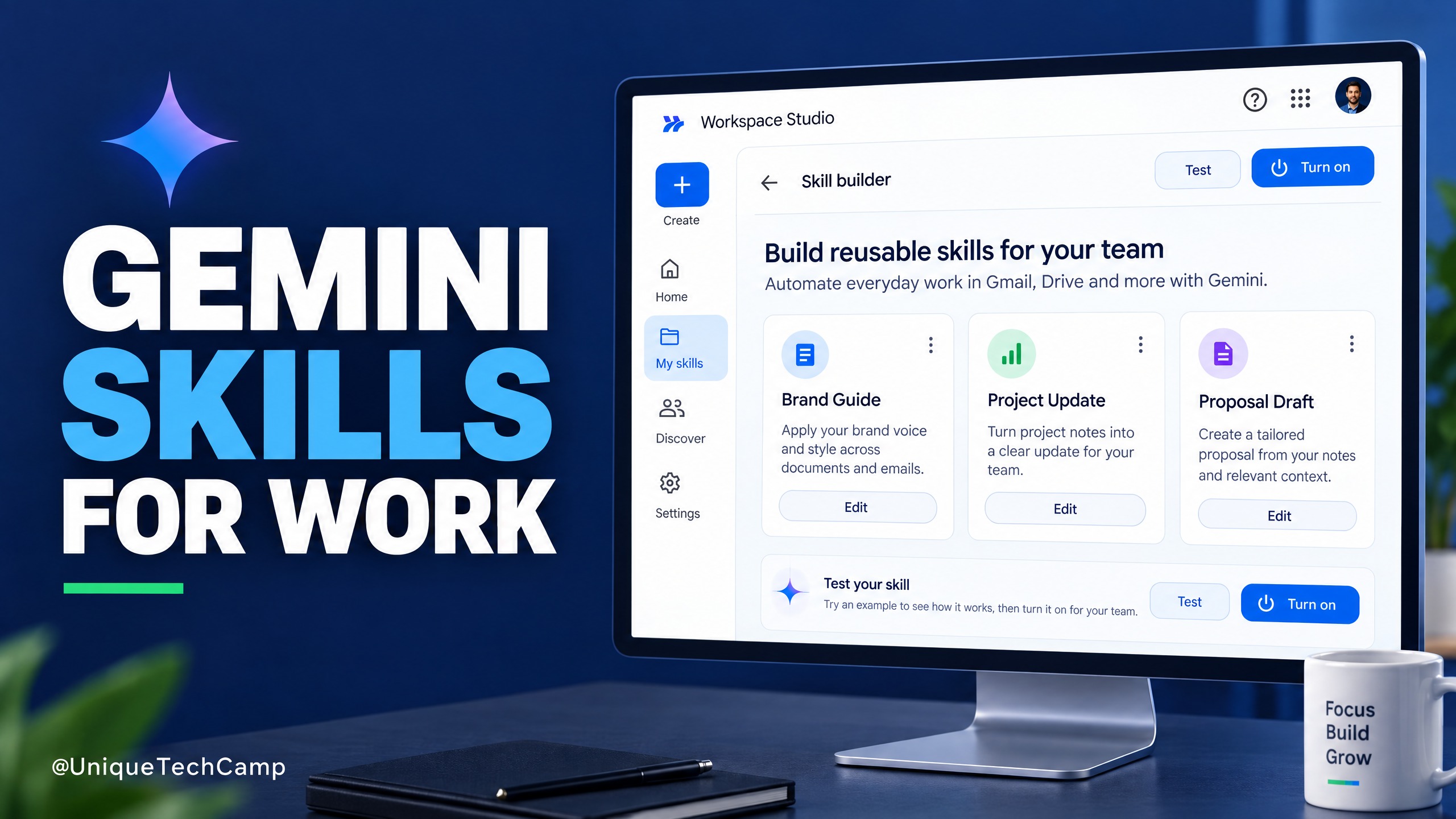
Google Workspace Skills: A Practical Guide for SMEs
Google Workspace Skills let teams reuse custom instructions across supported Workspace apps. This practical guide explains the rollout, eligibility checks, a safe pilot workflow and what to measure before expanding.

Cloudflare Clef: A Practical AI Triage Guide for SMEs
Cloudflare Clef turns support messages into bounded decisions rather than free-form answers. Here is a practical way for SMEs to test it, measure value and keep a human in control.
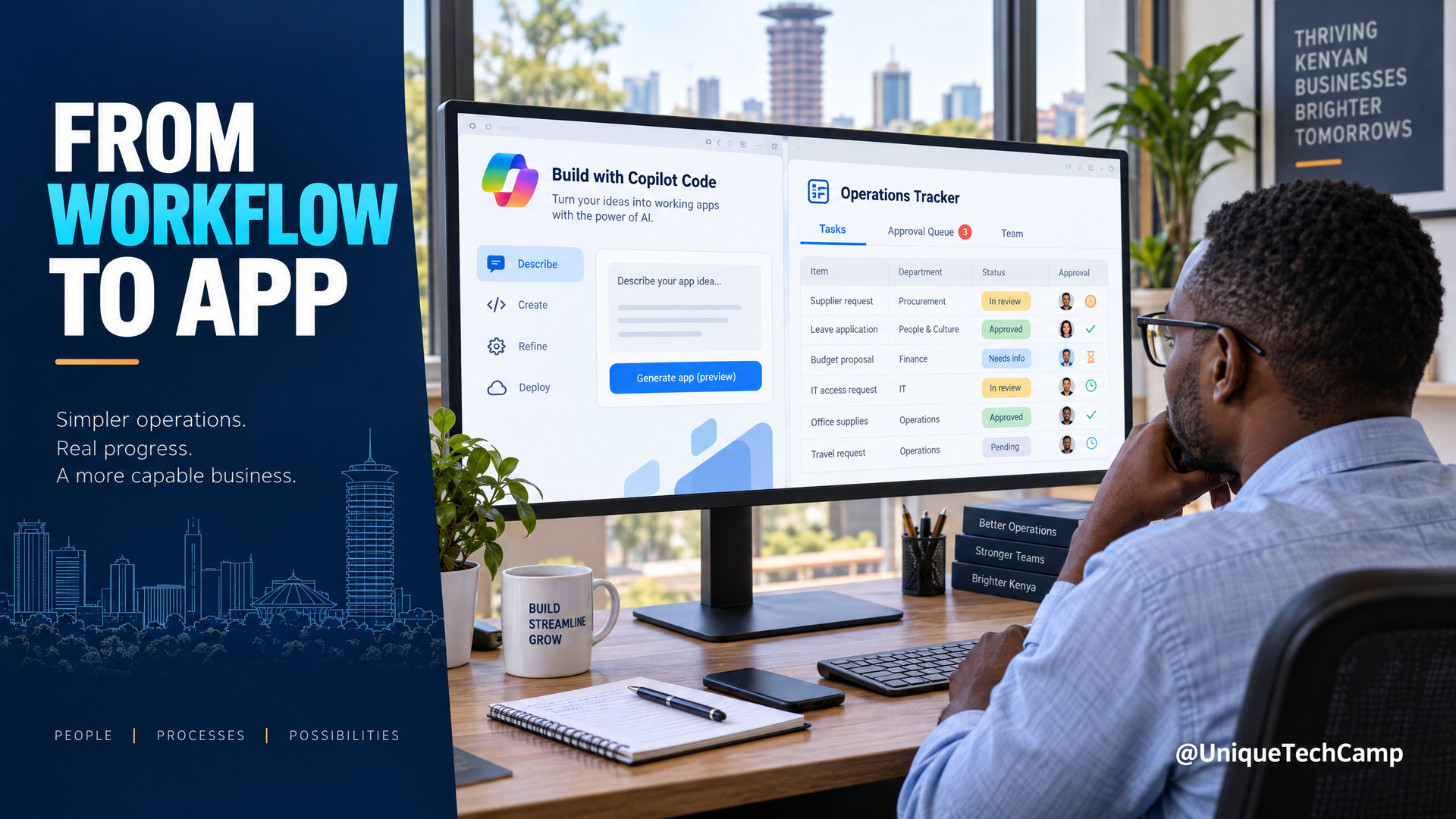
Microsoft Copilot Code for SMEs: A Practical Workflow-to-App Offer
Microsoft Copilot Code is still rolling out. Learn a practical workflow-to-app service for Kenyan SMEs, with verified pricing, usage limits and a safe pilot plan.

UniqueTechCamp Desk
Online • Reply < 5 mins