
Cloudflare Clef: A Practical AI Triage Guide for SMEs
Cloudflare Clef turns support messages into bounded decisions rather than free-form answers. Here is a practical way for SMEs to test it, measure value and keep a human in control.
UniqueTechCamp Editorial
Lead Systems Architect • UniqueTechCamp Engineering Unit
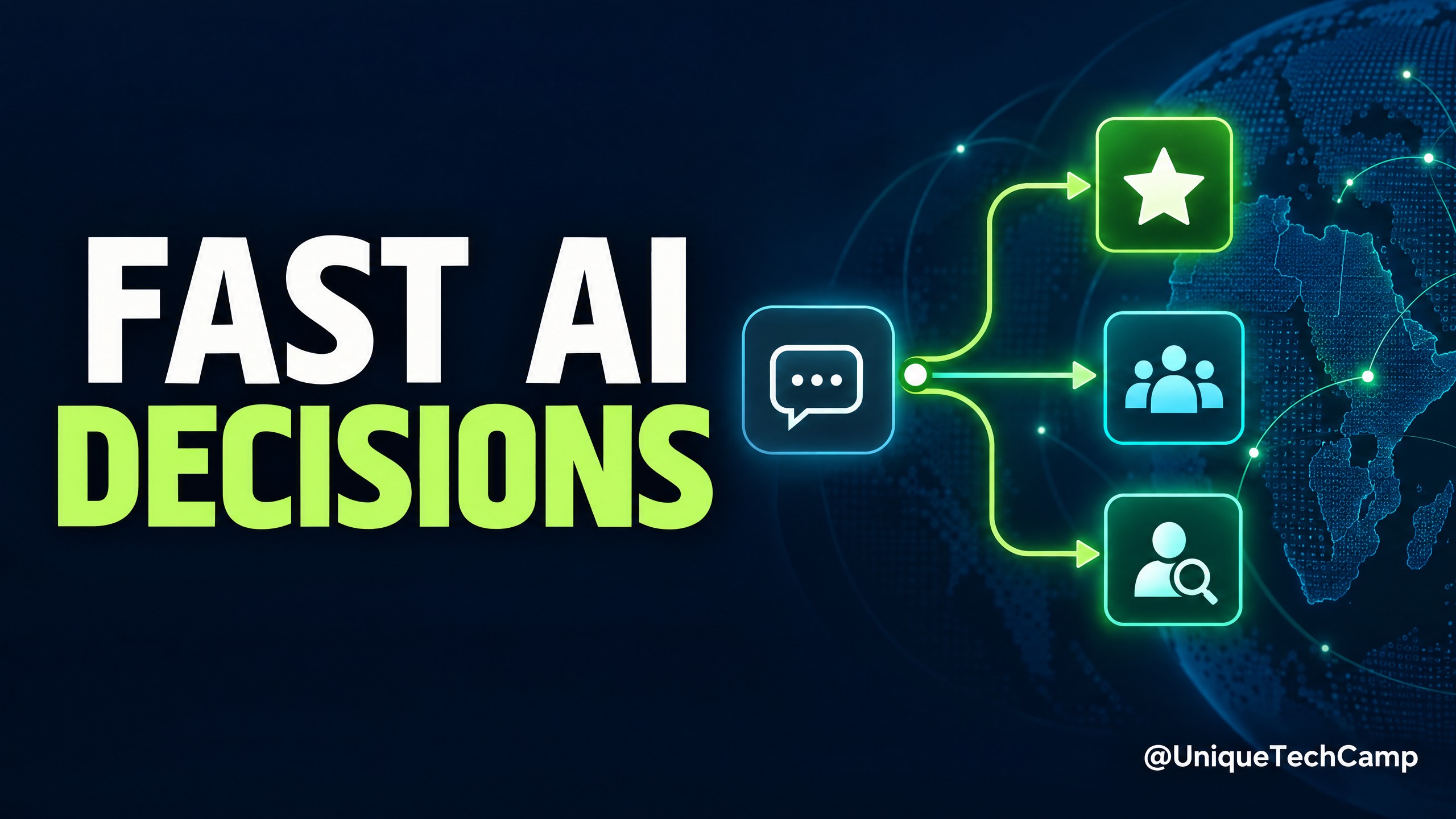
Why support triage is a practical starting point
A busy support inbox creates a repeated business problem: someone must read each message, decide how urgent it is, identify the right team and choose what should happen next. When the queue grows, customers wait while staff repeat the same first decision. That is an operations problem before it is a chatbot problem.
Cloudflare Clef is designed for that kind of bounded decision. Instead of writing an open-ended answer, it takes a case description and returns choices such as “billing”, “technical support” or “needs urgent review”. For a small business, the opportunity is not to remove every person from support. It is to make routine routing more consistent, then reserve staff attention for ambiguous or sensitive cases.
The practical question is whether the model can make one narrow decision reliably on your real queue, at a cost and risk your team can accept. This guide sets out how to find out.
What Cloudflare Clef does—and what it does not
Cloudflare announced Clef and Clef-flash on 1 October 2026, making both available through Workers AI. The company describes Clef as a 27-billion-parameter decision model and Clef-flash as a smaller, faster 9-billion-parameter version. The models accept a state, such as a support message with relevant order context, and answer typed questions from a defined set. Cloudflare’s release note for Clef on Workers AI and launch explanation describe the intended pattern.
That interface is different from asking a general language model to “read this ticket and do the right thing”. The Clef model card documents yes-or-no, choice and scoring questions, with up to 64 questions in one request. A business could ask whether a message is urgent, which approved queue should receive it, and whether a human should review it. The result stays within the options you define.
This does not make the answer automatically correct. It means the system has a narrower job and a more predictable output shape. Clef is not, by itself, a customer-service chatbot that drafts a polished response, checks your order database, approves a refund and sends an email. Those steps require separate systems and controls. A useful first pilot stops at classification and routing.
Cloudflare also publishes open model weights under the Apache 2.0 licence, while the hosted route is Workers AI. Open weights give technical teams another deployment option, but they do not make infrastructure, security, integration or maintenance free. Independent reporting by The Register says the reported local hardware requirements are substantial: 85 GB of video memory for Clef and 41 GB for Clef-flash under a single-concurrency, 64K-context assumption. Most SMEs should compare the total operating burden, not treat an open licence as a reason to self-host by default.
Where the business case may be strongest
Start where a wrong first route wastes time but does not itself make a high-impact decision. Examples include sending an online shop’s delivery question to fulfilment rather than sales, flagging a service interruption for the on-call team, or separating account-access requests from general product questions. A message can also be scored against a written checklist, such as whether it contains enough detail for a technician to investigate.
The gain to investigate is not a promised percentage reduction in handling time. It is whether better first routing reduces avoidable re-reading, transfers and queue delays without increasing missed urgent cases or customer frustration. A faster but inaccurate route can make the whole experience worse.
A workable first use case has three traits. The categories are already understood by the people who handle them. Someone can label a sample of past cases consistently. And a wrong decision can be caught before it triggers a refund, account lock, safety response or other consequential action.
Avoid starting with autonomous decisions about eligibility, complaints, credit, employment, medical issues, legal questions or access to essential services. A scoring answer is still a model judgement, not a policy authority. Keep those cases with trained staff unless the organisation has a separate, properly reviewed basis for automation.
A six-step pilot for a support queue
- Choose one queue and name the decisions. Pick a contained source, such as an email inbox or help-desk category. Write down the current first-pass decisions in ordinary language: destination team, urgency, missing information and whether a person must review it. Do not begin with “automate support”; that is too broad to test.
- Define the allowed outcomes and the escape route. Keep the initial categories short and mutually understandable. Include an explicit “unclear—human review” option. Decide which requests must always go to a person, including threats, suspected fraud, safety concerns and messages that mention several issues at once. Tell staff that the model recommends a route; the business’s approved policy remains in force.
- Prepare a representative, minimised test set. Ask experienced agents to label a sample of previous tickets using the new categories. Include routine cases, edge cases, incomplete messages, spelling variation and the languages your customers actually use. For a Kenyan or East African queue, test English, Kiswahili and mixed-language messages if they occur. Do not assume performance in a language from a product launch announcement: measure it on your own authorised examples. Remove names, phone numbers, payment details and unrelated conversation history unless they are genuinely required for the decision.
- Run the model in shadow mode. Connect a limited test to a copy or safe staging queue. The model can propose a destination while staff continue to make the actual decision. Record the proposed category, the human’s final category, any correction and the reason. Use stable case IDs rather than putting customer identifiers into analytics where they are not needed. Keep the prompt and decision rules versioned so that a change can be tied to a change in results.
- Set acceptance rules before looking at the score. Overall accuracy can hide an important failure. Measure precision and recall for each queue, and give special attention to urgent messages that the model wrongly marks as routine. Track how often staff override a route, how often the answer is unclear, and how long tickets wait before the right team receives them. Review examples with the people who own the queue, not only the engineer who connected the API.
- Roll out gradually with a stop switch. If results are acceptable, let the model route only the categories that passed review. Keep a human approval step for exceptions and any action that changes money, access or a customer’s rights. Monitor the same measures after launch. If routing quality falls, a connector fails or a category changes, revert to the existing human process while the issue is investigated.
A decision model can return scores or probabilities, but those are not automatically calibrated confidence values. Set any automation threshold using your own labelled data and the cost of mistakes. If the system cannot distinguish between two queues, sending the ticket to review is a valid result—not a failed demo.
Measure service quality and full cost
Before the pilot, record the current baseline for a comparable period. Useful measures include the share of cases that reach the right team first time, correction and escalation rates, the number of missed urgent cases, median time to first useful response, and backlog age. Report results by category and, where the sample allows, by language or message type. Keep the metric definitions fixed so a later change does not make the comparison misleading.
A practical operating dashboard can show four things together: model suggestion, human decision, eventual resolution route and time in queue. This lets the operations lead see whether faster categorisation actually improved service. It also reveals where a rule needs clarification or where the taxonomy has become outdated.
Cost has more than one line. Cloudflare’s current Clef model card lists $0.24 per million input tokens; the Clef-flash model card lists $0.09 per million input tokens. For illustration, a run of ten million input tokens would cost $2.40 for 10 million input tokens on Clef or $0.90 for 10 million input tokens on Clef-flash at those rates. That is not a per-ticket quote: the actual prompt size, usage pattern, model choice and applicable platform plan matter, and engineering, ticketing, logging and human review sit outside that arithmetic. Check the live Workers AI pricing page before committing.
Cloudflare says Workers AI includes 10,000 Neurons per day at no charge and lists $0.011 per 1,000 Neurons above that allowance on Workers Paid. The page says the neuron and token price columns are equivalent units; above the free allocation, Workers Paid is required. Do not assume the daily allowance corresponds to a fixed number of Clef tickets. Meter a representative test, add the rest of the platform and labour costs, then use a monthly cap or alert that fits the business’s budget.
Cloudflare’s launch post reports strong speed and benchmark results. Treat those as vendor claims rather than a business guarantee. At publication, The Register noted the results had not yet been independently reproduced on the official Decision Index. The Register’s independent coverage and The Decoder’s report are useful context, but neither substitutes for testing your own queue.
Handle customer data before connecting an API
Support messages often contain personal information even when a business does not ask for it. Start by deciding what the classifier actually needs. If the routing choice can be made from the message body and a broad product category, do not send an entire customer profile, payment history or unrelated conversation by default. Set retention, access and logging rules before connecting a live inbox.
Kenya’s Data Protection Act sets principles that include lawful, fair and transparent processing, limiting data to what is necessary, and safeguards for transfers outside Kenya. The Office of the Data Protection Commissioner’s cross-border transfer guidance discusses minimisation, security, due diligence and accountability. These are reasons to map the data flow and check current vendor terms, not a substitute for advice on the organisation’s specific obligations.
For a pilot, document which fields leave the ticket system, which provider processes them, how long logs remain, who can inspect them and what happens if a customer asks for correction or deletion. Use synthetic or redacted cases while building where possible. Have the person responsible for privacy or security review the design, especially if the queue includes sensitive information or the system may affect people in a significant way.
The model can also inherit uneven quality from historical labels. If one team has historically marked certain customers as “difficult” or routed messages inconsistently, repeating those labels at scale will not fix the underlying process. Check disagreements, give staff a way to challenge outcomes and make sure a human can see why the ticket was sent for review.
Package the work around the workflow
For a digital-services provider or an internal operations team, a sensible offer is a bounded “support routing assessment and supervised pilot”. The deliverable is not a promise that AI will save a certain number of hours. It is a mapped queue, a clear decision taxonomy, an authorised evaluation set, a measured baseline, a working route with human override, and an agreed review plan.
A provider can separate the engagement into discovery, integration and ongoing care. Discovery covers the queue, categories, exceptions and data flow. Integration covers the model call, ticketing connector, error handling and staff view. Ongoing care can cover sampled quality checks, category changes, access reviews and monitoring of cost and service metrics. Scope and price should reflect the client’s existing systems, risk and support needs; keep cloud usage visible rather than hiding it inside an unexplained “AI fee”.
For a Nairobi-based team considering this work, UniqueTechCamp offers an AI Solutions Desk where a business can discuss how to scope an AI workflow. The useful starting material is modest: the queue’s current categories, an anonymised set of representative cases, the team’s escalation rules and the service measures the business already tracks.
A business buying the work should ask for a demonstration on its own authorised examples, a written explanation of where the human review remains, an estimate of platform and maintenance costs, and a way to switch back to the existing process. A supplier should be comfortable saying “this category is not ready for automation” when the evidence points that way.
FAQs
Is Cloudflare Clef a chatbot?
No. Clef is designed to answer bounded decision questions, such as yes/no, choose-a-category or score against criteria. A separate system is needed to compose customer-facing replies or perform actions. A safe first use is routing a ticket, not letting a model make every downstream decision.
Is Cloudflare Clef free for a small business?
There is a Workers AI free allowance, but it is not an unlimited or fixed number of support tickets. Cloudflare lists model usage rates and a daily Neuron allocation, with Workers Paid required above that allocation. Check the current account terms and measure real usage; integration, monitoring and staff review also cost time and money.
Can Clef reliably classify Kiswahili or Sheng messages?
Do not assume that from the model’s multimodal description. The public product material does not establish a service-level guarantee for your particular mix of English, Kiswahili, Sheng or other languages. Include authorised local-language examples in the test set, compare outcomes by language and route uncertain messages to a person.
Should an SME let Clef approve refunds or close complaints automatically?
Not as the first pilot. Keep decisions that affect money, access, safety or a customer’s rights behind an approved policy and a human review. Once a narrow recommendation has been measured, the business can assess any further automation separately and document the additional controls it needs.
Conclusion
Cloudflare Clef is worth evaluating when the work is a repeated, bounded decision and the business can define good and bad outcomes. Its value for an SME will depend less on a launch benchmark than on the quality of the categories, representative local tests, a safe fallback and the service measures that matter to customers. Start with one queue, run it beside human decisions, and expand only where the evidence supports it.
Need this built for your business?
If support messages are being transferred repeatedly or urgent cases are hard to spot, map the current process before buying a model integration. Talk through the workflow with UniqueTechCamp’s AI Solutions Desk or book a free strategy consultation to scope a human-checked pilot and decide whether Clef—or a simpler rule-based route—is the right fit.
Deploy An Autonomous AI Lead Gen System Today
We engineer high-converting web applications with integrated 24/7 WhatsApp qualification bots and multi-channel follow-up drips.
Related Strategy Articles
Google Workspace Skills: A Practical Guide for SMEs
Google Workspace Skills let teams reuse custom instructions across supported Workspace apps. This practical guide explains the rollout, eligibility checks, a safe pilot workflow and what to measure before expanding.
Microsoft Copilot Code for SMEs: A Practical Workflow-to-App Offer
Microsoft Copilot Code is still rolling out. Learn a practical workflow-to-app service for Kenyan SMEs, with verified pricing, usage limits and a safe pilot plan.
Gemini 4 Argon for Cybersecurity Teams: Build an AI-Assisted Patch-Readiness Service Only If You Have Access
Google has announced Gemini 4 Argon for complex work and defensive cybersecurity, but access remains restricted. Learn what an authorised, human-checked patch-readiness service could look like for East African software teams.
UniqueTechCamp Desk
Online • Reply < 5 mins