Checked against the announcement and policy pages available on 5 October 2026.
A new advertising channel can appear inside a tool customers already use to explore products, which makes it tempting to treat a launch as immediate growth. But an announcement is not yet a Kenyan campaign that a local business can buy, measure and fulfil. The useful questions are what has launched, what remains a test, and whether the customer journey is ready if access opens.
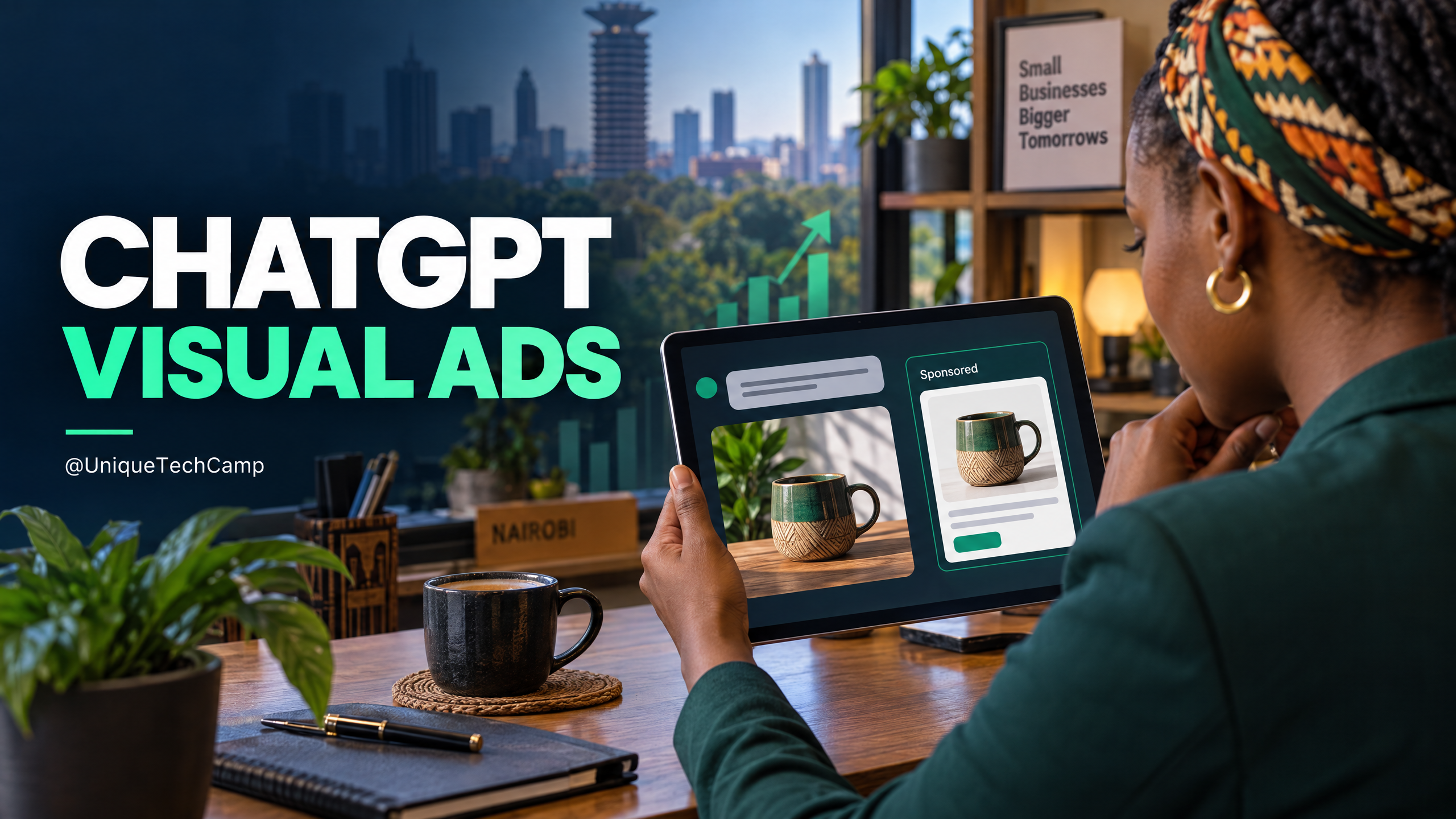
On 5 October 2026, OpenAI announced a new visual ad format for ChatGPT alongside expanded measurement and brand-suitability work. The company says the new format will first be tested during image generation, with clearly labelled ads kept separate from the image being created. OpenAI says the ads will not influence ChatGPT’s answers. Testing is planned for later in October with an initial group of advertisers in the United States; the announcement does not give a Kenyan launch date or a public price schedule.
 alongside expanded measurement and brand-suitability work. The company says the new format will first be tested during image generation, with clearly labelled ads kept separate from the image being created. OpenAI says the ads will not influence ChatGPT’s answers. Testing is planned for later in October with an initial group of advertisers in the United States; the announcement does not give a Kenyan launch date or a public price schedule.
This is a planning topic, not a reason to promise more enquiries or shift proven media spend. Here is what Kenyan SMEs can prepare without buying access, and what to verify before treating ChatGPT Ads as an acquisition channel.
What OpenAI announced—and what it did not
The new format is visual: OpenAI describes images that can show product inspiration, how an item is used, or the experience associated with a service. The company says the first test will run during image generation in ChatGPT. That is different from claiming that an advertiser can alter the generated picture or pay to change an AI answer. OpenAI says the ad will be labelled, remain separate from the generated image and not affect the answer. Independent coverage from TechCrunch and BleepingComputer reports the same initial US-only test and separation from generated content.
The announcement also describes work on conversion-data integrations, attribution partners, geo-based experiments and brand-suitability evaluation. Those are measurement and assurance developments, not proof that every advertiser will receive the same reporting or that a campaign will generate incremental sales. OpenAI’s advertiser page offers a sign-up route and outlines a simple campaign workflow, but it does not publish a rate card or confirm that Kenyan businesses can join the visual-format test. Treat “sign up” as an invitation to check eligibility, not as evidence that the new format is available in Nairobi.
Why a Kenyan business might pay attention
People use conversational tools to compare options, clarify needs and explore ideas. A relevant visual can explain how a product or service works. OpenAI identifies consumer categories such as household goods, local services, travel, education and digital products as initial advertising areas. For Kenyan businesses, that is a reason to monitor the channel, not a forecast of reach, qualified leads or revenue.
The commercial idea is familiar: show a useful offer in a relevant context, send interested people to a clear destination, then record whether they take a meaningful next step. What is different is the surrounding conversational experience. The user may have shared personal context with an AI tool; an advertiser must not assume that this makes private conversation text available for targeting, that a person has agreed to marketing, or that a click signals purchase intent. OpenAI’s public advertiser page describes advertising that uses richer context signals, while its announcement says conversations remain private and its measurement partners do not access private conversations for brand-suitability evaluation. These are platform statements, not a substitute for the business’s own privacy review.
Check access and policy before planning spend
OpenAI says the visual test will begin later in October in the United States with an initial advertiser group. Its public ChatGPT Ads page provides a campaign-manager sign-up path and a sales-support form. Neither page gives a Kenya launch date or a published minimum budget. Before treating this as a purchasable channel, check that the account can be created from Kenya, whether the campaign can target the intended market, which billing currency and fees apply, what formats are open, and whether the advertiser’s category is eligible. Ask for current written terms. Do not turn an unconfirmed US test into a local-currency budget estimate.
Read the live OpenAI Ad Policies before building creative. The policy says its placement safeguards are designed to keep advertising away from sensitive or unsuitable conversations. It also applies standards to the whole advertising path: copy, image or video assets, and the landing page. The policy restricts several regulated or sensitive categories and says some areas may require case-by-case approval. Rules can change; a category listed as broadly suitable is not a guarantee that a specific product, claim or destination will be accepted.
A furniture maker could prepare a truthful product page. A clinic or financial provider should check current market and category rules before assuming a general AI-ad feature permits a regulated offer.
A practical readiness checklist for SMEs
1. Choose one business outcome before choosing an advert
Write down the customer action that would matter: a qualified enquiry, a confirmed appointment, an order that is paid and fulfilled, or a request for a proposal that meets your criteria. Define the event precisely. “Someone clicked” is not the same as “someone in our service area asked for a relevant job”; “someone began checkout” is not the same as a completed sale.
Record the baseline from a period that reflects normal trading. Use the same definition of a qualified enquiry across channels. If your business closes work through a call or WhatsApp conversation, make sure the final outcome can be joined back to the initial source in your own lead register or CRM. Otherwise, a new dashboard can report activity while your team still cannot tell whether it produced useful work.
2. Prepare a truthful visual and a matching destination
A visual placement makes product photography, service illustrations and landing-page consistency important. Use images you own or have permission to use. Show the real product, service or experience; do not imply that a generated lifestyle image is a photograph of a completed client job. State material conditions such as location, availability, delivery limits or the next step where they affect the offer.
Make the landing page answer the question raised by the visual. If an ad depicts a particular item, the destination should show that item, its current details and a clear way to ask, book or buy. If the destination instead opens a generic home page, a visitor has to reconstruct the promise for themselves. Test the journey on a phone: load the page, understand the offer, tap the call or WhatsApp button, submit the form, and confirm that the right staff member receives it.
Keep claims supportable. OpenAI’s policy prohibits misleading assertions about capabilities, prices, outcomes, affiliations and comparisons. Do not imply guaranteed income, an endorsement that does not exist, or a special relationship with the platform. The same discipline protects trust on every advertising channel.
3. Instrument the journey with consistent campaign labels
Agree campaign names before any link is published. Google’s official URL-builder guidance recommends consistent source, medium and campaign parameters, with content labels available to distinguish creative versions. A simple example might use a consistent source for the platform, a paid-media medium, and one campaign name reused in reporting. The values are your naming convention; they do not prove that a platform integration exists.
Use the same campaign label in analytics, the lead register and the sales team’s outcome notes. Track the steps that matter to your business: visits, enquiries, qualified enquiries, appointments, attendance, quotes, orders, cancellations and completed work. Be explicit about how you count duplicates and how long you allow for a lead to convert. If staff complete a sale offline, capture the agreed outcome without copying unnecessary personal details into a URL.
A team considering AI-assisted enquiry qualification or follow-up can ask the UniqueTechCamp AI Solutions Desk to scope that workflow separately from an ad purchase. Do not bundle them and assume one result proves the other.
4. Separate attribution from incremental impact
Attribution assigns credit to a touchpoint under a chosen rule. Incrementality asks whether the advertising caused additional outcomes that would not otherwise have happened. Those questions are related, but they are not interchangeable. A platform’s attributed conversion count can be useful for optimisation and still overstate the extra business created by the campaign.
For a small business, begin with a modest, well-defined test only after access and costs are confirmed. Decide what will be compared, what time period is fair, which other promotions must stay stable, and what result would justify continuing. If the available audience is too small to support a meaningful comparison, say so; do not dress normal week-to-week variation up as proof. A simple before-and-after check can be a useful operational signal, but it cannot by itself isolate the effect of the ad from seasonality, stock, pricing or sales follow-up.
OpenAI’s announcement describes early partner findings and says some incrementality work is still developing. Treat those results as partner-reported examples with their own brands, periods, methods and attribution definitions. They do not predict what a Kenyan retailer, school, café or service firm will achieve. Set your own baseline and record what changed.
5. Protect customer data and brand trust
Kenya’s Data Protection Act sets out principles including lawful, fair and transparent processing, specific purposes, data limited to what is necessary, and retention no longer than needed. The ODPC’s Personal Data Protection Handbook gives practical explanations of transparency, purpose limitation, minimisation, security and accountability. This is not legal advice; ask a qualified Kenyan privacy professional to assess your particular campaign and data flows.
As a practical precaution, do not put names, phone numbers, health details or other identifiable customer information in campaign URLs. Tell people what information you collect, why you need it and which systems or service providers will handle it. Limit access to lead data, set a retention period, and review whether any conversion upload includes data your team does not need to share. Do not reuse a service enquiry for unrelated marketing merely because the person clicked an ad.
Keep a human owner for replies, complaints and unusual cases. A person asking for a sensitive service or expressing distress should not be treated as an advertising segment. The platform says its placement guardrails avoid sensitive contexts; a business remains responsible for its own content, destination, follow-up and use of customer data.
A hypothetical Nairobi example
Imagine a furniture workshop that makes dining tables and serves several Nairobi neighbourhoods. Before any new ad channel opens locally, its team could prepare one accurate product page with current material options, actual photographs, delivery areas and an enquiry route. The page could include a WhatsApp message that identifies the table the visitor viewed without putting the visitor’s personal details into the URL.
The team could agree a campaign label, record qualified table enquiries, note which ones receive a quote, and track orders that are actually paid and delivered. It could define what counts as qualified—for instance, an enquiry for an available product within the delivery area—and note the reason when a request cannot be served. Those definitions would make a later test more useful whether the first contact came from ChatGPT, a search result, a referral or a social post. This is a workflow illustration, not a client case study or a promise of results.
What costs and limits should you plan for?
OpenAI’s 5 October announcement and public advertiser page do not give a rate card, minimum spend, billing currency or fee schedule. Do not invent an average cost-per-click or convert another advertiser’s result into a Kenyan price forecast. Before committing, confirm country eligibility, any minimum budget, bidding options, invoice and payment arrangements, third-party measurement costs, cancellation terms and the exact event used for billing.
Build your own test ceiling from what your business can afford to learn, the contribution margin of the offer and the conversion evidence you already have. Decide in advance who can approve a change, when the test will be paused, and which result would support further investment. That ceiling is a management choice, not a claim about OpenAI’s pricing. If terms are unavailable or the account is not eligible, continue improving the landing page and measurement without allocating spend.
Frequently asked questions
Can a Kenyan SME buy the new ChatGPT visual ads now?
OpenAI says the new visual format will begin testing later in October 2026 with an initial group of US advertisers. Its advertiser page has a sign-up route, but the announcement does not confirm Kenya eligibility or a Kenya launch date. Check the live account and policy requirements before planning a local campaign.
Will an ad be inserted into an image that ChatGPT creates?
OpenAI says the first visual ads will appear during image generation and remain separate from the image being created. It says the ads will be labelled and will not influence ChatGPT’s answers. Do not describe an ad as part of the generated image unless the product changes and the company documents that change.
How much does ChatGPT Ads cost?
The announcement and public advertiser page checked for this article do not publish a rate card or minimum spend. Ask OpenAI for current eligibility, billing currency, fees and terms; do not use an unverified online estimate as a Kenyan budget.
Can advertisers see the user’s ChatGPT conversation?
OpenAI says conversations remain private and that its brand-suitability evaluation partners do not access private conversations. Advertisers should not assume they can see prompt text or build a campaign around sensitive inferred details. Read the current platform and privacy terms, and assess your own data handling.
What should a small business measure first?
Start with one business outcome, such as a qualified enquiry, attended appointment or paid and fulfilled order. Use consistent campaign labels, connect the source to your lead or sales records, and distinguish platform-attributed conversions from evidence that the ad caused additional business.
Conclusion: prepare the journey, not a forecast
OpenAI’s announcement makes ChatGPT visual advertising worth watching, but the new format is still a US test and the public pages reviewed do not confirm local access or prices. Kenyan SMEs can prepare without spending: sharpen one offer, make its destination accurate, document a privacy-conscious measurement path, and define what would count as genuinely useful business. When eligibility, terms and reporting are clear, assess a limited test against your own baseline. Until then, treat the announcement as a prompt to improve acquisition readiness—not a promise of new income.
Need this built for your business?
If you own or manage a Kenyan business, start by mapping one offer from first discovery to a qualified conversation or completed sale. The UniqueTechCamp AI Solutions Desk can help scope the digital customer journey and any AI-assisted hand-off without assuming a new ad channel is available. For practical campaign measurement, review the Marketing Performance Analysis service , then book a consultation to discuss a measured next step for your business.

UniqueTechCamp Desk
Online • Reply < 5 mins