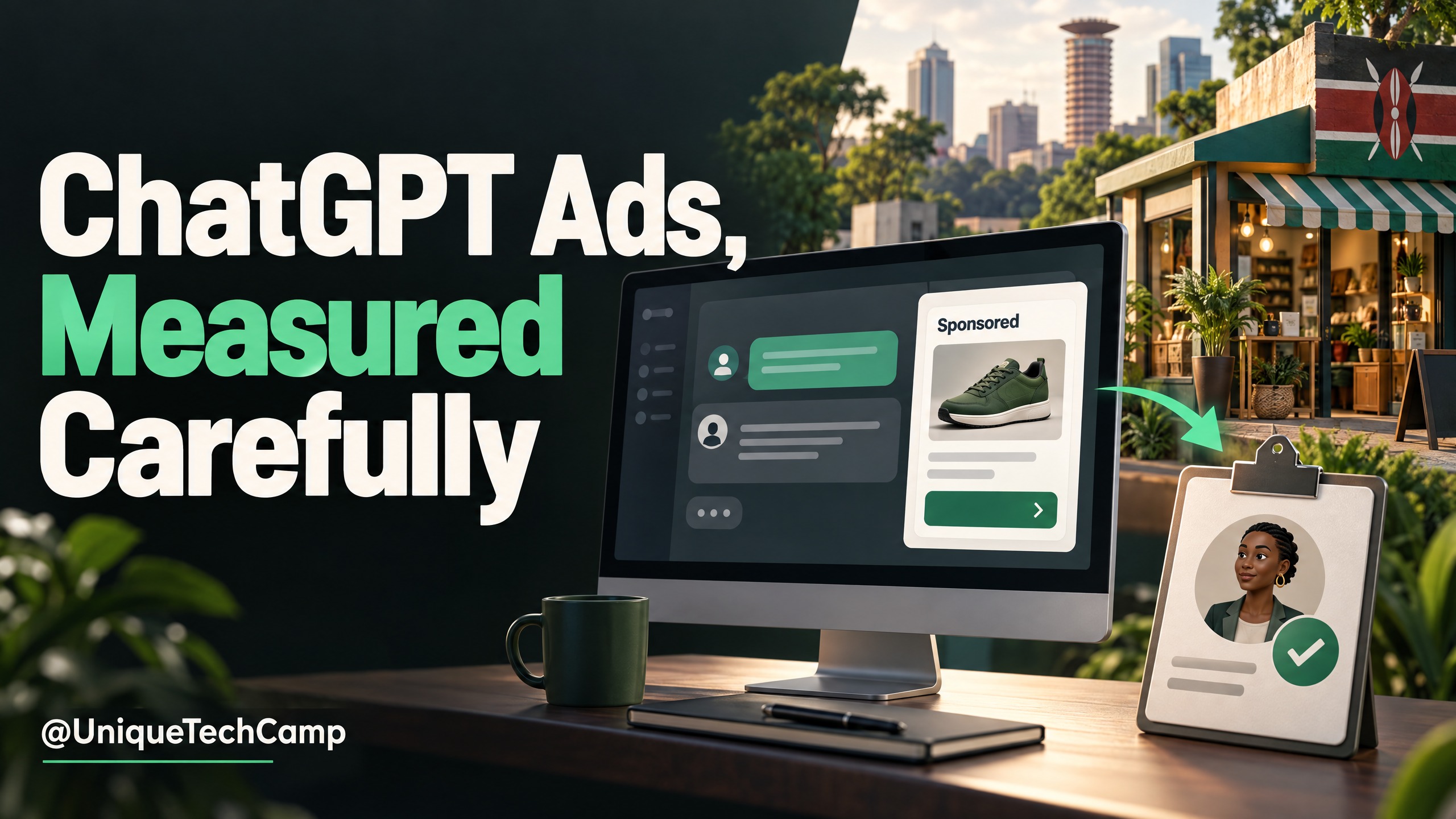
The new ChatGPT Ads ↗ expansion gives Kenyan business owners a reason to investigate another customer-acquisition channel. It does not give them a reason to move a working advertising budget overnight. OpenAI’s current self-service availability list explicitly includes Kenya, but account eligibility, audience targeting, ad approval and profitable demand are different questions.
For an owner selling household products, a local service or a training course, the useful question is not whether AI advertising sounds exciting. It is whether a narrowly defined offer can reach an eligible audience and produce enquiries your team can turn into paid work. This guide explains what is confirmed, what needs checking inside the account, and how to design a pilot without confusing clicks with customers.
What changed, and what has not been proved locally?
On 21 October 2026, OpenAI announced expansion into 26 additional countries, taking its stated total to 89. It also reported that more than 100,000 advertisers had run campaigns. Those are OpenAI’s global figures, not independent evidence of Kenyan audience size, local conversion rates or affordable acquisition costs.
The more useful local detail is in Ads Manager Availability ↗: Kenya is marked “Available” for self-service. The legal entity advertising and being billed must be based in a listed country. Creating a login alone does not establish eligibility.
Do not turn that into a claim that every Kenyan consumer can see your ad. The availability page describes advertiser access. Your account’s eligible locations and the inventory actually available to your campaign still need checking. Nor does the global announcement establish Nairobi-level reach or neighbourhood targeting.
Check access, audience and category before preparing a campaign
Confirm the business and the target geography
Use the real business entity and truthful billing information. Before funding anything, check verification requirements, the account’s country, billing currency and the locations you can actually select. Record these settings so another team member can review them.
OpenAI’s campaign setup guide ↗ says some new self-service accounts can initially advertise only in their home country. International eligibility depends on approved identity verification and required advertising spend from campaigns in that home country. Selecting another country does not override the restriction. Do not spend merely to unlock a market that may not suit your business.
For non-product-feed campaigns, supported sub-national targeting may be available, but location availability varies by country. Search for the actual locations your business serves; do not assume a Nairobi estate or postcode is supported. A campaign draft is not proof it can deliver.
Check the offer against current advertising policy
OpenAI’s advertising policies ↗ cover the creative and landing page together. Initial supported categories include household goods, local services, travel and experiences, digital products and education, subject to review. A useful pilot might therefore concern a specific home-maintenance service or a clearly described course, rather than an undefined “everything we sell” campaign.
Regulated categories need particular care. Current policy generally prohibits or restricts health, financial and legal service advertising outside the US. Kenyan clinics, lenders and law firms should not assume that ordinary business eligibility makes their offer eligible. Obtain product-specific clarification before investing in assets. An approved category is not a guarantee that a particular ad will pass review.
Understand the real cost controls, not just the daily budget label
The official ChatGPT Ads basics guide ↗ describes impression and valid-click billing. Views campaigns buy impressions; Clicks campaigns buy valid clicks. Conversion optimisation does not mean payment only when a sale happens: supported conversion campaigns can still bill for clicks or impressions.
There is published pricing guidance, but it is not a guaranteed Kenyan rate. OpenAI recommends a starting maximum CPC bid of USD 3–5 per click. That is a bid recommendation, not a fixed charged price or a promise of profitable traffic. The campaign guide lists a minimum daily budget of USD 25 per day for accounts billed in that currency; minimums vary by billing currency. Confirm the actual requirement in your account rather than converting that figure into a supposedly official local price.
A daily budget is also not a hard daily ceiling. The daily-budget rules ↗ describe an average over a seven-day period. An individual day can spend up to twice the selected daily budget, with a seven-times limit over the applicable period and proration rules when budgets change. Changing the budget during a day can affect that day’s maximum.
For an owner whose priority is a strict overall media allowance, inspect the campaign-total budget option: OpenAI calls it the stricter control for total spend. Check dates, timezone, pause behaviour and displayed limits before publishing. Separately allow for taxes, foreign-exchange costs, creative work, landing-page work and lead handling. Media spend is not the whole acquisition cost.
Build one measurable customer journey before buying traffic
Choose one offer, one intended customer situation and one main next step. For example, a Nairobi home-service business could test a defined inspection enquiry within the area it genuinely serves. This is an illustrative workflow, not a claim that the platform will deliver a particular audience or result.
- Write the qualification rule. Define a useful enquiry before launch: the requested service is relevant, the location is covered, the customer has provided a usable contact route, and a human can follow up. Keep “new chat”, “qualified enquiry”, “appointment” and “paid job” as separate statuses.
- Prepare a matching destination. The landing page should repeat the advertised offer, explain scope and exclusions, show the real business identity and make the next step obvious on a phone. Do not advertise an attractive offer and then send visitors to a generic page that hides the conditions.
- Test the enquiry path. Submit a test form, follow the mobile contact route and confirm that notifications reach the right person. A WhatsApp button click is not evidence that a conversation started, and a conversation is not proof of a booking.
- Assign the human owner. Decide who checks leads, who handles exceptions and who updates the sales record. Pause the pilot if the business cannot respond reliably; buying more traffic will not repair a broken handover.
A workflow review with UniqueTechCamp ↗ can start with this destination-and-handover problem rather than treating the ad platform as the whole system. The useful deliverable is a clear path from interest to a human-checked enquiry, with ownership at every step.
Set up carefully: publication can start delivery
OpenAI’s first-campaign quickstart ↗ describes account verification, billing setup, team access and a structure of campaign, ad group and ad. The campaign holds the objective, budget, dates and targeting; ad groups organise themes or intent; ads contain the title, copy, image and destination.
Context hints can describe relevant conversations, topics or keywords. They are not exact-match search keywords and do not guarantee placement in a specific conversation. Write plain descriptions of the customer need rather than attempting to force a particular answer or imply that ChatGPT endorses the business.
There is an important first-campaign trap: start and end dates may not be available before publication in the initial creation flow. OpenAI explicitly warns against publishing merely to unlock those settings. Once review, account, billing and campaign requirements are satisfied, ads can run and accrue spend. If you need a later start, resolve scheduling first rather than assuming review will create a safe waiting period.
Keep an approval record containing the final creative, destination, objective, billing basis, allowed locations, budget limits and responsible reviewer. Have someone other than the person building the campaign check it before activation.
Measure qualified demand, and allow for reporting delays
Add static campaign tracking parameters to the destination URL and test that they survive the click and the landing-page journey. Keep labels consistent across analytics and the sales record. If you install conversion measurement, test the event and deduplication before treating it as a reliable business result.
Ads Manager reports impressions, clicks, spend, click-through rate, average CPC, average CPM and configured conversions. The basics guide says impressions, clicks and CTR refresh approximately every 15 minutes, while spend insights may be delayed 7–8 hours. A displayed zero spend alongside delivery is not proof that no charges have accrued. Do not repeatedly increase budgets because the dashboard looks quiet.
Review these business measures alongside platform reporting:
- Cost per qualified enquiry: campaign media spend divided by enquiries meeting the pre-agreed rule.
- Enquiry-to-booking rate: confirmed bookings divided by qualified enquiries, using the same cohort and review period.
- Cost per paid customer: acquisition costs divided by attributable new paying customers, with the cost definition stated clearly.
- Commercial quality: whether booked work fits the service area, capacity, margin and customer expectations.
Do not divide by zero or present an incomplete cohort as a final result. Allow for the business’s normal decision cycle and label small samples as inconclusive. OpenAI also warns that review crawlers can visit tracked landing pages: analytics visits are not automatically billable ad clicks or real prospects. Reconcile the platform, analytics and lead log instead of expecting identical counts.
Protect customer trust and keep the test narrow
OpenAI says ads are labelled, separate from answers and do not influence ChatGPT’s responses. The current basics guide says ads are not shown to users on Plus, Pro or any Business plan. Advertisers do not receive people’s private ChatGPT conversations. Do not promise your sales team access to a prospect’s underlying chat or describe paid placement as an organic recommendation.
Your own destination creates separate responsibilities. Ask only for information needed to answer the enquiry, explain its use, restrict access and obtain appropriate permission for later marketing. Consult the ODPC’s data-protection framework ↗ and qualified advisers for your circumstances. Keep offer claims accurate and consistent with the destination; Kenya’s Consumer Protection Act ↗ addresses false or misleading representations. This is operational guidance, not legal advice.
Do not assume every newly announced feature is locally available. OpenAI’s 5 October visual-format update ↗ described an initial US test during image generation, not confirmed Kenyan access to that format. Measurement integrations and placement controls also have eligibility conditions.
Agree the decision rule before launch
Write down what would make the pilot worth continuing, changing or stopping. Pause for an incorrect destination, unexpected billing, an unmanageable response backlog or a misleading offer. If delivery is too limited to assess demand, record that as insufficient evidence rather than proof the channel works or fails.
If clicks arrive but qualified enquiries do not, inspect the offer, geography and landing page before increasing spend. If qualified enquiries arrive but bookings do not, review response quality and the sales handover. If paid work follows, compare acquisition cost with the contribution from that work and the capacity to fulfil it. Change one major variable at a time and retain the previous settings and results. This makes the next decision explainable instead of turning a small experiment into an open-ended subscription to hope.
Frequently asked questions
Can a Kenyan business use self-service Ads Manager?
Kenya is currently listed as available, and the advertising and billed legal entity must be based in an eligible country. Verification, billing, category review and account-specific delivery restrictions still apply. Check the live list and your actual account before committing.
Can I target only Nairobi customers?
Do not assume so. Supported location options vary by country and campaign type; new product-feed campaigns have country-level targeting. Inspect the locations available to your campaign. Advertiser eligibility does not establish neighbourhood targeting or a sufficient local audience.
Is the suggested CPC the amount I will always pay?
No. The published starting maximum-bid recommendation is USD 3–5 per click, not a guaranteed charged rate. Pricing uses an auction, and eligibility, delivery and competition affect outcomes. Compare actual cost with qualified enquiries and paid work, not a headline bid alone.
Does conversion optimisation mean I pay only for sales?
No. The campaign guide describes conversion optimisation with valid-click or impression billing. Confirm the selected billing method and supported event. A reported conversion also needs reconciliation with the business record before it is counted as a sale.
Should I replace Google or Meta advertising immediately?
No reliable Kenyan benchmark in the sources above establishes that ChatGPT Ads will outperform your existing channels. Treat it as a separately capped experiment. Continue, change or stop it according to qualified demand and commercial outcomes, not the novelty of the platform.
Conclusion: earn the right to scale
ChatGPT Ads is now worth investigating from Kenya because self-service advertiser access is explicitly documented. The responsible next step is verification, not a large commitment. Confirm the offer and geography are eligible, understand the true spending limits, repair the landing-page journey and measure what becomes paid work. Scale only when the evidence from your own business justifies it.
Need this built for your business?
If you own a business and need the landing page, enquiry qualification, tracking or human handover connected, discuss that workflow with UniqueTechCamp’s AI Solutions Desk ↗. You can also book a strategy consultation ↗ and review the Lead Generation Campaigns service ↗ for relevant funnel and follow-up work. Bring one offer, your service area, the current enquiry journey and your definition of a qualified lead. Establish the measurement and ownership first, then decide whether this advertising channel deserves a pilot.

UniqueTechCamp Desk
Online • Reply < 5 mins