
Bing AI Performance: A Content-Growth Guide for Kenyan SMEs
A practical Bing AI Performance guide for Kenyan SMEs: choose evidence-led content experiments without mistaking citations for customers.
UniqueTechCamp Editorial
Lead Systems Architect • UniqueTechCamp Engineering Unit
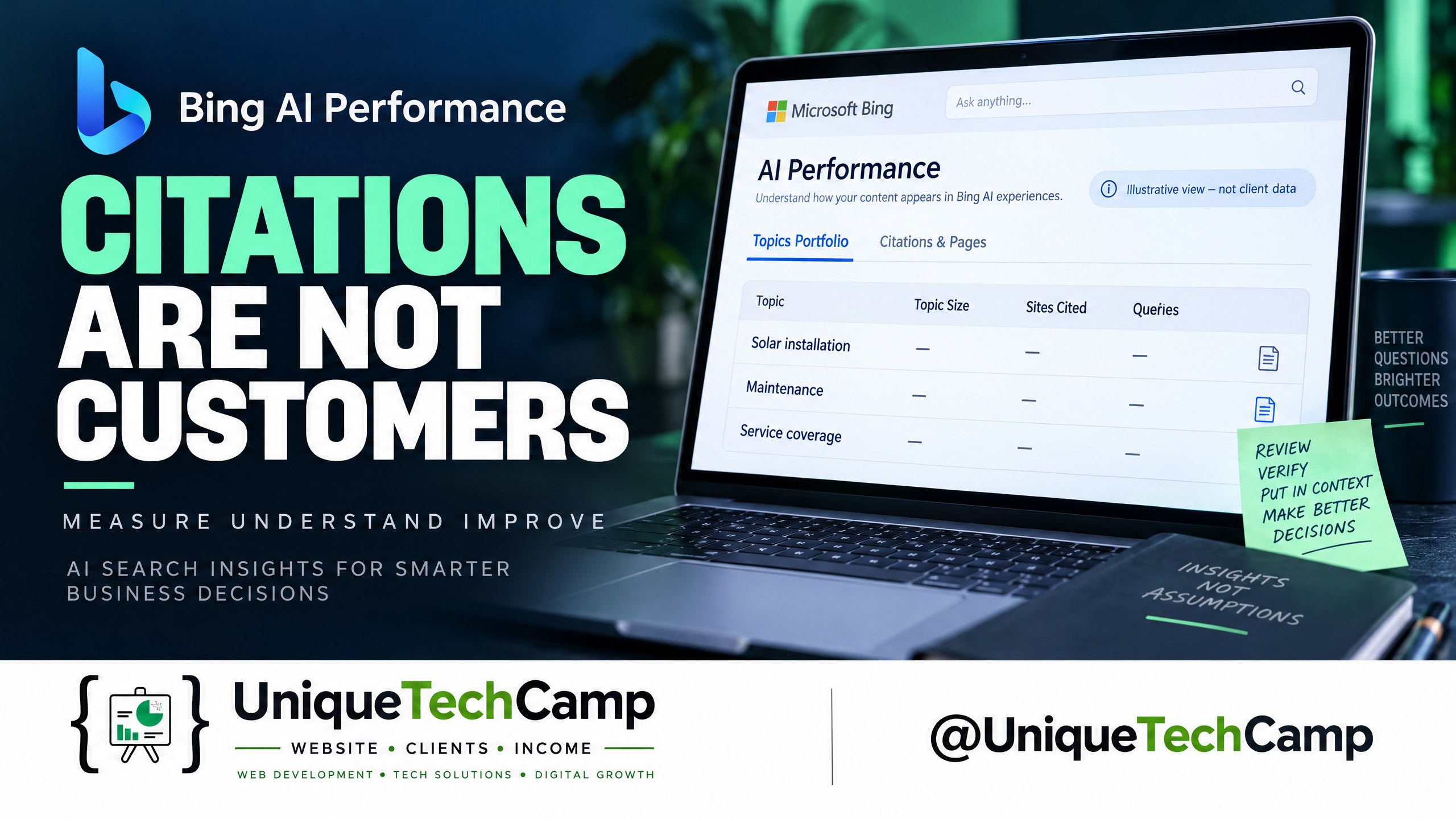
If you run a Kenyan small or medium-sized business, a new kind of visibility report may be appearing in your marketing conversations: a page is cited in an AI-generated answer, a topic has an opportunity query, or a competitor is mentioned in a summary where your business is absent. Those signals can be useful. They can also encourage expensive activity that has little connection to enquiries, sales or service quality.
The sensible question is not, “How do we make AI mention us everywhere?” It is, “Which content experiment is worth testing next, for a commercially relevant customer question, and how will we judge it honestly?” Bing AI Performance can help with that decision, provided you understand what it measures and what it does not.
This is practical planning guidance, not a tool newly released today. Microsoft introduced AI Performance in public preview on 10 February 2026, added visibility insights for intents, topics and citation share in a global preview on 16 June 2026, and introduced Topics Portfolio in beta on 13 October 2026. Features, data coverage and labels may change while they remain in preview or beta.
What Bing AI Performance can and cannot tell a business
Bing AI Performance is available through Bing Webmaster Tools , which Microsoft presents as a free set of SEO and generative-engine-optimisation tools. You need a verified property and sufficient data for the relevant reports. The product can show aggregated visibility signals for supported experiences, including Copilot, Bing AI summaries and selected partners. It is not a universal dashboard for every AI system on the internet.
The original report includes measures such as citations, average unique cited pages per day and activity by URL. Microsoft describes the underlying questions as sampled “grounding queries”. They are retrieval-oriented queries used to ground an answer, not a complete record of every user prompt. A citation means content was visibly referenced or shown as a source in a supported AI answer; it does not mean a reader clicked, trusted the business or became a customer.
The 16 June visibility expansion added AI-classified intents, themes called topics, and Citation Share. Citation Share is the percentage of citations attributed to your site among all site citations for the same grounding query. Treat it as a query-level visibility comparison, not market share, a search ranking, a competitor-domain score or a quality rating. Comparing time periods can reveal a change in the report, but it cannot prove that one content edit caused that change.
The 13 October Topics Portfolio beta adds a more planning-oriented view when a site has enough data. It can personalise topics and opportunities to the property and offer one-, two- or three-month windows. Approximate Topic Size represents total citations across all sites in a theme; Sites Cited approximates how many sites were cited; Queries approximates distinct grounding queries. Opportunity queries are queries for which other sites were cited and yours was not. They can contain competitor brands or an irrelevant intent, and a smaller site may see no topic tab simply because there is not enough data. That is not a penalty.
Microsoft’s AI Performance help says data refreshes daily with a short delay, supports CSV and Excel exports, and is based on an aggregated sample rather than every citation. Different views therefore need not match exactly. It does not provide exact prompts, a definitive answer to why a source was selected, or a built-in path from citation to click. An independent CXL discussion of Bing’s AI visibility tracking reinforces the attribution gap: citations are not clicks or conversions. Use the report as directional evidence for prioritisation, not as a sales ledger.
A seven-step workflow for useful content experiments
1. Confirm the property, access and reporting window
Start with the administrative basics. Confirm that the Bing Webmaster Tools property is the correct canonical website, that the relevant owner or delegated user can access AI Performance, and that the report is actually populated. A company with several domains, subdomains or language versions can otherwise draw conclusions from the wrong property.
Record the date you checked the report, the selected site, the selected time window and any filters. Align the reporting window with the business’s working calendar and time zone when you compare it with internal activity. Daily refreshes are delayed, so do not present a same-day export as a complete account of today’s visibility. If Topics Portfolio is absent, use the available cited-page view and record the limitation; do not assume a penalty or pay someone to “unlock” a promised result.
2. Preserve a baseline before changing anything
Export the available report before publishing an experiment. Keep the CSV or Excel file with the date, window, property and filters in a simple evidence folder. Add a screenshot only as a human-readable reference; the export is easier to sort and revisit.
Also note ordinary business baselines that can be measured independently: sessions to the relevant page, tracked form starts, server-confirmed form submissions, calls or WhatsApp conversations, and enquiries recorded by staff. A form click is not a submitted form. A server-confirmed form is not automatically a qualified lead. A WhatsApp start is a conversation initiation, not a sale. Keeping these definitions visible stops a visibility project from quietly becoming a vague revenue claim.
3. Choose a commercially relevant theme, not the biggest topic
A large Topic Size may be interesting but commercially useless. Select a theme that connects to a real service, location, product constraint or buying question your business can answer accurately. For a Kenyan SME, that might involve installation conditions, maintenance, delivery area, payment process, support boundaries or a comparison customers genuinely ask.
Review the intent classification and read the associated queries before choosing. Separate informational curiosity from a decision a prospective customer could plausibly make. A small, specific topic that matches your approved offer can be a better experiment than a broad topic with many citations but no route to an enquiry.
For example, imagine a Nairobi solar service business considering a page about backup-power planning. The useful theme would be one it can support with its own coverage area, system prerequisites, maintenance approach and warranty-approved statements. It should not invent installation capacity, savings or performance statistics. This is a hypothetical planning example, not a claim about an actual client or market result.
4. Inspect opportunity queries and remove noise
Opportunity queries deserve human review. “Other sites were cited and ours was not” is a prompt for investigation, not an instruction to create a page for every row. Read the wording and classify each opportunity as relevant, potentially relevant, competitor-branded, outside the service area, legally sensitive, or simply unrelated.
Exclude a query when answering it would require claims the business cannot substantiate, when it names a competitor in a way that does not fit the company’s service, or when its apparent intent is not a genuine customer need. Topics Portfolio ranges may contain mixed material, including competitor brands and irrelevant intent. The range is a prioritisation clue, not a ready-made content brief.
5. Make one evidence-led page change
Choose one page and one clear change. Improve the answer that a human customer needs: clarify eligibility, state the service area, explain the process, add a maintenance checklist, define an unfamiliar term, or show what information is needed for a quotation. Use the business’s approved facts and identify any statement that needs technical, legal or operational review.
Do not respond to an opportunity list with a batch of thin AI-written articles. A citation signal does not justify publishing unsupported claims, duplicating an existing article or making a page awkward for people. If AI tools help with outlining or editing, the final page still needs knowledgeable review, original evidence and a clear reason for existing.
A page change log should include the URL, old and new version, publication date, owner, reason for the change, evidence used, reviewer and any follow-up question. If the change is substantial, preserve the previous copy. A future comparison is only useful when you can tell what actually changed.
A useful brief for UniqueTechCamp’s AI Solutions Desk includes the selected topic, the customer question, approved source facts, the proposed page change and the evidence needed at review. This keeps an AI-assisted content conversation focused on a decision rather than a promised citation increase.
6. Review comparable windows without claiming causality
Choose a review interval that matches the report’s available one-, two- or three-month windows and the pace of the content change. A page published yesterday cannot fairly be judged against a full quarter. Keep the comparison rule consistent: same property, similar filters, recorded export date and the same definitions for business metrics.
Look for directional movement in cited URLs, query coverage, intent mix and Citation Share, then compare it with independent analytics and enquiry records. A change that appears in both sources may justify closer investigation. It still does not prove that the edit caused it. Other pages, competitors, retrieval changes, seasonality, media activity, offer changes and data sampling can all matter.
Use ordinary web analytics carefully. The Google Analytics service describes scope around GA4 events and funnels; it should not be read as an automatic Bing AI integration. A properly configured funnel can distinguish a page visit, form start and completed form; it does not reveal a visitor’s earlier AI-answer exposure. Measurable referrals and self-reported discovery can add partial context, not a verified person-by-person citation trail.
7. Record the decision and stop when the evidence is weak
At the agreed review, choose a next action: retain the change because it makes the page more useful, revise it because a factual or usability problem remains, or pause because the data cannot support a larger investment. Record the reason and next review owner. If the report is empty, keep improving verified customer answers rather than manufacturing a success score or commissioning a batch of speculative pages.
Keep a citation-to-lead gap in the register. Bing does not provide a customer identifier connecting a citation to a person, so do not join a citation row to a lead record as if it were an identifier. You can compare aggregate trends and ask new enquiries how they found the business, while labelling the answer as self-reported and incomplete. The aim is better decisions, not a forced attribution story.
Measurement, limits and realistic cost
Bing Webmaster Tools is free, but the project still consumes staff time and may require specialist support, copy review, development, approvals, analytics configuration and enquiry follow-up. Someone must verify the property, interpret the columns and check the facts.
Measure at three levels. First, visibility: which pages and topics are cited in the supported sample, how often unique pages are observed, and how Citation Share changes for a defined grounding-query set. Second, behaviour: relevant page sessions, engaged visits, form starts, server-confirmed submissions, calls and WhatsApp starts. Third, business handling: deduplicated enquiries, response time, qualified opportunities and eventual outcomes where the business’s normal records support them.
Do not report every event as a lead. Define a form click, server-confirmed form, WhatsApp start and qualified lead separately. Deduplicate ordinary business records, not the entire sales funnel by assumption. Keep “unknown source” available for enquiries whose origin cannot be established. This is more credible than assigning all growth to the latest citation report.
The most important limits are coverage, sampling and interpretation. AI Performance does not cover all AI systems, all prompts or all answers. Grounding queries are not full user prompts. Different views may not match because they use aggregated samples. Citations are not rankings, clicks, conversions or proof of quality. Topic Size, Sites Cited and Queries are approximate. Opportunity ranges may include competitors and irrelevant intent. A time-period comparison is not a causal experiment.
Frequently asked questions
What is Bing AI Performance actually measuring?
It reports aggregated, sampled citation and visibility signals from supported Bing-related AI experiences and selected partners. Depending on the view, you may see cited pages, average unique cited pages per day, intents, topics, citation activity and Citation Share for grounding queries. It is not a complete record of every AI prompt, every answer or every AI system.
Does a citation mean a customer visited my website?
No. A citation is not a click, enquiry or sale. The report does not provide a customer identifier linking a citation to a lead. Compare its directional visibility signals with independently measured visits, form submissions, calls and recorded enquiries, while keeping unknown source and self-reported discovery separate from confirmed attribution.
Should a Kenyan SME create a page for every Topics Portfolio opportunity?
No. Review each opportunity for customer relevance, service area, evidence, competitor branding and risk. Choose a theme your business can answer accurately and that connects to a real offer or decision. An opportunity range is a prompt for human judgement, not a publishing queue, and no topic tab may simply mean that the property lacks sufficient data.
How often should we review the report?
A monthly review is a practical starting point for a small team, with exports taken consistently and a shorter check only when a planned content change requires it. Match the comparison to the available one-, two- or three-month windows, allow for daily refresh delays, and avoid changing several pages at once if you want a clearer learning record.
Conclusion
Bing AI Performance is most useful when it turns an uncertain visibility signal into a disciplined content decision. Verify access, preserve a baseline, select a commercially relevant topic, reject noisy opportunities, make one evidence-led page change and compare it with both the report and the business’s own records. Keep the boundaries clear: sampled citations are not customers, Citation Share is not market share, and a time comparison is not proof of causality. For Kenyan SMEs, that restraint is not a disadvantage. It is how a free preview tool becomes a practical way to improve useful answers without wasting scarce content and staff capacity.
Need this built for your business?
If you want help translating AI visibility data into a focused experiment, measurement definitions and a reviewable change log, speak with UniqueTechCamp’s AI Solutions Desk . You can book a consultation to discuss your site, customer journey and internal approval needs, or review the matching Google Analytics service when your GA4 events and funnels need clearer measurement. Support should make the next business decision clearer, not promise that a citation will become revenue.
Deploy An Autonomous AI Lead Gen System Today
We engineer high-converting web applications with integrated 24/7 WhatsApp qualification bots and multi-channel follow-up drips.
Related Strategy Articles
Gemini Small-Business Tools: A Safe Growth Pilot for Kenyan SMEs
Google's Gemini business page brings brand, finance and app tools together. A cautious pilot for Kenyan SMEs, with privacy and review checks.
Google Docs Captions and Cross-References for Kenyan SMEs
Use Google Docs captions, cross-references and caption tables to keep Kenyan SME reports and tender documents easier to navigate after edits.

ChatGPT for Sales: A Human-Reviewed CRM Pilot for Kenyan SMEs
OpenAI's new ChatGPT for Sales adds sales workflows. Learn how Kenyan SMEs can pilot CRM connections with human review, privacy checks and clear measures.

UniqueTechCamp Desk
Online • Reply < 5 mins